DeFi Risk Management: 7 Strategies to Protect Funds
How to cut DeFi exposure with contract audits, protocol diversification, planned exits, multi-sig custody, insurance and automated monitoring.
Decentralized finance moves money through code that anyone can call and nobody can reverse. That is what makes it useful, and it is also why its failure modes are unfamiliar. A flaw in a lending contract is not a dispute to be settled afterwards; it is a withdrawal that has already cleared.
Most DeFi risk management is therefore preventative work done before capital is committed. This guide covers seven areas — auditing, diversification, liquidity, custody, monitoring, insurance and position scaling — and what each one involves in practice.
1. Smart Contract Auditing and Code Review
Smart contracts run without an intermediary and, once deployed, usually cannot be edited. A logic error is not a ticket to be fixed next sprint; it is a path an attacker can walk repeatedly until the contract is empty. An audit is a professional review of that code before it goes live: a firm reads the contracts, models how they can be abused, and publishes its findings.
Established protocols publish theirs. Uniswap keeps the V3 core reports in the audits folder of its Uniswap/v3-core repository, from ABDK Consulting and Trail of Bits. Aave does the same for V3 core, with reports from OpenZeppelin, Trail of Bits, ABDK, PeckShield and Sigma Prime, dated between November 2021 and April 2023. When a protocol will not say who reviewed its code, that silence is itself the finding.
What a thorough audit process looks like
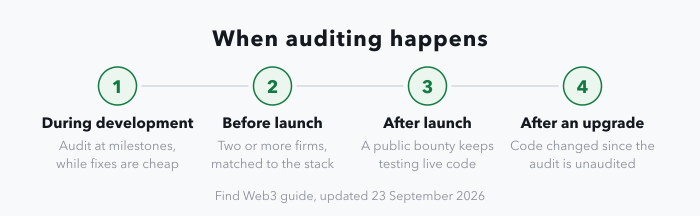
- More than one firm. No single reviewer catches everything. Two or more independent audits give you different people looking for different classes of bug.
- Reviews during development, not only at the end. Auditing at milestones catches problems while they are still cheap to fix, rather than a week before launch when the incentive is to ship anyway.
- A bug bounty after launch. A public bounty gives researchers a reason to report what they find instead of using it, and it keeps testing the code that is actually live.
- Auditors matched to the stack. Expertise in Solidity on the EVM does not transfer automatically to Rust on Solana. Read a firm's past public reports before hiring it.
An audit is not a guarantee. It is a dated statement by a named firm about a specific version of the code, which is why the date and the commit it covers matter as much as the firm's name. Contracts upgraded after the audit are, for security purposes, unaudited.
2. Diversified Protocol Exposure and Asset Allocation
Concentration risk in DeFi is not only about which tokens you hold. It is about how many separate pieces of code hold them. Funds spread across three lending markets survive an exploit in one of them; funds in a single protocol do not.
The distinction matters because the same stablecoin deposited in two protocols carries two different sets of contract risk. Yearn Finance's vaults are built on this idea: they deploy deposits across a curated set of strategies rather than a single venue, and move funds when the risk or yield of one changes.
Working approaches to diversification
- Set a cap per protocol before you deploy. Decide in advance what share of the portfolio any single protocol may hold, write it down, and treat it as binding. The number matters less than having fixed it before you were tempted.
- Weight toward code that has been live longer. Protocols with years of uptime, large balances and survived attacks have been tested by adversaries in a way that a new fork has not.
- Watch for shared dependencies. Two protocols on different chains are not independent if they use the same oracle, the same bridge or the same stablecoin. Correlation in DeFi often hides in infrastructure rather than in prices.
- Remember that aggregators add a layer, not remove one. A yield aggregator spreads you across protocols, but you now also hold the aggregator's own contract risk.
3. Liquidity Risk Management and Exit Strategies
Liquidity risk is the risk of not being able to leave. A position can be nominally profitable and still be impossible to close without moving the price against yourself, and thin pools get thinner precisely when everyone wants out.
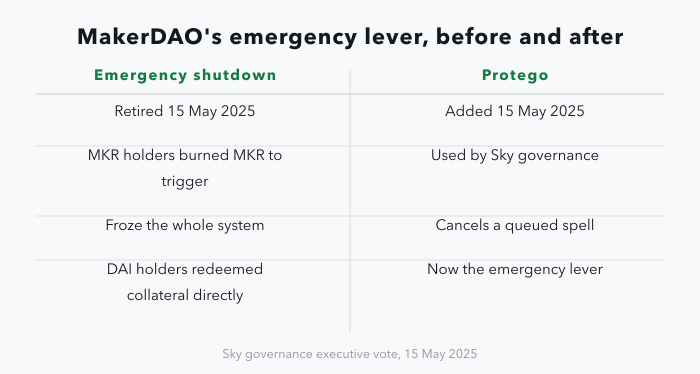
Protocols build their own versions of this. Aave and Compound use liquidations and reserve factors to close out positions automatically when collateral falls too far. MakerDAO, rebranded as Sky in August 2024, ran an emergency shutdown module for years: MKR holders who burned enough MKR into the contract could freeze the system and let DAI holders redeem collateral directly. Sky governance retired it in the executive vote of 15 May 2025, which disabled the module by setting the MKR required to trigger it to infinity and added Protego — a contract that lets governance cancel a spell already queued behind the pause delay — as the emergency lever in its place.
Working approaches to liquidity
- Hold a reserve you have not deployed. A buffer in major stablecoins or large-cap assets means you can meet an obligation or top up collateral without unwinding a position at whatever price the market offers that hour.
- Set alerts on pool depth, not only on price. On-chain monitoring can tell you when liquidity in a pool you are in drops below a threshold. That is usually the earlier signal.
- Test the exit while nothing is wrong. Unwind a small position in calm conditions to learn the real gas cost, slippage and routing behavior. Discovering them mid-crash is expensive.
- Route large exits through an aggregator. Tools such as 1inch and Matcha split a trade across venues to reduce price impact, which matters most for exactly the sizes that are hardest to move.
4. Multi-Signature Wallet and Custody Solutions
A multi-signature wallet requires several keys to approve a transaction, so no single compromised device or single person can move funds. For anything held on behalf of a team, a DAO or a treasury, this is the baseline rather than an upgrade.
Safe, formerly Gnosis Safe, is the most widely used implementation and is the default for DAO treasuries and protocol multisigs. The threshold is the design decision that matters: too low and it is barely better than one key, too high and a lost phone means funds are frozen.
Running a multi-sig properly
- Separate the signers physically. Keys held in one office, or on devices in one bag, are one incident away from being a single key.
- Rotate signers when people leave. A departed contributor who is still on the multisig is an open door nobody is watching.
- Make every signer prove their backup works. Each holder is responsible for their own key. A recovery procedure that has never been tested is a plan, not a backup.
- Sign something small on a schedule. Periodic low-value transactions confirm that every signer still has access before a transaction that matters depends on it.
5. Automated Risk Monitoring and Alert Systems
DeFi positions change while you are asleep. A collateral ratio that was comfortable at midnight can be liquidatable by morning, and manual checking does not scale past a handful of positions. Automated monitoring watches on-chain state continuously and either warns you or acts.
Tools exist for both. DeFi Saver automates collateralized debt positions, repaying or adding collateral to keep a position out of liquidation range. Yearn's vaults rebalance strategies according to internal rules rather than waiting for someone to notice.
Working approaches to automation
- Set thresholds against the asset's own behavior. A 5% move is routine for one asset and an emergency for another. Generic alert levels produce either noise or silence.
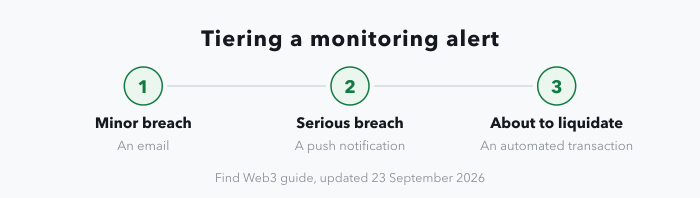
- Tier the alerts. An email for a minor breach, a push notification for a serious one, and an automated transaction for a position about to be liquidated. Everything arriving at the same urgency means nothing does.
- Test the rules against past crashes. Replaying your parameters over a real drawdown, such as the Terra and LUNA collapse in May 2022, shows whether they would have fired in time.
- Use more than one data source. If your automation depends on a single oracle or API, an outage or a manipulated feed becomes your failure too. Cross-check between independent sources before acting on a number.
6. Insurance and Risk Transfer Mechanisms
Audits and diversification reduce risk; they do not remove it. On-chain cover lets you pay a premium to move part of the remaining exposure — a contract exploit, a stablecoin losing its peg, a custodian failing — onto someone else's balance sheet.
Nexus Mutual operates as a member-owned mutual, where capital is pooled and claims are assessed by members rather than by a claims department. InsurAce offers cover across multiple chains and protocols. Both are themselves DeFi protocols, which is worth stating plainly: the cover is only as good as the pool behind it and the process that decides claims.
What to check before buying cover
- Read the exclusions first. Policies are narrow by design. Cover for a code exploit may exclude governance attacks, oracle manipulation or economic design failure — which are how a great deal of money has actually been lost.
- Subtract the premium from the yield. Cover on a newer protocol can cost enough to erase the spread that made it attractive. The number that matters is the return after the premium.
- Do not concentrate the cover either. A single insurer facing a large correlated loss is a counterparty like any other.
- Keep records as you go. Transaction hashes, addresses, timestamps and amounts, collected at the time. Assembling them after an incident, from a protocol that may no longer have a working front end, is much harder.
7. Gradual Position Scaling and Dollar-Cost Averaging
Entering a position in increments rather than all at once trades the chance of a perfect entry for a narrower range of outcomes. The average price you get is closer to the average price over the period, which is the point: it removes the decision about when, and with it the temptation to make that decision emotionally.
The same logic applies on the way out. Unwinding in steps reduces price impact and avoids betting the whole exit on a single moment.
Working approaches to scaling
- Fix the schedule in advance. A set amount at a set interval. Consistency is the mechanism; a schedule you renegotiate each week is just discretionary trading with extra steps.
- Size increments against transaction costs. Frequent small transactions on Ethereum mainnet can lose a meaningful share of each one to gas. Either make the increments larger or use a network where fees are lower.
- Let protocol health override the calendar. A security incident, a contentious governance change or a depegging event is a reason to pause the schedule rather than follow it.
The Seven Strategies at a Glance
| Strategy | What it protects against | What it costs |
|---|---|---|
| Smart contract auditing and code review | Exploitable bugs in deployed code | Audit fees; delay before launch |
| Diversified protocol exposure | One protocol failing taking everything with it | Gas; more positions to track |
| Liquidity management and exit plans | Being unable to leave without heavy slippage | Capital held idle in reserve |
| Multi-signature custody | One compromised key or one rogue signer | Slower approvals; coordination |
| Automated monitoring and alerts | Positions deteriorating while nobody is watching | Setup and upkeep; data feeds |
| Insurance and risk transfer | Residual loss after everything else | Premiums; narrow coverage terms |
| Gradual scaling and dollar-cost averaging | Committing everything at one price | Repeated transaction fees |
Why This Matters for a Web3 Career
None of these are one-time checks. Audits go stale when contracts are upgraded, diversification drifts as positions grow at different rates, and monitoring rules need revising as positions change.
For anyone working in the industry, that maintenance is the job. Risk work — liquidation modeling, monitoring infrastructure, governance security, audit coordination — sits close to where protocols lose money, which is why it tends to be visible in hiring. The Web3 jobs report tracks hiring by month and category, the salary page shows median pay from listings that state it, and the company directory lists the organizations currently hiring.
Browse open roles on Find Web3 to see who is hiring for security and risk work right now.