How Many Jobs Will AI Replace? 92 Million by 2030
 Jackson Pegg
The most quoted answer is 92 million jobs displaced by 2030, against 170 million created - a net gain of 78 million, from the World Economic Forum’s Future of Jobs Report of January 2025. It is a survey of what employers expect, not a measurement, and it covers every force reshaping work, of which AI is one.
This page used to lead with a different pair of numbers: 85 million jobs destroyed and 97 million created by 2025. Those came from the same series in 2020, that deadline has passed, and the Forum has never published a reconciliation - the phrase "85 million" does not appear anywhere in the 2025 edition. So the projections have been replaced here rather than stacked on top of each other, and what follows separates what is forecast from what has actually been counted.
Last checked 22 September 2026.
You Might Also Like
Contents
How Many Jobs Will AI Replace?
What Has Actually Happened So Far
How Many Jobs Are Exposed to AI
Young Workers and Entry-Level Jobs
What Happened to Software Jobs
What This Means If You Are Looking for Work
How Many Jobs Will AI Replace?
The Future of Jobs Report 2025 surveyed employers representing more than 14 million workers. Their expectations for the five years to 2030:
92 million jobs displaced, and 170 million created, a net increase of 78 million.
22% of all jobs churned - created, displaced or fundamentally changed - over the period.
41% of employers plan to reduce their workforce where AI can automate the tasks.
More than 120 million workers are at risk of redundancy on current trends.
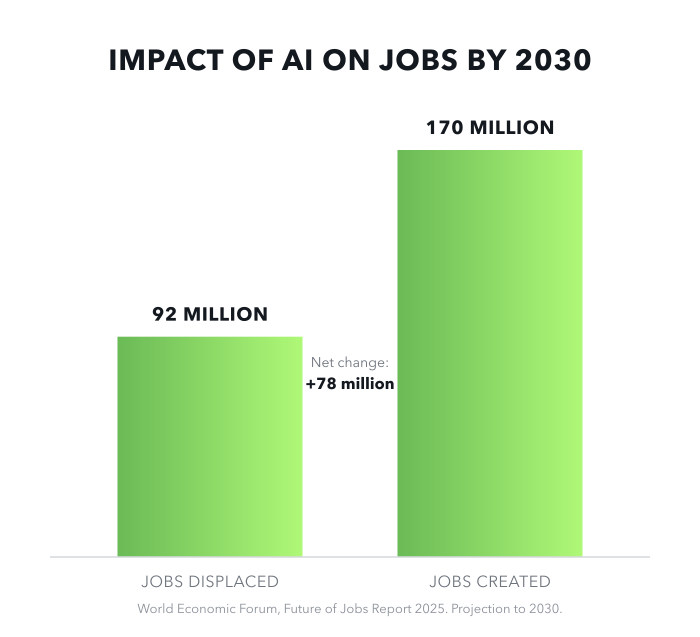
Two things are worth holding onto about that net figure. It is the sum of expectations from employers who were asked to guess, and the same exercise in 2020 produced a number nobody has since checked. Treat it as a description of what companies currently plan, which is useful, rather than as a measurement of the future, which it is not.
Sources: World Economic Forum, Future of Jobs Report 2025, WEF press release.
What Has Actually Happened So Far
Forecasts are easy to find and hard to check. These are the people counting instead.
Layoffs that name AI as the reason
Challenger, Gray & Christmas tracks announced US job cuts and the reasons employers give. In the first eight months of 2026, AI was cited in 116,175 announced job cuts, about 22% of the total, making it the leading stated reason year to date.
The trend inside that number complicates the headline. In August 2026 AI fell to the fourth most-cited reason, with 3,462 cuts, its lowest monthly total since December 2025, and total announced cuts for the year were 529,914, down 41% on the 892,362 announced over the same months of 2025. Fewer people are being laid off than last year, and a larger share of the ones who are hear AI given as the reason.
Whether the jobs are disappearing
Stanford’s Digital Economy Lab went through ADP payroll records covering millions of US workers, through June 2026. Its conclusion is blunt: "We find no evidence of widespread, economy-wide job displacement."
What it did find is concentrated at the start of careers. Employment for 22-to-25-year-olds in the occupations most exposed to AI is about 19% below where it would be had it kept pace with their less-exposed peers. The Budget Lab at Yale, tracking the same question with different data, reports that "the occupational mix is not yet changing in ways that clearly align with the introduction of AI into the workforce."
Read together: no mass displacement in the aggregate yet, a visible effect on the youngest workers in the most exposed jobs, and a lot of announcements outrunning the measurements.
Sources: Challenger, Gray & Christmas, Stanford Digital Economy Lab, The Budget Lab at Yale.
How Many Jobs Are Exposed to AI
Exposure is not replacement. These estimates count the jobs and the hours where AI can do some of the work, which is the ceiling rather than the forecast.
IMF: almost 40% of global employment is exposed to AI - around 60% in advanced economies, 40% in emerging markets and 26% in low-income countries.
Goldman Sachs: 300 million jobs globally are exposed to automation, with 6-7% of US workers displaced during a roughly ten-year transition, and a range of 3% to 14% under different assumptions.
Goldman Sachs: AI could automate tasks accounting for 25% of all US work hours.
McKinsey: about 57% of US work hours are spent on activities that demonstrated technology could in theory automate - 44% by software agents and 13% by robots.
OECD: around a quarter of workers were already exposed to generative AI in 2022-2024, and in some countries almost a third of job vacancies are highly exposed.
The spread between "25% of hours" and "57% of hours" is not a contradiction; it is the difference between what is commercially worth automating and what is technically possible. The IMF’s 2026 work adds the first real-world estimate of the effect: in occupations highly exposed to AI with little scope for the technology to complement the worker, employment is 3.6% lower in regions with greater demand for AI skills, five years after those skills appear.
Sources: IMF (2024), IMF (2026), Goldman Sachs Research, McKinsey Global Institute, OECD.
Young Workers and Entry-Level Jobs
If AI is displacing anyone yet, it is people at the beginning. The World Economic Forum and PwC found that more than one in three young workers (37%) are in occupations with medium to high exposure to AI-driven task change - three in four in Eastern Asia, 69% in North America and 63% in Europe. That matches the Stanford finding on 22-to-25-year-olds in exposed roles.
One caution before blaming everything on the technology: the OECD notes that young graduates’ unemployment risk has been rising "a trend that began well before the spread of generative AI models, suggesting more complex root causes." Entry-level hiring was weakening first.
Sources: WEF and PwC, Artificial Intelligence and the Future of Entry-Level Work, OECD Employment Outlook 2026.
What Happened to Software Jobs
Software is the job market where AI arrived first and where the data is best, so it is the closest thing to a natural experiment.
Indeed’s index of US software development postings stood at 76.62 on 11 September 2026, against 100 in February 2020: postings remain about 27.5% below their pre-pandemic level. The recovery that has happened is lopsided. Of the increase between May 2025 and May 2026, 71% came from senior roles and 37% from jobs that mention AI in the title - which is the entry-level squeeze showing up in one industry’s postings.
Crypto development has fallen further and faster, for reasons that are partly about AI pulling developers away and partly about the market. Weekly commits fell roughly 75% between early 2025 and March 2026, from about 850,000 to 210,000, and active developers fell 56% to around 4,600. Electric Capital’s longer series shows monthly active developers peaking at roughly 31,000 in 2022, falling to about 23,600 in 2024 and to an estimated 18,000 by mid-2025.
Sources: FRED, Indeed Hiring Lab series, Indeed Hiring Lab, CoinDesk, citing Artemis and Electric Capital.
What This Means If You Are Looking for Work
Three things follow from the numbers above rather than from the headlines.
The aggregate has not moved yet. No study that counts jobs, rather than surveying opinions, has found economy-wide displacement. Plan for a labor market that is changing shape, not one that is vanishing.
The pressure is on the first rung. Entry-level and junior roles in exposed occupations are where every measurement finds an effect, and it was already happening before generative AI arrived.
Exposure is not the same as replacement. The jobs where AI does part of the work are also where the new roles are appearing, which is what the Forum’s 170 million is describing.
Find Web3 lists crypto and Web3 roles from companies hiring right now: browse the board, see what those roles pay on the salary pages, or read the Web3 jobs report, which counts hiring on this board by month and category.
Conclusion
The honest answer to "how many jobs will AI replace" is that nobody knows, and that the people counting carefully have so far found less displacement than the people forecasting confidently expected. The best-supported figures are 92 million displaced and 170 million created by 2030 from employers’ own plans, against measured evidence of no aggregate displacement and a real, concentrated effect on the youngest workers in the most exposed jobs.
Every figure on this page names its source and its date. Where a projection has been overtaken - as the 2020 forecast of 85 million jobs by 2025 has been - it has been replaced rather than quietly left in place.