How to Get a Job in Web3: Skills, Portfolio, Network
Which Web3 roles are actually hiring, the skills employers test for, and how to build a portfolio and reputation that earn interviews.

Understanding What Web3 Careers Really Look Like
Web3 hiring is broader than trading and NFTs. The companies building protocols, wallets, exchanges and DAOs hire for most of the functions any software company needs, plus a few that exist only here: protocol economists who design tokenomics, community managers who run governance forums and support channels.
The roles split into technical and non-technical work. On the technical side: blockchain developers, smart contract engineers, protocol and infrastructure engineers, data analysts. On the non-technical side: UX and UI designers, community managers, writers, business development and partnerships. For which of these are actually being advertised month to month, the Web3 jobs report breaks postings down by month and category, and the companies page lists who is hiring.
Beyond the Buzzwords: Real Web3 Roles
Some roles have no clean equivalent outside the industry:
- DeFi Partnership Lead: connects traditional finance firms with decentralized protocols — negotiating integrations, custody arrangements and joint products. The role often draws people out of banking or corporate development.
- Wallet Interface UX Designer: crypto wallets ask ordinary users to handle seed phrases, gas fees and transaction signing without a support line to call. The work draws designers from fintech, where the tolerance for a confusing confirmation screen is similarly low.
- Protocol Economist: designs tokenomics — the supply schedule, the incentives paid to users and validators, and whether those incentives still make sense once the initial emissions taper off. Usually an economics or quantitative background.
- DAO Governance Specialist: runs the decision-making machinery of a decentralized autonomous organization: drafting and shepherding proposals, running votes, keeping a public record of what was decided and why.
The Global and Remote Advantage
Most Web3 teams are distributed by default. A protocol incorporated in Singapore may have nobody in Singapore, and contributors are hired wherever they are. That widens the set of jobs open to you, and it widens the field of people applying for them — remote hiring is global in both directions.
Much of the work happens in forums and repositories anyone can read, so standing tends to follow from what you have shipped or argued rather than from a title.
Web3 Job Categories
The categories below appear most often on the job board, with the experience level employers typically ask for.
| Job Category | Experience Level Usually Advertised |
|---|---|
| Blockchain Developer | Mid-Level to Senior |
| Smart Contract Developer | Mid-Level to Senior |
| Solidity Developer | Mid-Level to Senior |
| Frontend Developer | Junior to Senior |
| Backend Developer | Junior to Senior |
| Full Stack Developer | Mid-Level to Senior |
| UX/UI Designer | Junior to Senior |
| Community Manager | Junior to Senior |
| Content Creator/Marketer | Junior to Senior |
| Project Manager | Mid-Level to Senior |
| Business Development Manager | Mid-Level to Senior |
| Product Manager | Mid-Level to Senior |
| Data Scientist | Mid-Level to Senior |
Entry-level smart contract roles are rare: the cost of a bug is measured in funds lost, so teams hire people who have already audited or shipped something. Junior openings are more common in frontend, design, community and content.
Building Skills That Actually Matter to Web3 Employers
You do not need to become a developer to work in Web3. You do need to understand the product well enough to be useful on day one.
Prioritizing Your Learning Journey
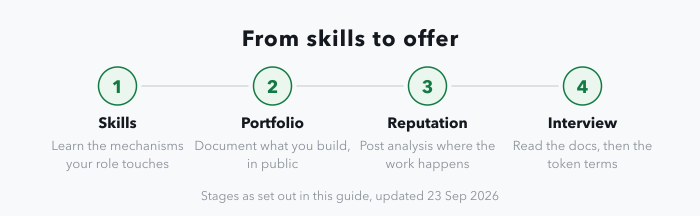
Pick a small number of things and finish them. Structured courses from Udacity or Coursera give you a sequence to follow. Developer communities on Discord and Telegram are where the questions get answered. Open-source contributions on GitHub are the part a hiring manager can actually read.
Non-technical candidates should aim at the concepts their role touches. Someone going for a growth role at a decentralized exchange is expected to know what an automated market maker is, where liquidity comes from and how providers get paid. Understanding the mechanism matters more than being able to implement it.
Teams are distributed and asynchronous, so a clear proposal, a readable bug report or a plain explanation of a complex mechanism is visible work in a way it rarely is inside a company.
Showcasing Your Web3 Knowledge Authentically
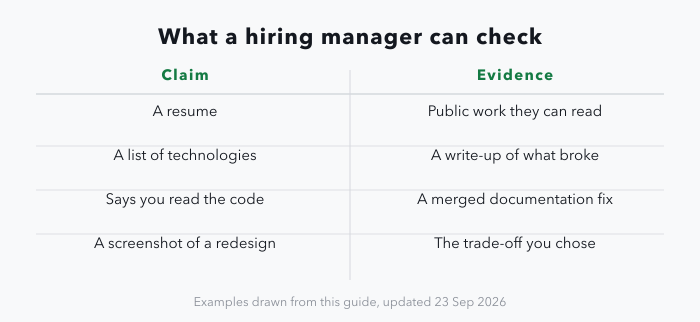
Document what you build, in public. A short write-up of a project — what you tried, what broke, what you changed — is more convincing than a list of technologies.
Domain understanding shows up even in design work. Web3 projects are frequently community-governed, and a designer who understands how a proposal moves from forum post to on-chain vote can build an interface that supports that process rather than obscuring it.
Check what is currently advertised on the Find Web3 job board and aim your learning at the requirements that keep repeating.
Creating a Portfolio That Demonstrates Real Understanding
A resume matters less here than evidence. Most of the work in this industry is done in public, which means a hiring manager can check your claims directly.
Beyond the Resume: Showcasing Your Web3 Skills
Small real contributions beat large hypothetical ones. A merged fix to a protocol's documentation is a public record that you read the code, found something wrong and followed the project's contribution process to the end.
Treat learning projects as professional work. If you built a simple dapp, document the architecture, the problems you hit and how you solved them. If you experimented with DeFi yield farming, write up what you put in, what came back and what the risks were — impermanent loss, contract risk, the difference between advertised yield and realized yield.
Where to Showcase Your Web3 Work
- GitHub: keep projects public and documented. A clear README does more for you than an extra repository.
- Governance forums: posting substantive analysis on Snapshot or a project's Discourse forum shows you can follow a protocol's direction and engage with its community. This counts for a lot in governance and community roles.
- Personal site: one place that collects the projects, the write-ups and the contributions, so nobody has to hunt.
For engineering roles specifically, see engineering jobs on Find Web3.
Highlighting Your Understanding Through Effective Communication
Explain your projects in terms of what they were for. Redesigning a DAO's voting interface is a UX problem and a governance problem at once: lower the friction and more holders vote, but make it too easy to vote without reading and you have made the decisions worse. Writing down that trade-off and the choice you made tells an employer more than a screenshot does.
Networking and Building Your Web3 Reputation
Applications are not the main channel in this industry. A large share of hiring starts with someone recognizing a name from a forum, a repository or a Discord server.
Where the Real Conversations Happen
The conversations that matter happen where the work happens: project Discord servers, crypto Twitter, and governance forums. A considered comment on an upgrade proposal demonstrates that you can read a technical document and reason about it. Answering beginners' questions in a developer channel does the same thing more slowly, and builds a record of being useful.
Building a Reputation Through Value
Contribute analysis rather than enthusiasm. Critique a governance proposal on its merits, publish your reasoning about a mechanism, or write the explanation that was missing. This work is public and permanent, and core teams read their own forums — a careful critique is often how people get noticed without applying for anything.
For marketing and community roles, Find Web3 lists what is open, and the Web3 jobs report shows how postings in each category have moved month by month.
Turning Connections into Opportunities
Approach companies you already follow. Read their documentation and their forum, then reference something specific when you reach out — a proposal, a release, a decision you disagreed with and why. In an industry where everything you might have read is one click away, generic outreach reads as generic.
Mastering Web3 Applications and Interview Processes
Web3 interviews test two things at once: whether you can do the work, and whether you understand why the work is being done this way rather than with a database.
Researching Web3 Companies Effectively
Go past the website. Read the token distribution and vesting schedule, the governance structure, the last few forum proposals, and the tone of the community channels. Candidates who arrive with a specific observation — a gap in the documentation, a question about how a fee switch would affect incentives — start ahead of candidates who have only read the home page.
Navigating the Web3 Interview
Non-technical candidates get technical questions here, and that is normal. You are not expected to be a protocol engineer; you are expected to be able to hold a complex idea and reason about it out loud. Ask about strategy, the problems the team is stuck on, and how decisions get made between the team and its token holders.
Compensation in Web3 frequently comes in two parts: salary and tokens. Before the conversation, understand how the token side works — the size of the allocation, the cliff before anything vests, the vesting period after it, whether the tokens are liquid at all, and what happens to unvested tokens if you leave. A large headline number attached to an illiquid token on a four-year vest is not the same offer as cash, and the risk sits with you.
For salary figures, this site publishes medians for 15 roles, calculated from listings that state pay rather than from surveys or estimates.

Showcasing Cultural Fit
Teams here care whether you believe in what they are building, partly because much of the work is self-directed and public. Interest in open-source development and in the specific problem the protocol addresses reads as genuine when you can name particulars. Be ready to say what you think Web3 is actually good for, and where you think it is oversold.
Creating Your Personal Web3 Career Action Plan
Setting Realistic Learning Timelines
Learn for the role you are targeting, not for the industry. A prospective community manager needs governance models, community tooling and writing; Solidity can wait indefinitely. A prospective smart contract developer needs Solidity or Rust, the standard libraries, testing frameworks and common vulnerability classes, and can skip most of the rest.
Set goals small enough to finish. "Complete a Solidity basics course this month, ship a simple dapp next month" gives you two things to point at in eight weeks. "Master Solidity" gives you nothing.
Building Accountability and Tracking Progress
Find a study partner, join a cohort, or publish your goals where people will notice if they stop moving. Track what you finish in a spreadsheet, in Trello or Asana, or in a journal.
The record is useful twice: it keeps you honest, and it becomes the material you show employers. Dated evidence that you have been building steadily for six months answers the question every hiring manager has about career changers.
Mindset Shifts for Long-Term Success
The pace of change here is hard to keep up with, and feeling behind is the normal condition rather than a sign you are failing. Narrow your attention to the part you are working on, and share the things you finish — a completed course, a merged pull request, a proposal you drafted. Together they are the portfolio.
Find Web3 lists open Web3 roles across the companies hiring, with salary data and monthly hiring figures alongside them.