Web3 Interview Preparation: An 8-Step Checklist
Research the protocol, build STAR stories, run mock interviews, line up your portfolio and references, and plan the logistics of the day.
A Web3 interview usually mixes the behavioral questions you would get anywhere with domain-specific ones about blockchain, DeFi, tokenomics or whatever the company builds. The preparation is not different in kind from any other industry, but the research is: most of what a Web3 company does happens in public, and interviewers expect you to have looked.
This checklist covers eight steps: researching the company, building STAR stories, preparing your own questions, planning how you present yourself, knowing your resume, running mock interviews, readying references and a portfolio, and handling logistics.
1. Deep Dive: Company and Role Research (Web3 Edition)
Reading the "About Us" page is table stakes. In Web3 you can go considerably further, because much of the project runs in the open.
Why It's Crucial for Web3 Roles
At most traditional tech companies the interesting data is proprietary. At a Web3 project the source code, transaction history, governance decisions and community discussions are often public. Ignoring that is a missed opportunity to show initiative and analytical skill.
How to Execute Your Deep Dive
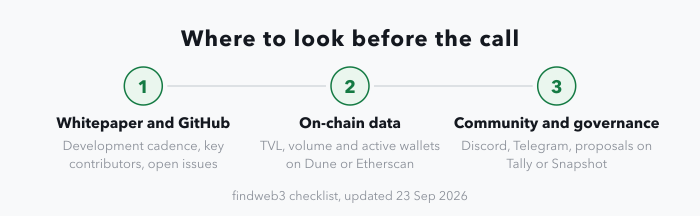
- Protocol and technology: Start with the whitepaper. Understand the problem they are solving and the technical solution they propose. Then review their GitHub repository for development cadence, key contributors and open issues. Is the project actively maintained?
- On-chain data: Use Dune, Nansen or a block explorer such as Etherscan to look at their metrics. For a DeFi protocol that might be total value locked, transaction volume and unique active wallets. For a Web3 game it might be daily active users and retention.
- Community and governance: Join their Discord and Telegram. Read the discussions, note the community's complaints and the general sentiment. If it is a DAO, read recent governance proposals on Tally or Snapshot. Knowing what the contentious debates are shows you follow the project.
For the wider context around a specific employer, this site keeps a list of companies currently hiring and a monthly breakdown of Web3 hiring by category.
Pro tip: Bring your findings up as questions rather than verdicts. Instead of "your TVL is down," try "I noticed a dip in TVL that looks like a sector-wide trend. What is the team doing on capital efficiency in this market?"
2. Prepare and Practice Your STAR Stories
Behavioral questions like "tell me about a time you faced a challenge" are an attempt to predict future performance from past behavior. The STAR method (Situation, Task, Action, Result) gives you a structure for answering them.
Why It's Crucial for Web3 Roles
Web3 teams are small and the work is often ambiguous. Interviewers are checking whether you can take ownership without much direction. A STAR story lets you show a situation you handled that resembles the ones you would face here, rather than asserting that you can handle them.
How to Execute Your STAR Preparation
Aim for a set of five to seven versatile stories you can adapt to different questions.
- Deconstruct the method. Situation: set the scene. Task: your specific responsibility or goal. Action: the concrete steps you took. Result: what changed as a consequence.
- Align with the role. Read the job description for the skills it keeps returning to — problem-solving, leadership, shipping under deadline — and pick stories that demonstrate those specifically.
- Quantify where you can. Give the actual number if you have it: how much cost came out, how much retention moved, over what period. "The project was successful" tells an interviewer nothing. If you do not have a number, describe the change concretely instead of reaching for a vague one.
Pro tip: Practice out loud and time yourself. Under three minutes per story is a reasonable target. Recording yourself is the quickest way to catch pacing and filler words.
3. Develop Thoughtful Questions for the Interviewer
The interview runs both ways. Your questions are how you find out what the job is actually like, and a slate of specific ones also shows you did the research in step one.
Why It's Crucial for Web3 Roles
Web3 companies change direction quickly — after a market move, a technical decision, or pressure from the community. What you are trying to learn is how the team handles that: how they decide, what they count as success, and what happens to people when a roadmap gets rewritten.
How to Prepare Your Questions
Keep the questions open-ended. Cover the role, the team, and the company's direction.
- Role and performance: "How is success measured for this role in the first 90 days, and what does exceptional look like after a year?" or "What are the hardest technical or strategic problems the person in this role will hit?"
- Team and culture: "How does the team make decisions when there are competing technical opinions?" or "What does mentorship or development look like here in practice?"
- Company strategy: "How has the roadmap changed in response to recent market shifts?" or "What does the company need to get right in the next six to twelve months?"
Pro tip: Have eight to ten questions ready but do not work through them mechanically — follow the conversation. Leave compensation for later stages, once there is mutual interest. When it does come up, the median pay by role on this site, taken from listings that state a figure, is a reference point.
4. Plan Your Interview Attire and Professional Appearance
Web3 culture is casual, but how you turn up still communicates something. The point is not to meet a corporate standard; it is to show you took the meeting seriously.
How to Execute Your Appearance Plan
- Check the company's norms. Use the research from step one: their site, their social accounts, conference photos, employee profiles on LinkedIn. Startup casual or business casual? When it is unclear, aim one level up.
- Dress for the camera. Most Web3 interviews happen on video. Solid, neutral colors read better on camera than fine patterns. Check your background and framing, and test your lighting at the time of day the call is scheduled.
- Try the whole outfit on a day or two before, including shoes. It takes five minutes and rules out a surprise on the day.
Pro tip: Have a second outfit ready. A spill twenty minutes before a call is a solvable problem if you already know what you are changing into.
5. Master Your Resume and Be Ready to Elaborate
Your resume got you the interview, and the interviewer will use it as the map for their questions. Be ready to discuss every line on it.
Why It's Crucial for Interview Success
Hiring managers probe a resume for consistency and depth. Not being able to elaborate on your own bullet point, or fumbling a date, raises a question about the rest of it. Being able to talk fluently about each entry does the opposite.
How to Execute Your Resume Mastery
- Deconstruct every bullet point. For each achievement, have a STAR story ready. If the line says "increased user engagement," know the situation, the task, what you personally did, and the result.
- Explain transitions and gaps. A career change is a chance to name transferable skills. Address gaps directly and briefly — what you did with the time is usually the whole answer.
- Connect past to future. Draw the line yourself. If the job needs cross-functional work, describe a project where you coordinated with marketing, engineering and design. Do not make the interviewer do the mapping.
Pro tip: Print the exact version of the resume you submitted and annotate it with metrics, project names and dates. Read it the day before so your answers match the document in front of the interviewer.
6. Conduct Mock Interviews and Practice Sessions
Knowing your answers and delivering them under pressure are different skills. A mock interview is where you find the awkward phrasing and the gaps in a story while it still costs nothing.
Why It's Crucial for Web3 Roles
You will be asked to explain something technical to someone who does not share your background — a DAO's voting mechanics, what a zero-knowledge proof buys you, how a token model is supposed to work. That is a practicable skill and most people are worse at it than they think.
How to Execute Your Practice Sessions
- Vary who interviews you. A peer for comfort, a mentor or coach for candid feedback, and a peer-matching platform for practice with a stranger. Exponent Practice, which took over Pramp's free mock interview sessions in July 2024, is one option.
- Simulate real conditions. Same setup, same time of day, same time limit. Ask your partner to keep to it.
- Record and review. It is the step people skip. Verbal tics and unclear answers are invisible in the moment and obvious on video.
Pro tip: Ask for specific feedback. Not "how did I do?" but "was my answer on the smart contract design clear to you as a non-engineer?" Specific questions get usable answers.
7. Prepare Your References and Professional Portfolio
References and a portfolio are the parts of your case that someone else can verify.
Why It's Crucial for Web3 Roles
Much Web3 work is public by default, which makes a portfolio easy to assemble and easy to check: a GitHub profile for a developer, a campaign write-up for a marketer, a governance post or a dashboard for an analyst.
How to Execute Your Preparation
- Select and brief your references. Pick former managers, senior colleagues or close collaborators who saw the work. Ask permission in advance, then send them the job description and your current resume so they know which parts of your history are relevant.
- Curate, do not archive. A portfolio is a highlight reel. A developer shows repositories with clean code and a README that explains the project. A marketer shows campaign results. Tailor it to the specific job.
- Make it easy to open. A personal site, a single link, or a PDF. One URL you can paste into an email is enough.
Pro tip: Vary the references. A former manager speaks to your performance, a peer to how you collaborate, someone you managed to how you lead.
8. Plan Logistics and Arrive Early
Logistics are the cheapest part of the preparation to get right and an avoidable way to start badly.
For a remote interview
Test the call software the day before, not five minutes before. Check your microphone, your camera and your internet connection, and have a phone number you can dial in on if the video fails. Confirm the time zone in writing.
For an in-person interview
- Do a trial run to the location at the same time of day if you can. Traffic, the right entrance and parking are all easier to discover in advance.
- Have a second route. A backup mode of transport, the next train time, cash for a meter.
- Build in a buffer. Plan to be at the building 15 to 20 minutes early and to walk in 5 to 10 minutes before the scheduled time.
Pro tip: Save the interviewer's number before you set off. If you are going to be late, a call beforehand is a different thing from an unexplained late arrival.
From Checklist to Job Offer
None of this is about memorizing scripts. It is a routine: research the company properly, know your own stories, prepare questions worth asking, and remove the avoidable friction from the day itself.
Three things worth doing before an interview is even scheduled. Write your career wins up in STAR format and keep them in one document, so you are editing rather than inventing under pressure. Run a mock interview for a role you do not badly want. And look at your portfolio or GitHub profile as a stranger would, then fix what does not immediately show your most relevant work.
Find Web3 lists roles across blockchain, crypto and NFT companies. Browse the latest Web3 jobs.