NFT Statistics 2026: Volume, Prices and What Is Left
 Jackson Pegg
The NFT market did not decline. It collapsed, and then most of the places you could sell one closed. Nifty Gateway, MakersPlace and Foundation have all shut, Magic Eden left Ethereum and Bitcoin entirely, Tensor's team was bought for its memecoin app, and in OpenSea's biggest month in three years, NFTs were 13% of what it traded.
This page used to say the market cap was over $6 billion and that art was 85% of all NFTs. Both are gone, along with everything else on it that could not be traced to a source. What follows is what is measurable in September 2026, with the date on every figure and a note on which measurements you can trust.
Last checked 23 September 2026.
You Might Also Like
Contents
Top 10 NFT Statistics (Editor’s Picks)
How Big Is the NFT Market Now?
What a Typical NFT Sells For
Why the Volume Figures Disagree
The Blue Chips
The Marketplaces That Closed
The Records, and the One That Was Not
Where NFTs Still Work
What Could Not Be Sourced
Top 10 NFT Statistics (Editor’s Picks)
NFT sales are $1.92 billion so far in 2026, which annualises to about 92% below the 2022 peak of $23.8 billion.
The tracked NFT market cap is $2.21 billion across 1,976 collections, against roughly $35 billion at the March 2022 peak.
CryptoPunks alone is 41% of that - $897.8 million of the $2.21 billion - and the top five collections are more than half.
The average NFT sale is $75 this year, against $96 in 2025, $124 in 2024 and $420-460 at the peak.
There are now more than 1.34 billion NFTs in existence, up 25% in a year, from about 38 million in 2021. More supply, less money.
Wash trading is still roughly one flagged dollar for every dollar counted: CryptoSlam excluded about $60 million of flagged volume against about $120 million of sales in the first three weeks of September 2026.
Bored Ape's floor is 95.5% below its high: 6.85 ETH against 153.7 ETH in May 2022.
Blur's token is down 99.6% from its February 2023 high.
Three well-known art marketplaces closed - MakersPlace, Nifty Gateway and Foundation - and Magic Eden shut its Ethereum and Bitcoin marketplaces in February 2026.
In October 2025, OpenSea's biggest month in three years, it traded $1.6 billion of crypto tokens against $230 million of NFTs.
How Big Is the NFT Market Now?
$1.92 billion of NFTs have sold in 2026 to 22 September, on CryptoSlam's index. Annualised, that is roughly $2.6 billion against $23.8 billion in 2022 - a fall of about 92%.
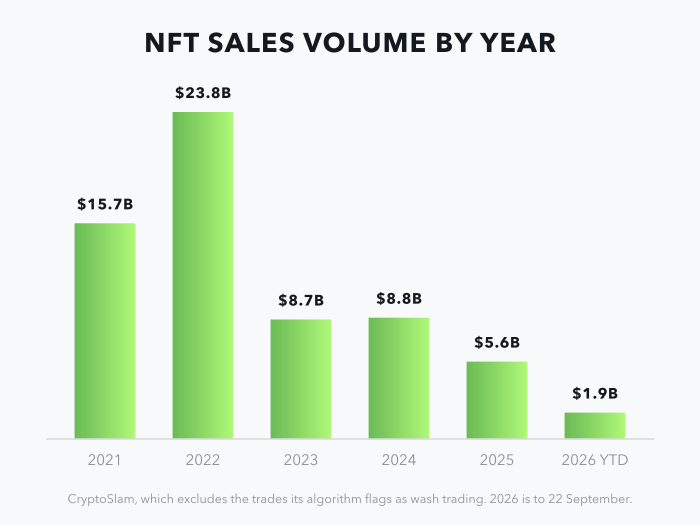
On the stock side rather than the flow, CoinGecko tracks a $2.21 billion market cap across 1,976 collections, against roughly $35 billion at the March 2022 peak on NFTGo's measurement. And it is concentrated to the point of being one asset: CryptoPunks is $897.8 million of it, about 41%, with the top five collections more than half.
The whole multi-chain market now trades under about $12 million a day, Ethereum first at roughly $5-7 million, then Polygon, Bitcoin and BNB Chain.
Sources: CryptoSlam, CoinGecko NFT market.
What a Typical NFT Sells For
$75, year to date. The average sale was $96 across 2025 and $124 in 2024, against $420-460 at the 2021-22 peak.
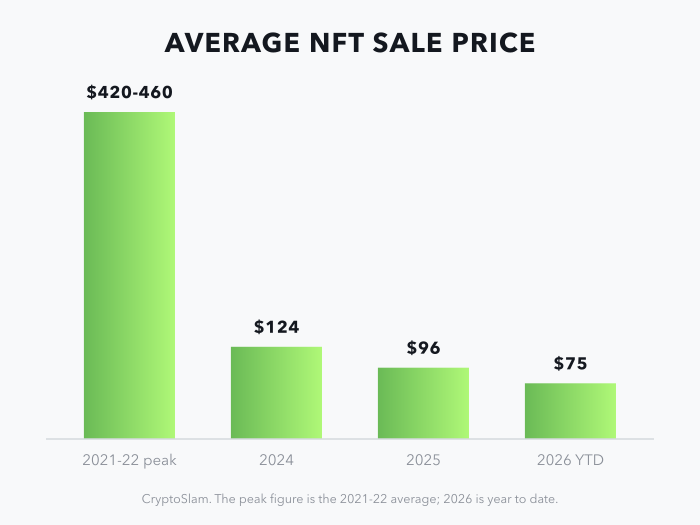
The supply went the other way. There were about 38 million NFTs in 2021; there were more than 1.34 billion at the end of 2025, up 25% in a year, and a dashboard read in September 2026 puts it above 1.6 billion. The market is minting more objects each year and paying less for each of them, which is the whole story in two numbers.
Sources: CryptoSlam, via Cointelegraph.
Why the Volume Figures Disagree
Any two NFT statistics pages will quote different volumes, and the reason is wash trading - selling something to yourself to manufacture a price.
CryptoSlam filters flagged trades out of its headline figure and shows the excluded amount separately. In 1-22 September 2026 it excluded about $60 million against about $120 million of counted sales. The algorithm is proprietary, so the filter cannot be audited - but the figures here use it, because an unfiltered number is worse.
DappRadar filtered too, and has stopped publishing. Its last State of the Dapp Industry was Q3 2025, on 9 October 2025: no Q4, no annual, nothing in 2026.
CoinGecko's NFT volume is unfiltered and diverges from CryptoSlam by several times. Neither is wrong; they are counting different things.
When a page quotes an NFT volume without saying whose number it is, assume it is the largest one available.
Sources: CryptoSlam methodology, DappRadar reports.
The Blue Chips
Bored Ape Yacht Club: 6.85 ETH ($18,971), against an all-time-high floor of 153.7 ETH ($420,430) on 1 May 2022 - down 95.5%.
CryptoPunks: 32.43 ETH ($89,851), against 125 ETH in August 2021 and $477,924 in October 2021 - down about 74% in ether and about 81% in dollars.
Blur, the token of the marketplace that briefly beat OpenSea: $0.0204, down 99.6% from its $5.02 high of February 2023, having set an all-time low in August 2026.
Note the two different declines on CryptoPunks. A floor quoted in ether and a floor quoted in dollars tell different stories, and pages that mix them - as the old version of this one did - produce numbers that cannot be reconciled.
Sources: CoinGecko.
The Marketplaces That Closed
The clearest measure of this market is not a price. It is who is still open.
MakersPlace announced its closure on 15 January 2025, after six years.
Nifty Gateway, the Gemini-owned platform that sold Pak's record-setting piece, announced its closure on 23 January 2026 and shut a month later.
Foundation announced its permanent shutdown in 2026.
Magic Eden announced on 27 February 2026 that its Ethereum, Polygon, Base, Bitcoin Ordinals and Runes marketplaces would close within two weeks - a month after doing $576 million of volume.
Tensor, the leading Solana NFT marketplace, ended differently: Coinbase acquired its team's memecoin app in November 2025 and the marketplace and its token were handed to the community.
OpenSea survived by becoming something else. In October 2025, its biggest volume month in three years, it traded $1.6 billion of crypto tokens against $230 million of NFTs. Its own token launch was postponed in March 2026 citing market conditions, with no new date announced.
Sources: Gemini / Nifty Gateway, Magic Eden via Decrypt, The Block.
The Records, and the One That Was Not
Pak, “The Merge” - $91,806,519. Still the largest, and often misreported as one sale: it was 28,983 separate collectors buying 312,686 units over 48 hours in December 2021.
Beeple, “Everydays: The First 5000 Days” - $69.3 million at Christie's in March 2021. The buyer ran a fund issuing tokens backed by Beeple works, which is worth knowing when the price is quoted as a market signal.
CryptoPunk #5822 - about $23.2 million (8,000 ETH) in February 2022, the largest single-item secondary sale.
CryptoPunk #9998 - $532 million, which never happened. In October 2021 it changed hands for 124,457 ETH; buyer and seller were the same party, the purchase was funded by a flash loan and repaid in the same transaction. It still appears on lists of the most expensive NFTs ever sold.
Sources: Nifty Gateway, Christie's, Decrypt.
Where NFTs Still Work
Two honest bright spots, both smaller than the 2021 story and more durable than it.
Physical collectibles. Courtyard, which vaults real Pokémon and sports cards and mints tokens against them, was the leading NFT collection by volume in the third quarter of 2025, and the lead later passed to Collector Crypt. The token is a claim on an object in a vault, which is a use rather than a bet.
Gaming is not the bright spot people assume. DappRadar's last report found gaming NFT volume down 17% and sales count down 32% quarter on quarter, while every other tracked category grew.
On the regulatory side, the SEC and CFTC issued joint guidance in March 2026 putting “digital collectibles”, including NFTs, outside the securities definition - which removes a question that had hung over the market since 2021.
Sources: DappRadar, SEC and CFTC joint guidance.
What Could Not Be Sourced
These were on the old page. None survived:
“The NFT market cap is over $6 billion.” It is $2.21 billion on the tracker the claim came from.
“Art is 85% of all NFTs.” No survey, no method, no date - and contradicted by what actually trades.
“More than 500,000 active NFT wallets, each doing one transaction a week.” No origin. DappRadar's last count of trading wallets was 2.14 million in a quarter, which is a different measure entirely.
“The average value of a single NFT is less than $200.” Right by accident, wrong in method: there was no source, and the real figure is $75 year to date.
The energy claims. “The computational power needed to run Ethereum” has been wrong since the merge in September 2022, which cut the network's energy use by about 99.9%.
“Millennials are 3x as likely to trade NFTs as Gen Z.” A survey with no house, sample or date attached.
Conclusion
NFTs in 2026 are a $2 billion-a-year market that trades under $12 million a day, concentrated in five collections, with an average sale price of $75 and more than a billion tokens in existence. The infrastructure that grew up around the 2021 boom has mostly closed, and the largest surviving marketplace makes most of its money trading something else.
What is left is smaller and more specific than the thing that was sold in 2021: a claim on a vaulted trading card, a membership, a piece of art with a price its buyer can defend. That is a real market. It is not the one the statistics pages are still describing.