Reducing Technical Debt in Web3 Smart Contracts and dApps
Spot technical debt in a dApp, keep a registry of it, prioritize smart contract refactoring, and make the case to stakeholders.
Technical debt is the accumulated cost of shortcuts in code and architecture: decisions that made sense under deadline pressure and now make a system slower to change and easier to break. Reducing it means finding those decisions, ranking them by risk, and fixing them in a deliberate order rather than whenever someone runs out of patience.
In Web3 that work carries more weight than it does in most software, because deployed contract code is usually immutable and often holds user funds.
The Stakes of Technical Debt in Web3
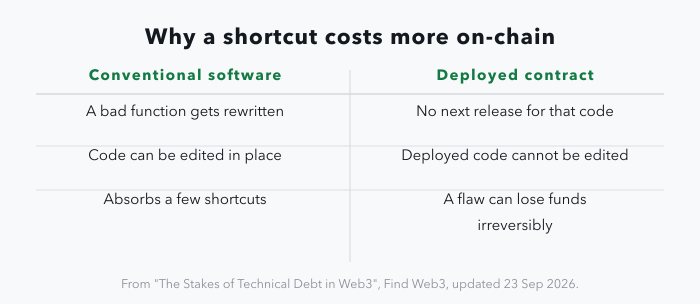
Conventional software can absorb a few shortcuts. A bad function gets rewritten in the next release. A deployed smart contract has no next release for the same code: it cannot be edited in place, and a flaw in logic that moves funds can cause losses nobody can reverse.
The pressure to ship a protocol or a dApp is real, and the shortcuts are familiar. Skip the tests for edge cases. Hardcode a value that should be configurable. Put everything in one large contract because splitting it takes longer. Each decision is small on the day it is made. Together they become the reason a team can no longer change anything safely.
How a Small Shortcut Becomes a Major Flaw
An unoptimized contract does not just run slowly. Every wasted operation is gas that someone pays for, so inefficient code arrives as a bill for the people using the dApp.
Logic that was never refactored can also hide well-known vulnerability classes — reentrancy and unchecked external calls among them — of the kind that have been used to drain funds from live protocols.
The Real Cost of Ignoring It
- Security vulnerabilities: outdated libraries and hastily written contracts widen the attack surface.
- Slower development: engineers spend their time reading around undocumented code instead of shipping.
- Eroding user trust: high gas costs, recurring bugs, or a breach push users to an alternative. For adoption and usage figures, see our Web3 statistics page.
- Direct financial cost: an exploit and years of wasted gas are both real money.
Finding and Measuring Technical Debt in Your dApp
You cannot prioritize debt you have not written down. The first step is turning "the codebase is a mess" into a specific list: which contract, which function, what goes wrong, and who it costs. In Web3 that list covers both on-chain code and the off-chain services around it.
What Technical Debt Looks Like in Web3
- Expensive functions: functions that cost far more gas than comparable ones usually point at unoptimized code — redundant storage writes, loops that grow with the user base, work that could happen off-chain. Users pay that difference.
- Convoluted contract logic: if the frontend has to make a long chain of calls to complete one user action, the contract interface was designed around the implementation rather than around use.
- Thin test coverage: missing tests on the paths that move funds or change permissions are the gaps that show up in audits, if you are lucky, and in incidents if you are not.
- Outdated dependencies: old versions of Hardhat, Foundry, or Ethers.js carry fixed vulnerabilities that are already public and already indexed by anyone looking.
Web3 Technical Debt Indicator Matrix
Connecting symptoms to their likely cause and impact gives a team a shared vocabulary for the argument about what to fix first.
| Debt Category | Common Indicators | Potential Impact |
|---|---|---|
| Smart Contract Code | High gas usage, complex loops, lack of comments, redundant storage writes. | Poor user experience, increased user costs, potential for re-entrancy or integer overflow bugs. |
| Protocol Architecture | Tightly coupled contracts, monolithic design, poor upgradeability patterns. | Difficult to maintain and update, high risk during migrations, stifles future feature development. |
| Testing & Verification | Low coverage on critical paths, no formal verification, missing fuzz tests. | High risk of security vulnerabilities, exploits, and financial loss. Brittle code that breaks easily. |
| Off-Chain Infrastructure | Outdated libraries/frameworks, fragile indexing services, lack of monitoring. | Inaccurate dApp state, poor performance, downtime, and potential for security breaches. |
| Documentation | Missing NatSpec comments, outdated architecture diagrams, no clear developer onboarding docs. | Slows down new developers, increases the risk of mistakes, creates knowledge silos. |
Your Technical Debt Registry: Making Debt Visible
Once you start spotting these issues, they need somewhere to live. A technical debt registry can be a spreadsheet or a board in Jira or Trello. The point is that the debt is visible to everyone, including the people who decide what the team works on.
Treat each entry like a bug report rather than a complaint. For every item, record:
- A specific description. Not "the rewards contract is messy" but "the
claimRewardsfunction loops over every registered user, so it will hit the block gas limit once the list grows past a few hundred entries." - The exact location. The contract, the file, and the line numbers where possible.
- The type of debt. A code smell flagged by a tool like Slither, an architectural flaw such as a monolithic contract, or a gap in the test suite.
A registry turns abstract frustration into a backlog you can plan sprints around.
A Prioritization Framework for Smart Contract Refactoring
Cataloging the debt is the easy half. The harder question is what to fix first, and it matters more here than in most codebases: a minor gas inefficiency is an annoyance, while a reentrancy vector is a live threat to user funds. Teams need a repeatable way to weigh risk against effort instead of fixing whatever irritates the loudest engineer.
The Web3 Debt Quadrant
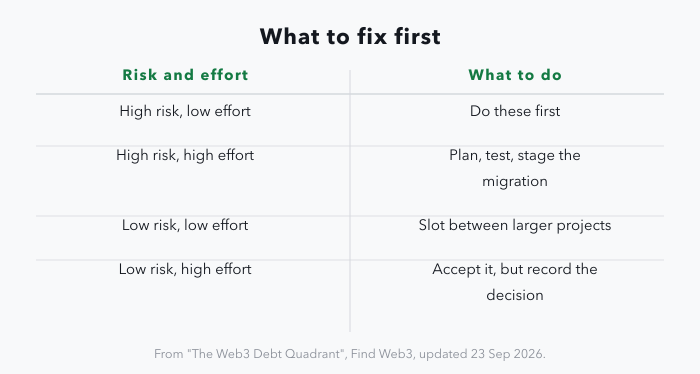
Plot every item from the registry on two axes:
- Security and financial risk (Y-axis): how likely is this issue to cause loss of funds, corrupted state, or protocol failure?
- Effort to remediate (X-axis): how much developer time, testing, and migration work will a fix take?
From Quadrants to Action
- High risk, low effort (quick wins): patch a known vulnerability in a dependency, fix a broken access control check. Do these first.
- High risk, high effort (major overhauls): refactoring a monolithic contract with suspected reentrancy exposure, for example. These need planning, exhaustive testing, and usually a staged migration.
- Low risk, low effort (housekeeping): comments, small gas savings, removing dead functions. Good work to slot between larger projects.
- Low risk, high effort (reconsider): if a task costs weeks and removes little risk, accepting the debt for now may be the right call — as long as that decision is recorded. For definitions of the terms in this section, see our Web3 dictionary.
Getting Buy-In from Stakeholders
Leadership rarely funds "cleaning up messy code." The same work funded as "reducing the chance of an exploit in the contract that holds customer deposits" is a different conversation. Describe the outcome — security, uptime, lower user costs, faster delivery of the next feature — and say what happens if the work is deferred.
Actionable Techniques for Reducing Technical Debt
Paying debt down is where the risk lives. Ad-hoc fixes to contracts that hold funds can create worse problems than the ones they solve, so the work needs the same rigor as a feature launch: planning, tests, and documentation of what changed and why.
Refactoring Smart Contracts Safely
Refactoring a live contract is not editing. Because the deployed bytecode is fixed, the work means moving logic and state to a new contract, and the migration itself is the risky part.
The strangler fig pattern is a useful model: rather than replacing the old contract in one step, route functionality to a new one piece by piece until nothing depends on the old code.
Proxy patterns are the common implementation. A stable proxy address holds state and delegates to a logic contract; to ship a fix, you deploy a new logic contract and repoint the proxy. That isolates the change and allows a phased rollout, but it introduces a trade-off worth stating plainly: whoever controls the upgrade key can change the logic users are trusting. Upgradeability moves risk from the code to the key management around it.
Improving Your Off-Chain Components
Technical debt is not only a contract problem. Indexers, APIs, and frontends accumulate their own.
- Indexing services: a slow or unreliable subgraph usually means the data model grew by accretion. Simplifying the entities and the query patterns is normally a bigger win than tuning around the existing shape.
- Frontend libraries: standardize how the app talks to Ethers.js, or whichever chain library it uses, remove duplicated call logic, and move repeated patterns into shared components.
- CI/CD pipelines: automated tests, static analysis, and deployment checks are the cheapest defense against new debt, because they catch it before it is merged rather than after it is deployed.
Adopting Proactive Development Practices
Clearing old debt matters less than not creating it.
Break monolithic contracts into single-responsibility modules — token logic separate from governance logic, for instance. Smaller contracts are easier to reason about, cheaper to audit, and less likely to require a full migration when one part changes.
Raise test coverage on the functions that handle user funds and permission changes before raising it anywhere else.
Record architectural decisions as Architecture Decision Records: short markdown files stating the decision, the alternatives, and the reasoning. The value is not the document; it is that a developer two years from now can see why the odd-looking choice was deliberate.
Building a Culture That Prevents Future Technical Debt
The teams that stay out of debt treat code review as part of the work rather than a formality. A review that only looks for bugs will pass code that is correct today and unmaintainable in six months. Reviewers need a mandate to raise missing documentation, tangled logic, and gas inefficiency as review comments in their own right.
Weaving Maintenance into Your Workflow
Debt reduction survives only if it has capacity reserved for it. Teams that name a fixed share of each sprint for refactoring, tests, and maintenance keep that work from being deferred every time a feature request arrives. The specific share matters less than protecting it: a cleanup phase scheduled for "after launch" rarely happens.
Clear project scope helps as much as any engineering practice, because most reckless shortcuts start as a deadline that moved after the work was committed.
Fostering a Mentorship Mindset
Process does not teach judgment. Developers new to Web3 often have not yet seen what a shortcut costs when the code is immutable, and mentorship is how that transfers.
- The reasoning behind the practice: explain why a pattern exists, not just that it is required. "Check effects before external calls" lands better with the exploit it prevents attached.
- Security from the first commit: in contracts that hold funds, secure and maintainable are the same requirement.
- The longer horizon: show newer engineers how today's design decisions constrain what the protocol can do in two years.
Engineers looking for teams that work this way can browse engineering roles in Web3.
Frequently Asked Questions
Is All Technical Debt Actually Bad?
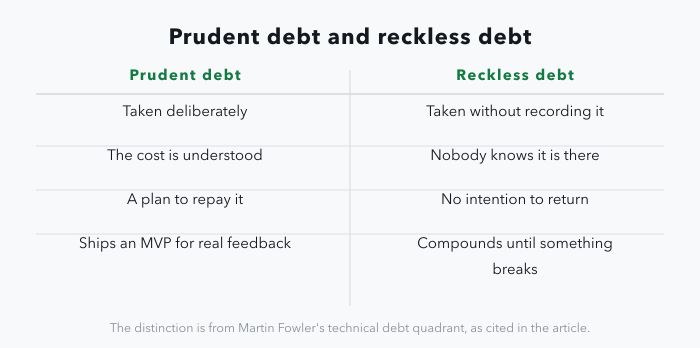
No. The useful distinction, from Martin Fowler's technical debt quadrant, is between prudent and reckless debt. Prudent debt is taken deliberately, with the cost understood and a plan to repay it: shipping an MVP on simplified architecture to get real user feedback can be the right call.
Reckless debt is the shortcut taken without recording it or intending to return. That is the kind that compounds, because nobody knows it is there until something breaks.
How Can I Get My Non-Technical Manager to Care About This?
Translate it into a number they already track. Measure what the inefficient function actually costs — gas per call multiplied by calls per week is a figure you can pull from your own contract's history — and what the refactor would save. Do the same for engineering time lost to a fragile subsystem. A measured cost from your own system is more persuasive than an industry statistic, and it is defensible when someone checks it.
How Often Should We Deal With Technical Debt?
Continuously, in small amounts. A dedicated "cleanup phase" tends to slip off the roadmap; capacity reserved in every sprint does not. Reserve a share of each sprint for refactoring, testing, and maintenance, keep it steady, and hold to it when a feature deadline gets tight — that is the moment the policy is actually tested.
Find Web3 lists engineering, design, and marketing roles at crypto companies. Browse engineering jobs, see what Web3 roles pay, or check the Web3 jobs report for hiring by month and category.