7 Web3 Salary Negotiation Tips: Timing and Anchoring
How to benchmark Web3 pay, time the ask, anchor a number, and negotiate tokens and equity alongside base salary.

Compensation in Web3 is harder to read than in most industries. Pay is usually split between cash and tokens, sometimes with equity on top; ranges move with a company's funding stage and with which chain it builds on; and many roles are remote, which changes how employers set numbers in the first place. Preparation is worth more than confidence here.
This guide covers seven things to do before and during a pay conversation, whether you are taking a new role or asking for a raise. For a starting figure, the salary medians on this site are taken from Web3 job listings that publish a range, across 15 roles, and the Web3 jobs report shows hiring by month and category.
1. Research Web3 Market Salary Benchmarks
A range you can defend beats a single hopeful number. In Web3 that range depends on things a generic salary tool will not capture: which language you write (a Solidity developer and a Rust developer are different markets), which chains you have shipped on, whether the company is pre-seed or post-token, and whether it pays in cash, tokens, or both.
How to Implement This Strategy
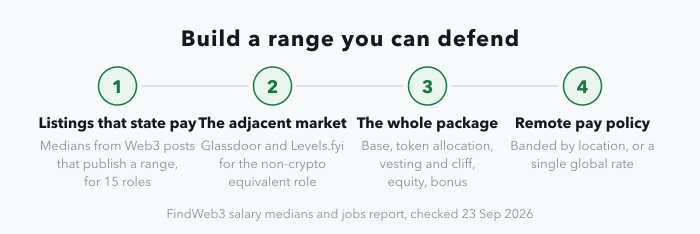
- Start with listings that state pay. The salary page takes medians from Web3 job posts that publish a range, for 15 roles, and the jobs report shows how hiring has moved by month and by category — useful for judging whether your role is scarce at the moment.
- Check the adjacent market. Glassdoor and Levels.fyi cover the non-crypto equivalent of your role: backend engineer, product designer, community lead. That figure is a floor to argue from, particularly with a company hiring people in from outside crypto.
- Price the whole package. Base, token allocation, vesting schedule and cliff, equity, bonus. A grant quoted in dollars is worth that amount on the day it was quoted, not on the day it vests, so ask how many tokens it is and what share of supply that represents.
- Ask how remote pay is set. Some companies band remote pay by location, some pay a single global rate. The answer changes what number is realistic before you name one.
2. Document and Quantify Your Achievements
Numbers move a pay conversation; adjectives do not. Before the meeting, write down what you did in terms someone else can check: contribution to total value locked, gas saved by a contract change, audit findings closed, uptime held, users retained, support load removed.
How to Implement This Strategy
- Write the number, not the adjective. "Cut deployment time by a quarter by moving the test suite to Hardhat" is a claim a reader can interrogate. "Improved efficiency" is not. The same applies to community work: growth, retention and event attendance beat "grew the community."
- Use the STAR structure. Situation, task, action, result. It keeps each example to a few sentences and puts the outcome at the end, where it is remembered.
- Cover on-chain and off-chain work. On-chain results are public and easy for someone to verify: the value secured by a protocol you audited, a proposal you took through governance. Off-chain wins — a release process you shortened, a runbook that cut incident time — only exist in the conversation if you supply the number yourself.
Five to seven prepared examples are enough for any interview or review. If you need the precise term for something you worked on, this site keeps a Web3 glossary.

3. Perfect Your Timing
Leverage is not constant. The same request lands differently depending on what happened in the weeks before it and where the company sits in its budget cycle.
How to Implement This Strategy
- Raise it after a visible win. A completed audit, a launch you carried, a migration that did not break anything: ask while the work is recent and clearly attributable to you.
- Get ahead of the budget. Start the conversation a couple of months before the annual review cycle, while your manager can still build the increase into next year's plan instead of looking for it in a closed budget.
- Use a change in scope. New reports, a new protocol to own, or absorbing the work of someone who left are all moments when the job has changed, which is a cleaner basis for a raise than time served.
4. Practice the Collaborative Approach
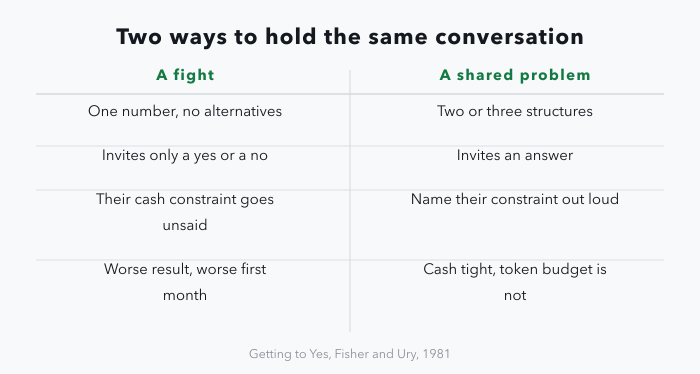
Treating the conversation as a fight tends to produce a worse result and a worse first month in the job. The alternative is interest-based negotiation, set out in Getting to Yes by Roger Fisher and William Ury (1981): treat the gap between the offer and your number as a shared problem with more than one solution.
That framing is worth more at early-stage crypto companies than almost anywhere else, because cash is often genuinely constrained while token budget is not.
How to Implement This Strategy
- Frame it as a joint problem. "How can we structure this so it reflects the scope and still works with the budget?" invites an answer. A flat demand invites only a yes or a no.
- Name their constraint out loud. "I know cash is tight until the round closes — could we look at a larger token allocation instead?" shows you have understood the limit and moves to the part that can move.
- Bring two or three structures, not one number. Higher base with a standard grant; lower base with a larger grant on a longer schedule; base plus a defined bonus tied to a milestone. Letting them choose keeps the conversation open.
5. Master the Art of Anchoring
The first number said out loud sets the range the rest of the conversation works inside. If the employer names it, you are arguing upward from their figure; if you name it, they are arguing down from yours.
How to Implement This Strategy
- Open above your target, within reason. Leave yourself room to come down, and make sure the bottom of your range is still a number you would accept. An anchor you cannot justify costs more than no anchor at all.
- Attach the reason to the number. Say the figure and its basis in the same breath: "Based on senior Solidity roles with cross-chain bridge experience, and on the published ranges for those roles, I am looking at the top of that band." The justification is what stops the number sounding arbitrary.
- Anchor on the whole package when base is fixed. Where the band for a role is genuinely set, anchor on total compensation instead — base plus grant plus bonus — because that is usually where the flexibility is.
6. Negotiate Beyond Base Salary
Base salary is often the least flexible part of an offer and the only part people negotiate. Token allocation, vesting terms, equipment, training budget, notice period and leave are frequently easier to approve, and some of them are worth more than the raise you were refused.
How to Implement This Strategy
- Decide what you actually want first. A shorter cliff, a faster vesting schedule, a conference and certification budget, a hardware allowance, extra leave, a title that matches the work. Ranking these before the call stops you accepting the first substitute offered.
- Put a figure on each. A training budget or an upgraded health plan has a dollar value; naming it makes the request easy to compare against the raise it is standing in for.
- Check the vesting terms before anything else. The schedule and the cliff decide whether a grant is worth anything at all if you or the company change direction in the first year. Ask what both are, and whether either can move.
- Use it when the base stalls. "I understand the base is fixed. Could we look at the vesting schedule and the training budget to close the gap?" keeps the conversation going rather than ending it.
7. Prepare for Common Objections
Most pushback comes in a few recognizable shapes. Deciding how to answer them beforehand is the difference between a pause and a stall.
How to Implement This Strategy
- Write out the three you expect. "The band for this role is fixed." "Your experience does not line up with the level." "That is more than people already on the team are paid." Each has a calm answer and none of them has a good improvised one.
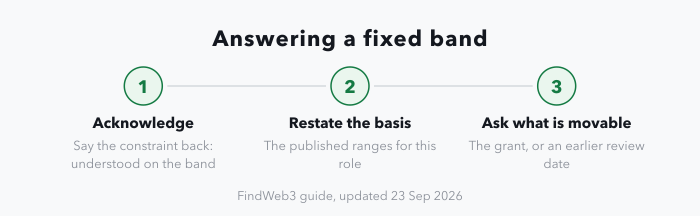
- Answer with a question. Acknowledge the constraint, restate the basis for your number, then ask what is movable: "Understood on the band. Given the published ranges for this role, could we look at the grant or at an earlier review date instead?"
- Say it out loud once. Rehearsing with someone else exposes the sentences that read as reasonable on the page and sound defensive in the room.
The Seven Tips at a Glance
| Tip | Use it when |
|---|---|
| Research market benchmarks | Before you name any number, and before a recruiter asks for your expectations |
| Document and quantify achievements | Ahead of a review, or whenever you are asking for more than the role was scoped at |
| Perfect your timing | After a visible win, and a couple of months before budgets are set |
| Practice the collaborative approach | Throughout, and especially at early-stage companies with real cash constraints |
| Master the art of anchoring | When you are asked for a number first, or can get in ahead of the offer |
| Negotiate beyond base salary | When the base is fixed or the band is closed |
| Prepare for common objections | Before any conversation where pushback is likely |
Final Thoughts
These work together rather than separately. Research gives you the number, documentation gives you the reason for it, timing decides when it lands, and the rest is how the conversation is held. Almost all of the work happens before anyone says a figure out loud.
Open Web3 roles are listed on the job board.