Smart Contract Security: Common Vulnerabilities and Fixes
Reentrancy guards, emergency stops, role-based access control and oracle hardening, plus the tools to test a contract before it ships.
A smart contract's code is public and, once deployed, usually permanent. A flaw cannot be quietly patched: it sits on-chain as a standing target until someone finds it. That makes security a property of the whole development process — design, implementation, testing, deployment and key management — rather than a review bolted on at the end.
The High Stakes of Smart Contract Security
Smart contracts hold and move user funds, and immutability cuts both ways. Once a contract is live, its code is fixed and any gap in it is public. Unless the contract was built to be upgraded, the flawed version is the version that stays.
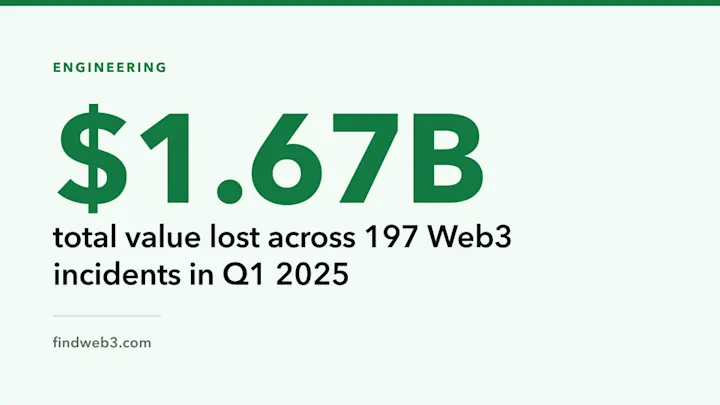
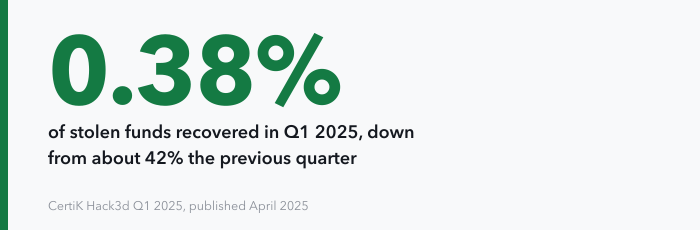
The losses are documented. CertiK's Hack3d report for the first quarter of 2025, published in April 2025, put total value lost at roughly $1.67 billion across 197 incidents, with $1.54 billion of that on Ethereum and only 0.38% of stolen funds recovered, down from about 42% the previous quarter. CertiK attributes around $1.45 billion of the quarterly total to a single event, the February 2025 Bybit exploit, so the figure covers the industry's whole security surface rather than contract bugs alone.
That mix is the point. The threats range from coding errors to economic exploits, oracle manipulation and operational failures such as a compromised private key. A contract can be flawless and still lose everything through the key that controls it.
Common Smart Contract Vulnerabilities and Key Defenses
Many of the largest losses come from a small number of well-known vulnerability patterns. Knowing them is the first line of defense.
| Vulnerability Type | Description | Primary Defense Mechanism |
|---|---|---|
| Reentrancy | An attacker's contract repeatedly calls back into the victim's contract before the first invocation is finished, draining funds. | Use the Checks-Effects-Interactions pattern; employ reentrancy guards. |
| Access Control Flaws | Functions with privileged access (e.g., withdraw, changeOwner) are improperly protected, allowing unauthorized calls. |
Implement Role-Based Access Control (RBAC) and the principle of least privilege. |
| Integer Over/Underflow | An arithmetic operation creates a number that's too large or small for its data type, causing it to wrap around to an unexpected value. | Use modern Solidity versions (0.8.0+) which have built-in checks; use secure math libraries. |
| Oracle Manipulation | An attacker manipulates external price feeds that a DeFi protocol relies on to trigger unfair liquidations or arbitrage. | Use decentralized oracle networks (e.g., Chainlink) and implement sanity checks on incoming data. |
Building Security in Before You Write Any Code
Much of the security work on a smart contract happens before the first line of Solidity. Architecture decides which categories of bug are possible at all: a function that settles its own state before it makes any external call cannot be reentered, whatever the caller does.
Neutralize Reentrancy with Checks-Effects-Interactions
Checks-Effects-Interactions (CEI) is the main structural defense against reentrancy, the vulnerability behind several of the largest DeFi hacks.
- Checks: Validate first. Use
require()to check permissions, inputs, and the contract's current state. If anything is off, the transaction reverts here. - Effects: Update internal state next — balances, ownership, flags. Settle the internal books before anything leaves the contract.
- Interactions: Only once checks have passed and state changes are complete does the contract touch the outside world, sending ETH or calling another contract.
Changing state before the external call closes the door on a malicious contract calling back in to exploit a stale balance.
Assume every external contract you call is hostile. CEI is what coding to that assumption looks like.
Planning for the Worst with an Emergency Stop
No amount of testing catches everything. An emergency stop, or circuit breaker, is a fail-safe that pauses critical functions when something goes wrong.
In its simplest form it is a boolean flag such as isPaused, controlled by a multisig or another secure admin address. When it is set, functions like withdraw() revert. It does not fix the bug, but it buys time to investigate, warn users and plan a recovery without losing more funds. The Pausable module in the OpenZeppelin Contracts library implements this, and it is easier to include from day one than to retrofit.
Designing for the Future with Upgradeability
Many projects handle immutability with upgradeable contracts built on a proxy pattern, which separates logic from data so new logic can be deployed without changing the address users interact with or losing stored state.
- Proxy Contract: The stable address users interact with. It holds the contract's storage.
- Implementation Contract: The currently active business logic.
- The Upgrade: Deploy a new implementation contract, then point the proxy at the new logic address.
Upgradeability is not free. It introduces its own attack surface — storage layout collisions, initialization bugs, and an upgrade key that is itself a target. The Web3 dictionary covers terms like proxy and immutability if they are new.
Implementing Robust Access Control and Data Feeds
Defining who can do what inside a contract is the bedrock of its security, and OWASP ranks access control flaws first among smart contract risks in its 2025 list.
The onlyOwner modifier is where many projects start, but it is usually too blunt for a real protocol. A live system tends to have admins who can pause the contract, minters who can create tokens, and a treasury role that moves funds. Handing all of that to one account creates a single point of failure.
Moving to Granular Role-Based Access Control
Role-Based Access Control (RBAC) defines specific roles and grants each one only the permissions it needs — the principle of least privilege applied to contract functions.
This is a place to use an audited library rather than write your own primitives. The AccessControl contract in the OpenZeppelin Contracts library provides the machinery for creating, granting and revoking roles.
Splitting privileges shrinks the blast radius. If a minter key is compromised, the attacker can mint tokens; they cannot drain the treasury or upgrade the contract.
Oracle Manipulation
Many contracts depend on external information, especially price data. Those feeds, known as oracles, are an attack surface of their own: an attacker who can feed a contract a bad price can exploit its logic for a large payout.
This is recognized as a top-tier risk. The OWASP Smart Contract Top 10 for 2025 lists access control vulnerabilities at SC01 and price oracle manipulation at SC02. These exploits commonly use flash loans to skew the spot price on a single decentralized exchange for the length of one transaction, triggering unfair liquidations or draining protocol funds.
Hardening Your Oracle Integrations
Securing data feeds means not trusting a single source.
- Use decentralized oracle networks. A single centralized price feed is a single point of failure. A network like Chainlink aggregates data from many independent sources, which is harder to manipulate.
- Implement time-weighted average prices (TWAPs). Flash loan attacks depend on large, very brief price swings. A TWAP averages price over a longer window, so a momentary spike barely moves the result.
- Build in sanity checks. Bound the values a contract will act on with
require()statements. If an oracle suddenly reports ETH at $10, the transaction should revert rather than proceed.
Your Practical Toolkit for Testing and Auditing
Nobody ships flawless contract code on the first attempt. Testing works as a layered process: automated checks on your own machine, then manual tests against your specific business logic, then an external review by people who did not write the code.
Start with Automated Security Scanners
Automated scanners are the first layer. They flag common vulnerabilities and known anti-patterns in the IDE or in CI, which clears the low-hanging fruit so that human review can concentrate on business logic, where the subtle bugs live.
Three kinds of analysis are worth knowing:
- Static analysis: Slither reads source code without running it, builds a model of the contract's logic, and checks it against known bug patterns such as reentrancy, unlocked pragmas and dangerous delegate calls. It is fast enough to run on every commit.
- Dynamic analysis (fuzzing): Echidna bombards a contract with large numbers of generated inputs, searching for a transaction sequence that violates the invariants you define. The quality of the results depends on the quality of the properties you write.
- Symbolic execution: Mythril treats inputs as symbolic variables and explores execution paths to determine whether an unwanted state — an attacker draining the contract, for example — is reachable. It is slower and better suited to targeted analysis than to every build.
There is a trade-off between speed and depth, which is why teams generally run more than one tool.
Smart Contract Security Tool Comparison
| Tool Name | Analysis Type | Best For | Key Feature |
|---|---|---|---|
| Slither | Static | Finding common vulnerabilities early. | Fast, CI/CD integration, rich set of detectors. |
| Echidna | Dynamic (Fuzzing) | Property-based testing and finding logic bugs. | Tests user-defined invariants, not just known patterns. |
| Mythril | Symbolic | Automated vulnerability detection. | Works on deployed bytecode as well as source. |
Don't Skip Unit and Integration Testing
Scanners find known patterns; they cannot validate your project's specific business logic. Frameworks like Foundry and Hardhat ship testing suites for that, and two kinds of test matter:
- Unit tests: Small and fast, checking individual functions in isolation. Does
deposit()update the balance correctly? DoescalculateFee()return the expected amount for a given input? - Integration tests: Checking how parts of the system interact. Can a user deposit tokens into Contract A, stake them in Contract B, and withdraw the resulting rewards from Contract A? These catch bugs that only appear when components talk to each other.
A test suite is also a record of how the contract is supposed to behave. Coverage percentage is a weak target on its own; edge cases, complex interactions and the system's critical invariants are what need covering.
Preparing for a Professional Audit
An independent audit is the last step before deployment, and it works best when the codebase is ready for it.
- Clean and documented code. Consistent style, useful comments, and documentation that explains the architecture and intended behavior. Auditors cannot infer intent from code alone.
- A complete test suite. Handing over working tests lets auditors understand the logic quickly and spend their limited time on novel attack vectors rather than on basics.
- The right firm. Look for a public track record on protocols similar to yours, and read their published reports to see how findings are explained.
An audit is not a guarantee. It is an external perspective from people who have seen many protocols fail, and findings are worth treating as actionable rather than as criticism. Deep testing and verification experience is also what security-focused blockchain engineering jobs tend to screen for.
Securing Your Deployments and Operations
A well-written, audited contract can still be compromised through weak operational security. A flawless contract controlled by a vulnerable key is a vault with the key left under the doormat.
Private Keys and Operational Risk
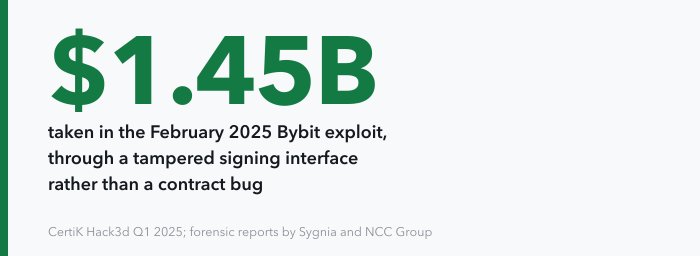
The largest single crypto loss of the first quarter of 2025 — the $1.45 billion Bybit exploit in CertiK's Q1 figures — did not come from a bug in contract logic. Forensic reports by Sygnia and NCC Group found no vulnerability in the Safe smart contracts; attackers compromised the interface the signers used, so a malicious transaction was displayed as a routine one and approved.
Attacks on the accounts and processes that control contracts sit outside what a code audit examines. An attacker who takes a deployer or admin key can upgrade an otherwise sound contract into a malicious one, and no amount of review of the original code prevents that.
A Playbook for Key Management
The keys with administrative power over a contract can drain funds, upgrade it, or freeze it permanently. The goal is to remove any single point of failure.
- Hardware wallets. At a minimum, any address with privileged access should be controlled by a hardware wallet such as a Ledger or Trezor. Keys in a browser extension or a
.envfile on a server are not protected. - Multi-signature wallets. A multisig is itself a contract that requires several independent keyholders (3 of 5, for example) to approve a transaction, so compromising one key is not enough.
- Multi-party computation (MPC). MPC splits a private key into encrypted shards held by different parties and devices. A signature is produced only when a threshold of them cooperate, and the full key is never reassembled in one place.
Deployer addresses should be kept strictly separate from personal ones, used sparingly, stored with the highest level of protection available, and ideally placed behind a multisig from the start.
Secure Deployment Scripts and Why Source Code Verification Matters
Hardcoding private keys into deployment scripts risks committing them to a public repository. Use environment variables that are managed securely and never version controlled.
Once the contract is on-chain, verify its source code. Uploading the source to a block explorer such as Etherscan lets anyone confirm that the deployed bytecode matches the Solidity you published. That does three things:
- It builds user trust. Unverified contracts ask users to take your word for it.
- It enables community review. Researchers can read the code and report what they find.
- It simplifies integration. Other developers can see exactly how the contract works before building on it.
Security does not end at deployment. Monitoring on-chain activity and having an incident response plan are part of the job, and the DeFi statistics page tracks the wider context those incidents happen in.
Answering Your Smart Contract Security Questions
Is a Professional Audit Enough to Guarantee Security?
No. An audit is a necessary step, not a guarantee.
Audits are effective at finding code-level vulnerabilities, logic flaws and deviations from established practice. What they cannot cover is everything outside the code — most obviously a compromised key or a compromised signing process used to deploy or manage the contract. In CertiK's Q1 2025 figures, private key compromises alone accounted for about $142 million across 15 incidents, and the quarter's largest single loss, the $1.45 billion Bybit exploit, came from a tampered signing interface rather than a contract bug.
An audit inspects the blueprints and construction of the vault. It does not stop a thief who picks up the keys from a desk.
Security is the combination: a competent audit, strong operational practice such as multisig control of privileged roles, and continuous on-chain monitoring.
What Is the Single Most Important Practice for a New Developer?
The Checks-Effects-Interactions pattern. Validate inputs and permissions, update internal state, and only then make external calls. Because the contract's state is fully settled before any outside code runs, a malicious contract that calls back in finds nothing stale to exploit. It closes off reentrancy, historically one of the most costly bug classes in DeFi, as a structural matter rather than a thing to remember.
What Can I Do for a Contract Already Deployed?
It depends on how the contract was designed.
If it is upgradeable through a proxy, deploy a patched implementation contract and point the proxy at the new address.
If it is not upgradeable, the work shifts from prevention to mitigation and monitoring:
- Verify source code. If it is not verified on a block explorer such as Etherscan, do that first.
- Set up monitoring. Tools like Forta watch on-chain activity and can alert you to suspicious transactions involving your contract.
- Create a wrapper. If the contract holds user funds, a wrapper contract can add validation in front of calls to the original.
- Establish a response plan. Decide in advance how you will communicate with users. In the worst case, the responsible move is to disclose the vulnerability and guide users through migrating funds to a new contract.