What Are Distributed Systems? CAP Theorem and Design Basics
How distributed systems scale and stay available, what the CAP theorem forces you to trade, and which consistency model to pick.
A distributed system is a group of independent computers that coordinate over a network and present themselves to the user as a single service. Almost everything people use online runs on one. This guide covers what these systems are for, what they have to give up to work, and where you already depend on them.
What Are Distributed Systems Really
A distributed system is a collection of separate computing components, called nodes, connected and communicating over a network. To the end user, that web of machines looks like one reliable service. When you press play on a film, you do not see the servers involved; you see the film start.
That illusion of a single unified system has a name: transparency.
These systems exist because the demands placed on modern applications are larger than any one computer can meet. Spreading the work across many machines is how a service handles more load than a single machine could, and how it keeps running when part of it breaks.
Why This Approach Is Essential
Three needs drive the move away from a single centralized computer.
- Scalability: You cannot keep upgrading one computer forever. In a distributed system you add more machines (nodes) and share the load across them.
- Fault tolerance: If one machine crashes, others take over its work. That redundancy is what stops a single failure from taking down the whole service.
- Performance: Spreading a system geographically puts data and computation closer to users. Content delivery networks (CDNs) do exactly this, caching video and images on servers near the viewer to cut the round trip.
A distributed system is one in which the failure of a computer you didn't even know existed can render your own computer unusable.
The computer scientist Leslie Lamport wrote that, and it names the cost of the arrangement as well as its power.
If the terminology here is unfamiliar, the Web3 dictionary defines the terms.
The Essential Principles of System Design
Three properties decide whether a distributed system holds up in production: scalability, availability and performance. Each one addresses a different way a naive design fails.
Mastering Scalability
Scalability is a system's ability to absorb more work. There are two ways to get it.
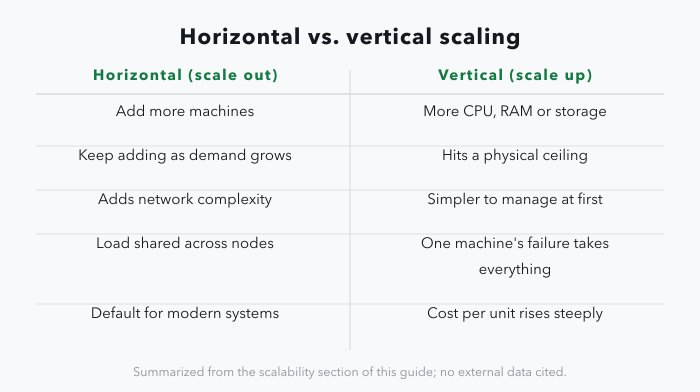
- Horizontal scaling (scaling out): Add more machines. It is a supermarket opening more checkout lanes rather than asking one cashier to work faster. This is the default approach for modern systems, because you can keep adding machines as demand grows.
- Vertical scaling (scaling up): Give one machine more CPU, RAM or storage. Simpler to manage at first, but there is a physical ceiling, and the cost per unit of capacity rises steeply as you approach it.
The choice is a trade-off. Horizontal scaling adds network complexity; vertical scaling leaves you with one machine whose failure takes everything with it. Large consumer services lean heavily on horizontal scaling for that reason.
Designing for High Availability
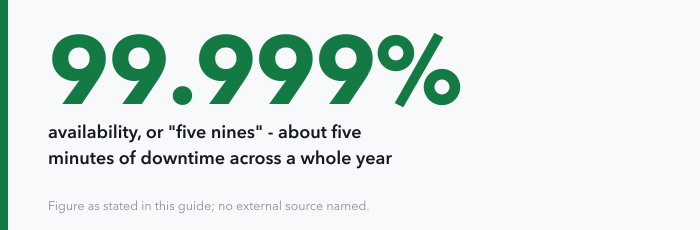
Availability is the share of time a system is actually serving requests. It is usually quoted in "nines": 99.999% availability, or "five nines", allows about five minutes of downtime across a whole year. For a payment gateway or an airline booking system, every minute of downtime costs money directly.
High availability comes from redundancy and fault tolerance. Redundant components sit ready to take over, and replication keeps multiple copies of the data, so the system can switch to a healthy part when one fails. Done well, the user never notices.
The design assumption is that components will fail, not that they might.
Optimizing System Performance
Performance has two separate measures, and they are not interchangeable.
- Latency: the delay on a single request. It is the wait after you click.
- Throughput: the total volume the system handles over a period, such as requests per second.
A highway shows the difference. Latency is how long one car takes to get from the on-ramp to its exit. Throughput is how many cars pass a given point in an hour. You can have low latency and low throughput (one car on an empty road), or high throughput and terrible latency (a jam full of crawling cars).
A well-designed system minimizes latency while maximizing throughput, and tuning one often costs something on the other.
The CAP Theorem
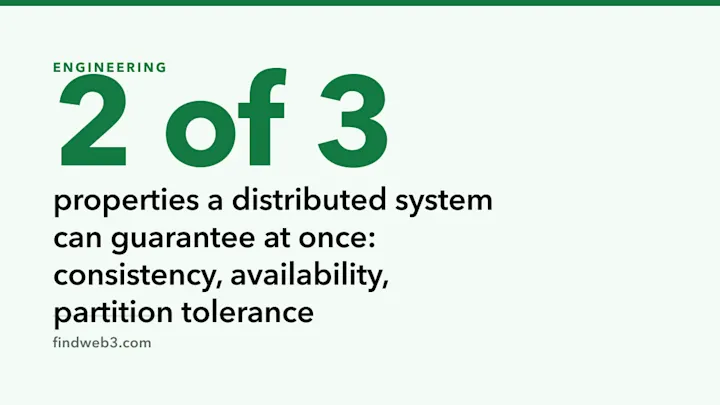
Eric Brewer put the CAP theorem forward in 2000, and Seth Gilbert and Nancy Lynch proved it formally in 2002. It says that a distributed system can guarantee only two of the following three properties at the same time:
- Consistency (C): Every read returns the most recent write, or an error. No client ever sees stale data.
- Availability (A): Every request gets a response. The data might not be the latest, but the system does not refuse.
- Partition tolerance (P): The system keeps operating when parts of it cannot reach each other, for example when the link between two data centers drops.
Networks fail in any real deployment, which makes partition tolerance non-negotiable. So the theorem comes down to one practical question: when the network splits, does the system prioritize consistency or availability?
Consistency vs. Availability
Take an airline booking system. When someone takes the last seat on a flight, the system must guarantee that nobody else can take it a moment later, which requires consistency. During a network partition it may have to stop accepting bookings altogether, sacrificing availability, rather than sell the seat twice.
A social media feed makes the opposite call. If your friend does not see your like for a few seconds, nothing is lost. The priority is that the feed keeps loading, so the system stays available and the replicas reconcile afterwards.
Choosing Your Consistency Model
Because strict consistency and high availability pull against each other, engineers work with consistency models: rules defining how strictly and how quickly updates must propagate. The right model is the one the application actually needs.
Distributed architectures fall into a few broad families — client-server, multi-tier and peer-to-peer — and each makes its own starting assumptions about where data lives.
Comparing Consistency Models in Distributed Systems
| Consistency Model | Description | Pros | Cons | Best-Fit Use Case |
|---|---|---|---|---|
| Strong Consistency | All nodes see the same data at the same time. A read is guaranteed to return the most recent write. | Data is always reliable and predictable. | Can introduce high latency; system may become unavailable during network partitions. | Financial systems, bank transactions, and inventory management. |
| Eventual Consistency | If no new updates are made, all replicas will eventually converge to the same value. | High availability and low latency. The system remains responsive. | Data can be stale for a period; complex to reason about application logic. | Social media feeds, DNS, and e-commerce product catalogs. |
| Causal Consistency | Writes that are causally related must be seen by all nodes in the same order. Unrelated writes can be seen in different orders. | A good balance between strong and eventual models. Preserves logical flow. | More complex to implement than eventual consistency. | Collaborative editing tools and comment threads where order matters. |
There is no best model, only the one that fits the problem. The choice shapes the user experience, the performance and the failure behavior of everything built on top of it.
Building Systems That Tolerate Failure
Servers crash, networks congest, disks fail. The goal is not a system that never fails but one that keeps working when parts of it do. That is fault tolerance, and it has to be designed in from the start.
An airliner is built on the same assumption: an engine may fail in flight, so there is more than one, plus backup systems, and the aircraft still reaches its destination. Distributed systems apply that logic so a single failure does not cascade into an outage.
Redundancy and Replication: The Core Strategies
Redundancy means backup components on standby, ready to take over when a primary one fails.
Replication applies to data: multiple live copies held on different machines, sometimes in different data centers. If the machine holding the primary copy goes offline, a node with an up-to-date replica takes over.
Both exist to remove single points of failure — any component critical enough that losing it stops the whole system.
Graceful Degradation
Some partial failures cannot be prevented. Under heavy load, or with components unavailable, a system can deliberately shed non-essential features to protect the core ones. During a traffic spike an e-commerce site might switch off personalized recommendations and new reviews while customers can still search and check out.
Common forms:
- Read-only mode: A social app stops accepting posts but still serves the feed.
- Reduced quality: A streaming service drops the resolution rather than stalling playback.
- Fallback data: An app serves cached, slightly stale data until the connection to the primary database is restored.
Automated Healing and Monitoring
Modern cloud environments automate the response. Monitoring watches for unresponsive servers, slow queries and failed health checks, and automated workflows act on what it finds: rerouting traffic away from a faulty machine, restarting a crashed process, or replacing a failing instance with a new one. Common failures are handled in seconds, often before anyone is paged.
How Different System Components Communicate
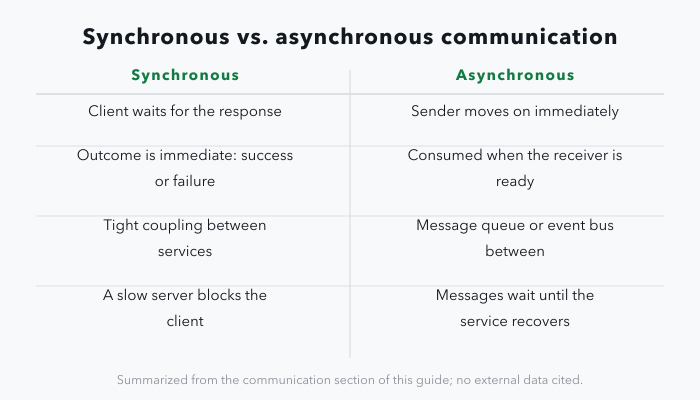
For a distributed system to work, its nodes have to talk to each other. How they do it shapes the system's responsiveness, resilience and complexity. The two models are synchronous and asynchronous.
A phone call is synchronous: you wait, connected, until it ends. A text message is asynchronous: you send it and get on with something else, trusting it to be delivered and read later.
Synchronous Communication: The Direct Approach
In a synchronous model, the client sends a request and waits for the response. It is direct, and the outcome is immediate: the request either succeeded or failed. A browser requesting a web page works this way.
The cost is tight coupling. If the server is slow or down, the client is stuck waiting. With hundreds of clients waiting on one slow service, the delay propagates outward into system-wide bottlenecks.
Asynchronous Communication: Building for Resilience
Asynchronous systems put an intermediary between services, usually a message queue or an event bus. One service publishes a message, or event, and other services consume it when they are ready.
The sender does not need to know which service receives the message, or whether it is online at that moment. If a receiving service crashes, messages wait in the queue until it recovers.
An Example From a Food Delivery App
Tapping "Place Order" starts a chain of independent steps.
- Order placement: The app publishes an
OrderPlacedevent to a queue and confirms the order on screen immediately, without waiting for the rest. - Payment processing: A separate payment service consumes
OrderPlaced, charges the card, and publishesPaymentSuccessful. - Restaurant notification: The restaurant's system consumes
PaymentSuccessfuland prints the order. - Driver dispatch: A dispatch service consumes the same event and starts looking for a nearby driver.
Each step is independent. A slow dispatch service does not hold up the payment or stop the kitchen receiving the order.
Where You See Distributed Systems Every Day
Streaming a film, searching for a restaurant, saving a file to the cloud: each one runs on a distributed system.
Powering the Cloud and Beyond
Cloud platforms such as Amazon Web Services and Google Cloud are themselves distributed systems on an enormous scale. Deploying an application to one of them means spreading it across machines in data centers worldwide.
A content delivery network is the clearest illustration of distribution for speed. Without one, a user in Tokyo loading a site hosted in New York pulls every image and script across the Pacific. A CDN caches that content on servers near Tokyo instead, and the round trip gets much shorter.
The Distributed Cloud and Edge Computing
Edge computing pushes processing further out still, to where the data is produced: IoT sensors, cameras, industrial equipment, vehicles. Instead of sending everything back to a central region and waiting for an answer, the work happens locally. That matters wherever the round trip to a data center is too slow to be useful.
The same principles underpin Web3. A public blockchain is a distributed system whose design goal is decentralization: no single operator, and participants who do not have to trust each other. Permissioned ledgers such as Hyperledger Fabric make a different bet, restricting membership to known participants. DeFi protocols, NFT marketplaces and DAOs all depend on networks of independent nodes running the same rules.
For the size and shape of the sector, see the Web3 statistics.
Frequently Asked Questions
What's The Main Difference Between Distributed Systems and Microservices?
They sit at different levels. A distributed system is the general category: any system where multiple independent computers work together and appear as one to the user. That could be a cloud platform, a peer-to-peer network or a replicated database.
Microservices are an architectural style: splitting one large application into small, independently deployable services that each do one thing and communicate over a network.
So a microservices architecture is one way to build a distributed system, not a separate thing.
Is Blockchain a Type of Distributed System?
Yes. A blockchain is a distributed ledger — a database replicated across many computers, kept in agreement by a consensus mechanism rather than by a central operator.
What distinguishes it from a conventional distributed database is governance and cryptography. A distributed database is normally run by one organization; a public blockchain is maintained collectively by its participants, and the cryptographic chaining of blocks is what makes past records difficult to alter.
All blockchains are distributed systems. Most distributed systems are not blockchains.
Why Is System Complexity Considered a Major Challenge?
Going from one machine to a network of them multiplies the number of things that can go wrong. Beyond ordinary bugs, there is network latency, partial failure where a node is neither clearly up nor clearly down, messages arriving out of order, and keeping data consistent across replicas.
A bug may only appear under a particular timing of events across three machines, which makes it hard to reproduce and harder to fix. That is why these systems demand careful design, thorough monitoring and tracing, and the assumption that anything can fail at any moment.
What Does It Mean for a System to Lack a Global Clock?
On a single machine, one clock orders everything that happens. In a distributed system every machine has its own clock, and they cannot be kept perfectly in sync.
There is therefore no universal source of truth for time. If two events happen on two different nodes, you cannot always determine which came first from timestamps alone. This is why engineers use logical clocks and vector clocks, which order events by causality — which event could have influenced which — instead of by wall-clock time.
Find Web3 lists engineering roles at companies building this kind of infrastructure. Browse Web3 jobs, or see what the listings pay on the salaries page.