Web3 Marketing Strategy: Channels, Rules and Costs
Which channels crypto projects can actually use, what the ad platforms and regulators allow, how to measure growth that lasts, and what marketing hires cost.
Web3 marketing is the work of getting people to use a product that runs on a blockchain. Most of it is ordinary marketing. What is specific to crypto is a narrow set of constraints: the large ad platforms refuse most of what a token project wants to advertise, the audience sits in a handful of chat and social apps, financial promotion rules bite in several major markets, and the default growth tactic of the last three years — paying users in tokens — has a legal shape that changed in 2026.
This page covers those constraints and what teams do inside them. Every figure below names its publisher and the date the data is from.
What no longer holds
Guides written in 2023 rest on assumptions that have since stopped being true.
- X is a much smaller ad business than Twitter was. SpaceX's second-quarter 2026 earnings put X's advertising revenue at $367 million for April to June 2026, against $1.08 billion for Twitter in the second quarter of 2022, the last quarter Twitter reported as a public company (Engadget, August 4, 2026).
- Ethereum stopped mining on September 15, 2022. Anything resting on proof-of-work energy arguments or miner incentives on Ethereum is out of date.
- Farcaster "Frames" are called Mini Apps. Frames v2 was rebranded in early 2025 and supported only to the end of March 2025 (Farcaster docs).
- Farcaster changed hands. Neynar acquired the protocol's contracts, code repositories and mobile app in a deal announced January 21, 2026, after a $150 million raise in 2024. Cofounder Dan Romero said that after five years Farcaster needed a new approach (CoinDesk, January 21, 2026).
- EigenLayer is EigenCloud. eigenlayer.xyz now redirects to eigencloud.xyz (checked September 23, 2026).
- Discord is mid-rebuild. Discord announced teen-safe defaults for every account worldwide on February 9, 2026, delayed the age assurance behind them in a February 24 update, and began placing every account into an age group on September 22, 2026 (Discord, September 22, 2026). It says over 90% of users will have their age determined automatically, and that it does not use age assurance data to target advertising (Discord, February 9, 2026).
Where the audience is
Four places are worth planning around, and they do different jobs.
X is where crypto argues in public and where launches get noticed. Treat it as an earned channel first. The paid product exists, and exchange and wallet ads run in a growing list of markets, but the revenue above shows the surrounding auction is thin next to 2022.
Telegram is where trading and token communities sit, and where bots and Mini Apps let a project put a working interface inside a chat. Telegram sells sponsored messages through its own ads console. Minimum spend, eligible countries and formats have changed repeatedly, so price a campaign from the console rather than from a number in a blog post.
Discord is where product communities sit, especially anything with a game, an NFT collection or a developer program attached. Its rewarded-ad format, Quests, ran about 70 campaigns in its first year at a 10% average acceptance rate, and Discord's Peter Sellis said more than half of those partners came back for a second campaign (MediaPost, April 2, 2025). Plan around the safety rebuild above: anything routed through an age-restricted server or channel will sit behind age assurance once that rollout lands.
Farcaster and other onchain social are small, technical and useful for reaching builders rather than volume. Distribution runs through Mini Apps, web apps that open inside a Farcaster client and can transact. The change of ownership is a reason to test the channel rather than to build a company's distribution on it.
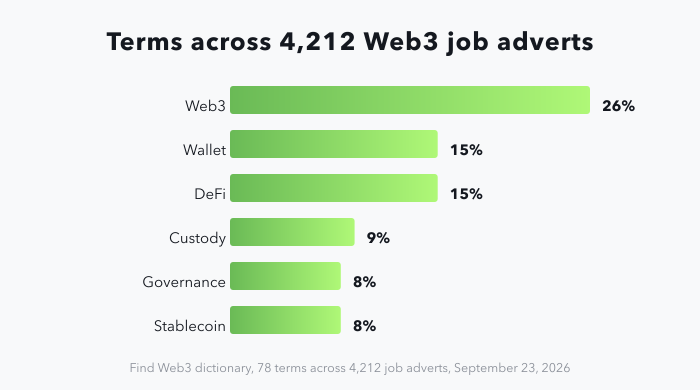
Choosing between them is easier with a sense of which parts of the industry are actually spending. The Web3 dictionary counts how often each of 78 terms appears across 4,212 job adverts on this board: "Web3" in 26%, "wallet" and "DeFi" in 15% each, "custody" in 9%, "governance" and "stablecoin" in 8% each (Find Web3, September 23, 2026). That is what employers are staffing for, and hiring is a better guide to where budget sits than any forecast of the market's size.
What the ad platforms will actually run
This is the constraint most plans discover late. Google's Cryptocurrencies and related products policy, read September 23, 2026, sorts crypto advertising into three buckets.
| Google Ads treatment | Covers |
|---|---|
| Allowed, no certification | Accepting crypto as payment, mining hardware, blockchain tax, legal and security services, educational material without investment advice, blockchain games with NFT items |
| Allowed with Google certification | Crypto exchanges, software wallets, hardware wallets, and crypto coin trusts (US only) |
| Prohibited | ICO pre-sales and public token offerings, initial DEX offerings, DeFi trading protocols, crypto loans, token liquidity pools, unhosted software wallets, unregulated dApps, trading signals and investment advice, sites that aggregate or compare crypto issuers, NFT wagering and social casino games paying NFT rewards |
Source: Google Ads policy, checked September 23, 2026.
A line runs through the middle of that table. A custodial software wallet can advertise once certified; an unhosted one cannot advertise at all. The same product sits on either side depending on who holds the keys, which is worth settling before a launch budget is written.
Certification is jurisdictional as well as categorical. Advertisers targeting the EU must hold a Crypto-Asset Service Provider authorization under MiCA from a national competent authority, and Google extended that requirement to Iceland, Liechtenstein and Norway in an update posted July 22, 2026 and effective that August (Google Ads). Certification cannot be bought, rented or transferred, which is worth knowing before an agency offers an "aged certified account."
So paid search and display are open to licensed exchanges and wallets and closed to almost everyone else. A token sale, a DeFi protocol or a self-custody wallet reaches people through content, community, integrations and crypto-native ad networks instead, and uses paid channels later to retarget an audience it already has.
Points programs and airdrops
Paying users in tokens, directly or through points that convert to tokens later, was one of the most widely copied growth tactics between 2023 and 2025. EigenLayer's restaking points, Blast's ecosystem points and Ethena's shards are the pattern: use the product, accrue points, receive an allocation at a date the team does not commit to.
Two things are worth being precise about.
The legal position got clearer in 2026, in one narrow respect. The SEC and CFTC issued a joint interpretation on March 17, 2026 covering airdrops, protocol mining, protocol staking and wrapping (SEC, March 17, 2026). Where an issuer distributes a non-security crypto asset for no or nominal consideration, there is no "investment of money" under the Howey test, so the distribution is not a securities offering. The interpretation does not reach arrangements where the recipient performs tasks, makes purchases or otherwise provides value in exchange. That carve-out is the whole question for a points program that requires deposits, referrals or promotional posting, and it is a question for counsel, not for a marketing plan. The SEC separately proposed a tailored offering framework for tokens, Regulation Crypto Assets, on August 18, 2026, with comments closing October 20, 2026. It is a proposal, not a rule.
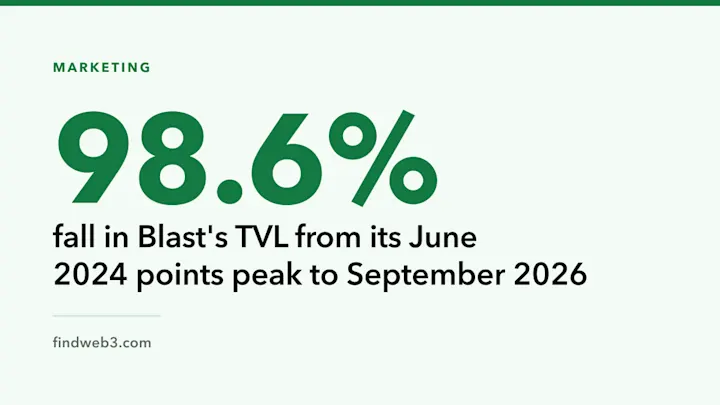
The retention problem is unsolved. Blast is the clearest record of it. Its total value locked peaked at $2.26 billion on June 6, 2024, during the points-and-airdrop period, and stood at $32 million on September 23, 2026, a fall of 98.6% (DeFiLlama chain TVL series, retrieved September 23, 2026). The chain still runs. The deposits were rented, not bought.
Incentives reliably buy activity and unreliably buy users. Any program paying for on-chain actions should be measured by what the cohort does after the reward stops, not by the size of the cohort. The same applies to quest platforms — Galxe, Zealy and Layer3 were all still operating when checked on September 23, 2026 — which are efficient at generating completions and poor at telling a person from a script. Budget for filtering, and decide before launch which on-chain action counts as real usage.
Disclosure rules to design around
Influencer and KOL marketing is still the highest-volume tactic in crypto and now carries the clearest rules.
- United States. The FTC's Endorsement Guides require a clear and conspicuous disclosure of any material connection between an endorser and a brand. The FTC treats "#ambassador," "partner" and "#endorsement" as ambiguous and inadequate, and points instead to plain wording such as "This is an ad for BRAND." Separately, the SEC charged Kim Kardashian on October 3, 2022 with unlawfully touting a crypto asset security after she failed to disclose a $250,000 payment for an Instagram post about EMAX; she settled for $1.26 million and agreed not to promote crypto asset securities for three years (SEC, October 3, 2022). The anti-touting provision applies to the promoter, not only the issuer.
- X. X launched a Paid Partnership label on March 1, 2026, applied by the creator from the composer or added afterwards through a post's menu. Crypto and financial promotions are permitted as tagged sponsored content, but financial and gambling promotions remain restricted in the UK, Europe and Australia (Social Media Today, March 2, 2026). Read X's own ads and creator policies before signing a KOL contract in any of those markets.
- European Union. MiCA (Regulation (EU) 2023/1114) has applied in full since December 2024 (ESMA). Article 7 requires marketing communications to be clearly identifiable as marketing, fair, clear and not misleading, consistent with the white paper, and not distributed before the white paper is notified and published. National regulators such as BaFin, the AMF and the AFM supervise this.
- United Kingdom. Cryptoasset firms marketing to UK consumers have had to comply with the financial promotions regime since October 8, 2023, including overseas firms, and covering websites, apps, social posts and online advertising. Promotions must be clear, fair and not misleading, carry the prescribed risk warning, and apply frictions including a 24-hour cooling-off period for new customers. Breach is a criminal offence under section 21 of FSMA. The FCA published its wider crypto rules on June 30, 2026; those take effect on October 25, 2027, with the authorization gateway open from September 30, 2026 to February 28, 2027 (FCA, June 30, 2026).
None of this is legal advice. The point for a marketing plan is that geo-gating, approval workflows and a written disclosure standard for every paid creator are setup costs, not optional polish.
What to measure
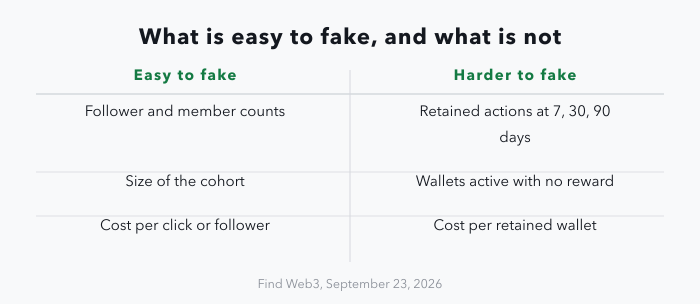
Follower counts and Discord member counts are easy to buy and easy to fake, which is why they are the numbers agencies report. Four measures are harder to fake.
- Retained on-chain actions by cohort. Group users by how they arrived, then count the action that means value to the business — a swap, a deposit, a mint, a second session — at 7, 30 and 90 days. This is what tells you whether a campaign bought users or bought activity.
- Wallets that come back without a reward. The share of a cohort still active in a week with no campaign running.
- Share of engagement from accounts under 30 days old. A cheap proxy for bot inflation on any social or quest campaign.
- Cost per retained wallet, not cost per click or per follower.
On tooling: Dune is still the common way to build this reporting, but its free plan changed. From September 10, 2026, accounts created before July 21, 2026 lose the ability to run queries and become view-only unless they upgrade; Dune attributed the change to the cost of running flexible queries over large blockchain datasets (Crypto Briefing, August 27, 2026). Any team that treated free dashboards as a permanent line item should recheck that assumption.
What this costs to staff
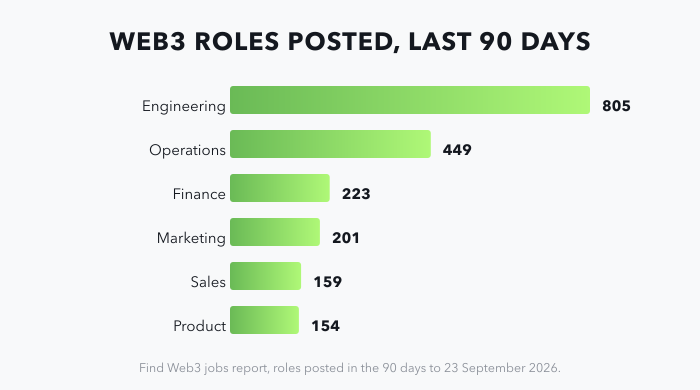
Marketing is the fourth-largest hiring category on this board: 201 roles posted in the last 90 days, behind engineering (805), operations (449) and finance (223), with a median of $152,440 across the 137 of those that stated pay (Web3 jobs report, Find Web3, September 23, 2026).
Looking at marketing listings over a full year gives a fuller picture:
| Measure | Figure | Listings |
|---|---|---|
| Median | $165,000 | 97 |
| Middle range (25th–75th) | $128,450–$195,000 | 97 |
| Mid-level median | $135,500 | 46 |
| Senior median | $186,000 | 51 |
| San Francisco median | $190,000 | 10 |
| New York median | $160,000 | 30 |
Source: crypto marketing salary, from Find Web3 listings that state pay, posted in the last 12 months, recounted daily. Updated September 23, 2026.
The spread is wide because the title is wide: the same words cover paid acquisition at an exchange and writing threads for a protocol. In the listings, roles owning a budget or a reported number are written with higher bands than roles producing content to a brief. See all Web3 salaries for how marketing compares with engineering and product, and companies hiring for who is staffing which functions.
A 90-day plan
For a team starting from nothing, in order:
- Decide which bucket the product falls into on the Google table above, and confirm the same for every other paid channel in scope. This determines whether paid acquisition exists at all.
- Write the disclosure standard before the first paid creator, covering the US, EU and UK if any of those are targets. Geo-gate what cannot be compliant.
- Pick one channel, not four. Telegram for trading products, Discord for products with a game or a developer program, X for anything that needs to be argued about in public.
- Define the one on-chain action that counts as a real user, and instrument it before spending anything.
- Run incentives last, not first. A points program launched before the product retains anyone measures nothing except how many scripts can read a rules page.
- Report cost per retained wallet at 30 days from week four onward, and stop anything that has no answer by week twelve.
Hiring for this? See open Web3 marketing jobs on Find Web3.
Claims removed from this page
This article was rebuilt in September 2026. The following were deleted because they could not be sourced or were no longer true.
- A $4.43 billion 2024 Web3 market size, a $6.15 billion 2025 forecast and a 38.9% CAGR, sourced to a market-research vendor selling the report.
- A projection that Web3 marketing would be a "$100 billion industry by 2030," attributed to a marketing agency's statistics page.
- "82% of Fortune 500 companies were planning to explore Web3 in 2023" and "65% of Web3 users are male," both from the same agency page with no methodology.
- A $200 million ASEAN blockchain fund launched in 2024, sourced to an innovation-consultancy blog.
- An infographic described as showing "Web3 marketing adoption, tactics and ROI compared to Web2," including a claim of higher average ROI in Web3 campaigns. The image was AI-generated and measured nothing.
- A CoinMarketCap screenshot described as evidence of market dynamics, used twice — and pointing at the same image file as the infographic above.
- Screenshots described as a Dune dashboard, a DeFiLlama chart, a Discord server and a Google Analytics view, none of which were real product interfaces.
- An embedded YouTube video from an analytics vendor, dropped into a section on vanity metrics with no relation to it.
- A "Community Engagement Tactics Performance Analysis" table rating six tactics by response rate, retention and cost effectiveness. No data existed behind any cell.
- Claims of first-hand experience: talking to marketers who "crushed it in Web3," to community managers who scaled projects to millions in TVL, and to teams whose liquidity mining users vanished.
- A link to kooky.domains, which now redirects to an unrelated payments site, and a link to a digital marketing directory that had no bearing on the topic.
- A comparison table describing Discord and Telegram as "decentralized platforms." Both are centralized companies.
- Roughly 2,500 words of padding: restatements of "community is king," a multi-chain section that said only that different chains have different cultures, and a closing pitch.