Blockchain Development Tools 2026: What Is Still Maintained
Foundry, Hardhat 3, Remix, viem and the rest, checked against their own sources in September 2026, plus four tools older guides recommend that are now retired.
A list of tools is only as good as the day it was checked, and blockchain tooling turns over fast enough that the difference shows. So this page is dated: every tool below was checked against its own website, repository or package registry on 23 September 2026. Four tools that this page used to recommend are no longer live products under those names.
The tools that are gone
Anything written about blockchain development before 2024 will send you to at least one of these.
| Tool | Status | Use instead |
|---|---|---|
| Truffle | Archived. Consensys announced the sunset on 21 September 2023 and gave 90 days' notice; the codebase became a public archive on 20 December 2023. trufflesuite.com now redirects to archive.trufflesuite.com. |
Foundry or Hardhat |
| Ganache | Archived alongside Truffle, on the same dates. | Anvil, which ships with Foundry, or the Hardhat network |
| web3.js | Sunset 4 March 2025; the repository was archived the following day. ChainSafe announced the sunset on 15 January 2025, and said the final phase would transfer npm access to the Ethereum Foundation. | viem or ethers.js |
| Substrate | Not dead, but no longer a product under that name: its code was folded into the Polkadot SDK, and substrate.io redirects to polkadot.com. |
Polkadot SDK |
How completely Truffle went is measurable. In the Solidity Developer Survey 2025, run by the Solidity team in February and March 2026 with 1,095 usable responses from 87 countries, Truffle was the primary framework of exactly one respondent — down from 2.4% in the 2024 survey.
What developers report using
The Solidity team runs the one large survey that asks developers directly, so it is the source for every share in this section. Figures are from the 2025 edition, fielded February–March 2026.
| Question | Answer | Base |
|---|---|---|
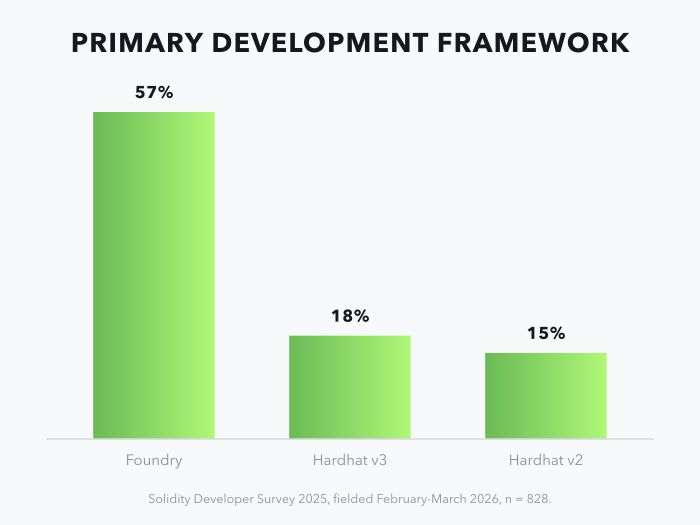
| Primary development framework | Foundry 57%, Hardhat v3 18%, Hardhat v2 15% | n = 828 |
| Secondary framework | Remix 41% | n = 871, multiple choice |
| SDKs and libraries | ethers.js 70%, viem 39%, wagmi 33%, web3.py 16%, alloy 6% | n = 871, multiple choice |
| Solidity version in use | v0.8.x 86% | n = 871, multiple choice |
| Chains deployed to | Ethereum mainnet 52%, Base 40%, Arbitrum 35%, Polygon 30% | n = 871, multiple choice |
| Other contract languages used | none 43%, Rust 28% | n = 871, multiple choice |
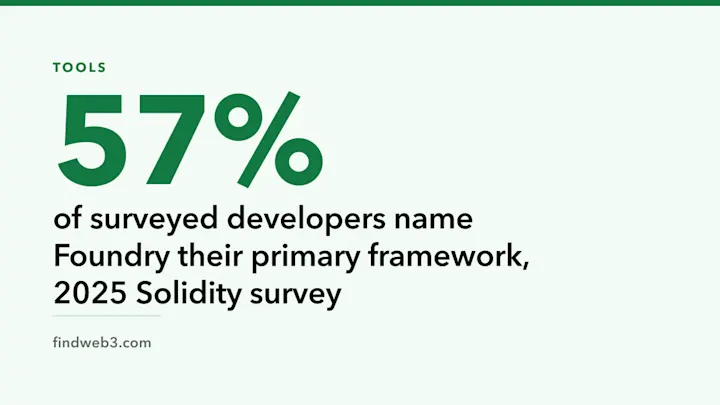
Foundry rose from 51% in the 2024 survey to 57% in 2025. Read the shares with the sample in mind: 70% of respondents describe themselves as smart contract developers, and teams working on permissioned or non-EVM chains are barely represented.
Writing the contract
Solidity
Still the default language for the EVM and the chains that copy its design. The latest release is 0.8.37, published 10 September 2026 (soliditylang.org). The 0.8 series has held since December 2020, which is why 86% of surveyed developers are on it.
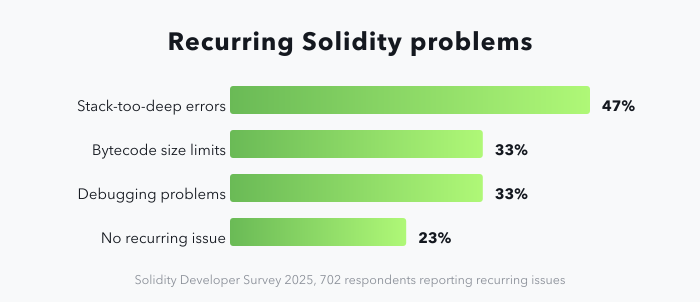
The survey is also the clearest available picture of where Solidity hurts. Among 702 respondents reporting recurring issues, stack-too-deep errors led at 47%, followed by bytecode size limits and debugging problems at 33% each; 23% reported no recurring issue.
Vyper
A Python-flavored alternative for the EVM, designed to be smaller and easier to audit than Solidity by leaving features out. Actively maintained, with Curve, the Ethereum Foundation and Optimism among its listed sponsors (vyperlang.org). It is a minority choice: the Solidity survey found 43% of respondents use no second contract language at all.
Rust, for Solana and beyond
Rust is the most-selected alternative language in the survey at 28%, which reflects Solana, NEAR and Arbitrum Stylus rather than EVM work. On Solana the standard framework is Anchor, whose latest release is v1.2.0 (4 September 2026). Check the repository before following a tutorial: Anchor has moved twice, from coral-xyz to the Solana Foundation and now to otter-sec/anchor, and its 1.0 release (2 April 2026) renamed the TypeScript package from @coral-xyz/anchor to @anchor-lang/core and changed the default local validator.
Building, testing and deploying
Foundry
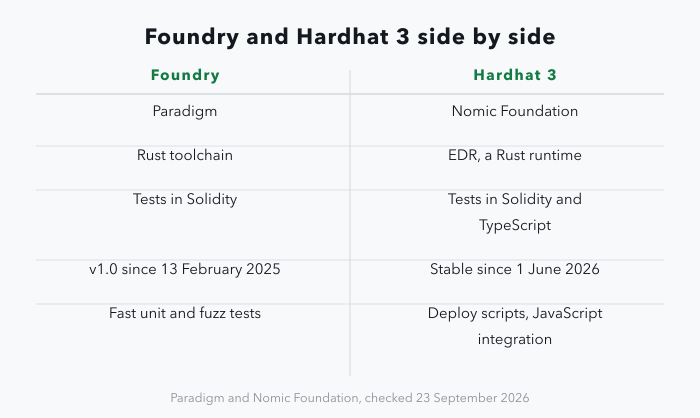
A Rust toolchain from Paradigm, at v1.0 since 13 February 2025. Four commands: forge builds and tests, cast talks to a chain from the shell, anvil runs a local node, chisel is a Solidity REPL. Its defining choice is that tests are written in Solidity rather than JavaScript, so there is no second language between you and the contract — an approach Hardhat has since adopted too — and its fuzzing and invariant testing are why security-focused teams use it. Documentation at getfoundry.sh.
Hardhat 3
Hardhat 3 became stable on 1 June 2026, after shipping as a beta in August 2025 (Nomic Foundation). It is a substantial rewrite rather than a version bump: Solidity tests alongside the TypeScript ones, multichain support, a Rust execution runtime called EDR, and Hardhat Ignition for deployments. The current npm release is 3.17.0, published 17 September 2026 (hardhat.org). Hardhat 2 is on an end-of-life path — Nomic has said it will support the Glamsterdam hardfork but not the one after it — so a project still on v2 has a migration to plan.
Choosing between the two is less binary than the framework percentages suggest. Running both in one repository is common, with Foundry for fast unit and fuzz tests and Hardhat for deployment scripts and JavaScript integration.
Remix
The browser IDE at remix.ethereum.org, with nothing to install. It is the most used second-choice tool in the survey at 41%, which describes its actual role: a scratchpad for a quick contract, a place to poke at a deployed one, the thing you put in front of someone learning. The project site has moved to remix.live, a desktop build and an AI assistant now sit alongside the web IDE, and some of the newer features are on paid plans. The browser IDE itself is still free.
Contract libraries
OpenZeppelin Contracts
The standard implementations — ERC-20, ERC-721, ERC-1155, access control, upgradeable proxies — reviewed and audited far more heavily than anything a single team would write (docs). The current audited release on npm is 5.6.1, published 27 February 2026. OpenZeppelin publishes under three npm tags, and the distinction matters: latest is audited, dev is feature-complete but unaudited, next is a release candidate. Installing from the master branch through Foundry's forge install is a documented mistake, because, in the project's own words, the release process involves security measures that master does not guarantee.
Using an audited library is not the same as having an audited system. The composition is yours, and so is the risk in it.
Connecting an app to the chain
ethers.js
Still the most used library in the survey at 70%, currently at 6.17.0 on npm, published 18 June 2026. Complete, well documented, and the thing most existing code and most tutorials assume. Site at ethers.org.
viem and wagmi
viem is the TypeScript-first alternative, on 39% and rising, with wagmi on 33% layering React hooks on top of it. viem releases constantly — 2.56.8 was published on 18 September 2026, five days before this page was checked. If you are starting a React front end now, this is the pair most new projects reach for; if you are maintaining something, ethers is not a problem to be fixed.
RPC providers
Reading and writing to a chain means talking to a node, and most teams rent one rather than run one. Alchemy, Infura and QuickNode are the common choices. Infura is a Consensys product and is increasingly presented as part of MetaMask's developer tooling, so the name on the documentation may not match the name in an older tutorial.
Getting data in and out
Chainlink
Contracts cannot see anything outside their own chain, which is what an oracle is for. Chainlink is the largest such network, and its product set has grown well past price feeds: Data Feeds and Data Streams for market data, VRF for verifiable randomness, Automation for triggering contract calls on a schedule or condition, CCIP for cross-chain messaging, and Functions for calling an ordinary API. If you read an older guide referring to Chainlink Keepers, that product is now called Automation.
The Graph
For reading history back out of a chain, The Graph indexes events into a queryable API. The workflow in older tutorials no longer exists: there is no hosted service. You develop against Subgraph Studio, which the documentation describes as free, rate-limited and not visible to the public, then publish the subgraph to the decentralized Graph Network for production.
Checking the code before it ships
This category exists because a deployed mistake cannot be quietly patched.
- Slither, from Trail of Bits, is the standard static analyzer for Solidity and Vyper, and works with both Hardhat and Foundry projects. Trail of Bits shipped an MCP server for it on 15 November 2025, which lets an AI assistant query the analysis rather than guess at it.
- Fuzzing and invariant testing are built into Foundry and now into Hardhat 3's Solidity tests. This is the highest-value testing available for contracts, and it is free.
- The SMTChecker ships inside the Solidity compiler and formally checks assertions. It is almost unknown: in the 2025 survey, 45% of 854 respondents did not know what it was and only 7% use it often.
- Verification — publishing source that matches deployed bytecode — runs through Etherscan for most chains, with Sourcify as the open alternative. Among the 142 survey respondents who answered on verification pain points, 15% said verification is flaky or unreliable and 11% named Etherscan specifically, though the most common answer, at 18%, was no issues at all; of 851 respondents, 48% did not know Sourcify existed.
No tool on this list substitutes for an audit of anything holding real money.
Permissioned and non-EVM platforms
Hyperledger Fabric
The enterprise permissioned framework, where membership is controlled and privacy is the point. Chaincode is written in Go, Java or Node.js. Two governance facts date most older writing about it: Hyperledger became part of LF Decentralized Trust in September 2024, and Fabric 3.0 shipped on 16 September 2024, adding a Byzantine fault tolerant consensus option. The current release is 3.1.5 (18 June 2026), with the 2.5 line still receiving fixes in parallel — 2.5.16 shipped the day before — so check which version a set of docs or a tutorial is written against. Project home at LF Decentralized Trust.
Corda
R3's permissioned platform for regulated finance, with CorDapps written in Java or Kotlin. corda.net now redirects to R3's own site. R3 documents three lines side by side — Corda Open Source 4.14, Corda Enterprise 4.14 and Corda 5.2 — and the 4.x and 5.x lines are not the same product, so check which one a guide is describing before you follow it.
Polkadot SDK
The Rust framework for building an entire chain rather than deploying a contract onto one, formerly called Substrate and merged with the Polkadot and Cumulus repositories into paritytech/polkadot-sdk, with the documentation now at docs.polkadot.com. The learning curve is Rust plus the fact that you become responsible for consensus, governance and economics as well as application logic.
What these skills are worth
Find Web3 tracks pay from the job listings that state it, so these are advertised figures rather than survey responses. Checked 23 September 2026, and they move as listings arrive:
- Web3 developer: median $200,000, from 278 listings
- Blockchain developer: median $170,000, from 21 listings
- Blockchain security engineer: median $204,000, from 21 listings
Blockchain security engineers are advertised above the developers whose code they check, though on 21 listings each those two medians will move with a handful of new adverts.
Which tools employers name is a separate question from which tools developers use, and the answer is that they mostly do not name them. Across the 4,212 job adverts counted for the Web3 dictionary on 23 September 2026, "smart contract" appears in 246, "EVM" in 140, "Layer 2" in 130 and "rollup" in 61.
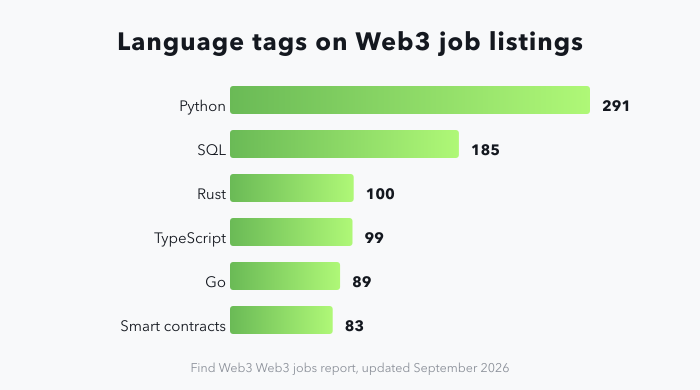
The tags attached to those listings point the same way. In the Web3 jobs report, updated September 2026, the most common tags naming a language or platform are Python (291 listings), SQL (185), Rust (100), TypeScript (99) and Go (89), with smart contracts on 83. A crypto company hiring engineers is mostly hiring ordinary backend, data and infrastructure engineers, and the contract specialists are the smaller part of it. That is a reason to keep general engineering skills sharp and to treat Foundry versus Hardhat as the small decision it is.
The same report counts 2,172 roles posted in the last 30 days across 280 hiring companies. Engineering is the largest category over the last 90 days at 805 roles, with a median of $200,000 across the 313 engineering listings that state pay. Blockchain jobs and the companies hiring are listed as they arrive.
How this page is maintained
This page was rebuilt in September 2026 and every tool on it was checked against a primary source, because the previous version recommended three archived tools as current. Removed in the rewrite: Truffle, Ganache and web3.js as live recommendations; a first-person account of building with tools the site has not built with; illustrative images of product interfaces that were generated rather than captured; and three outbound links to commercial pages unrelated to the subject.