Blockchain Project Management: Teams, Risk and Compliance
How decentralized projects change governance, team structure and technology choices, plus token volatility, regulators and energy impact.
Blockchain Project Fundamentals
Blockchain project management differs from conventional software delivery in a small number of specific ways, and most of them follow from decentralization: who decides, who can see the work, and what "finished" means when part of the system runs on a network no single party owns. The established methods still apply — Agile planning, a backlog, a sprint cadence — but governance and stakeholder work need adapting.
Understanding the Blockchain Project Landscape
The first hurdle is usually the distance between the technical design and the business case. The people approving the budget often cannot say what a smart contract does, why a ledger entry is final, or why a migration cannot simply be rolled back. That gap produces unrealistic expectations and late surprises. Time spent early translating the architecture into business terms is rarely wasted.
The table below sets out where the two approaches diverge.
| Challenge Category | Blockchain Project Management | Traditional Project Management |
|---|---|---|
| Governance | Decentralized decision-making, requiring new governance models | Centralized authority, potentially slower decision-making |
| Stakeholder Management | Distributed stakeholders with varying levels of technical understanding | Clearly defined roles and responsibilities |
| Implementation Complexity | Integrating new technologies and managing scarce technical expertise | Established processes and readily available resources |
| Security | Smart contract vulnerabilities and data integrity concerns | Traditional security measures and data protection protocols |
| Regulation | Evolving regulatory landscape and legal uncertainties | Established regulatory frameworks |
| Interoperability | Integrating with existing systems and other blockchains | Compatibility within existing infrastructure |
Core Principles of Blockchain Project Management
- Decentralized governance. Decision rights are often spread across parties that do not share a management chain. Write down who can approve a protocol change, a treasury spend, or a contract upgrade before the first one is needed.
- Iterative development. Requirements move as the underlying platforms move. Plan in short increments and expect to revisit decisions made in the first month.
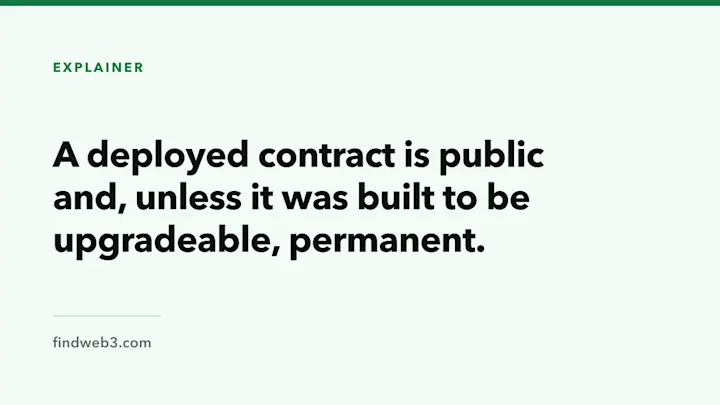
- Security first. A deployed contract is public and, unless it was built to be upgradeable, permanent. Audits, test coverage, and a deployment checklist belong in the plan from the start, not in a hardening phase at the end.
- Interoperability. Few projects stay on one chain and one stack for their whole life. Assume data and assets will need to move, and choose designs that do not make that a rewrite.
Scaling Blockchain Projects
Resource Allocation and Market Volatility
Budgets are harder to hold still than on a conventional project. If a team is paid partly in tokens, holds a treasury in one, or pays network fees to run its own infrastructure, costs move with the market rather than with the plan. Contingency in the budget and a willingness to re-plan mid-quarter are worth more here than a precise annual forecast.
Technology Selection and Avoiding Lock-In
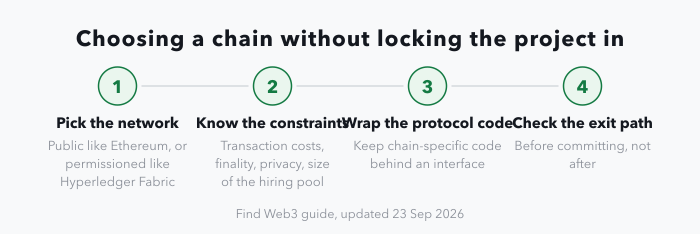
Choosing a platform — a public network such as Ethereum, or a permissioned one such as Hyperledger Fabric — sets the constraints on everything that follows: transaction costs, finality, privacy, and the size of the hiring pool. Keep protocol-specific code behind an interface so that a change of chain is a contained piece of work rather than a new project, and check the exit path before committing, not after.
Building Sustainable Blockchain Implementations
Energy use is now a standing question for anything built on a public chain, and the answer is decided mostly by the consensus mechanism, which is chosen at the start.
Choosing a Consensus Mechanism
Proof of work, used by Bitcoin, secures the chain by making block production computationally expensive; the electricity is the security. Proof of stake replaces the race with staked capital at risk, which removes the mining workload. Ethereum moved from proof of work to proof of stake in September 2022, so ether is no longer mined. Permissioned chains typically use a mechanism with no open competition at all. The Cambridge Bitcoin Electricity Consumption Index is the standard public estimate of what proof of work costs in electricity terms.
| Consensus Mechanism | How a Block Is Validated | Relative Energy Use |
|---|---|---|
| Proof of work (PoW) | Miners race to solve a hashing puzzle; the winner proposes the block | High — the puzzle consumes electricity by design |
| Proof of stake (PoS) | Validators are selected to propose and attest, with staked funds at risk | Low — no hashing race |
| Delegated proof of stake (DPoS) | Token holders elect a small set of validators to produce blocks | Low |
| Proof of authority (PoA) | A known, permissioned set of validators signs blocks in turn | Low |
Measuring Environmental Impact
Picking the mechanism is the large decision; the rest is measurement. If sustainability is a project objective, it needs a definition and a number attached to it — energy drawn by the nodes the project actually runs, compared against the system being replaced — tracked like any other key performance indicator. A target stated as a percentage reduction against a named baseline can be checked. A commitment to being "green" cannot.
Managing Stakeholders Through Blockchain Complexity
Establishing Realistic Timelines
Estimates are less reliable when the platform underneath is still changing. Integrating a permissioned network, getting a contract audited, or waiting on a third party's upgrade can all take longer than the plan allowed, and the honest response is to say so as soon as it is visible rather than at the review.
The related failure is overpromising at the outset. Blockchain is a fit for a narrow set of problems — shared records between parties that do not trust each other, assets that need to move without an intermediary — and stating plainly where it does not help protects the project later.
Translating Complex Concepts into Business Value
Technical teams and business stakeholders use different vocabulary for the same system. Describing a supply chain project in terms of disputed shipments resolved, or reconciliation work removed, lands better than describing cryptographic hashing. The translation is part of the project manager's job, not an optional extra.
Maintaining Engagement During Long Development Cycles
Long builds lose their audience. Regular written updates, a working prototype people can click, and a short introductory session on how the system works keep stakeholders able to contribute rather than just approve. Stakeholders who understand the mechanism ask better questions and accept setbacks more readily.
Regulatory Compliance in Blockchain Projects
Rules differ by jurisdiction and change during the life of a project, so compliance has to be planned rather than discovered.
Building Compliance Checkpoints into Project Planning
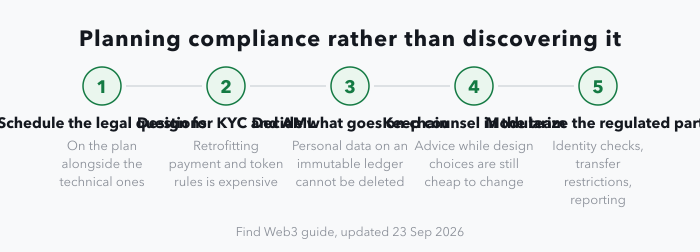
Put the legal questions on the schedule alongside the technical ones. Know Your Customer and Anti-Money Laundering obligations shape the design of anything that touches payments or token issuance, and retrofitting them after a system is built is expensive. Data protection is the same problem in a sharper form: personal data written to an immutable ledger cannot be deleted later, so the decision about what goes on-chain is a compliance decision as much as an architectural one.
Incorporating Legal Expertise into Development Teams
Counsel involved continuously, rather than consulted at the end, lets developers understand the consequences of design choices while those choices are still cheap to change. Token issuance, custody, and the enforceability of a smart contract are all areas where the technical answer and the legal answer differ.
Governance and Modular Architecture
A governance framework that names who decides what — and how quickly — lets a project respond to a rule change without stopping. Architecture does the same job in code: keeping the parts likely to be regulated, such as identity checks, transfer restrictions, and reporting, in separate modules means a new requirement changes a component instead of the system.
Building High-Performance Blockchain Development Teams
Identifying Critical Skill Sets
"Blockchain developer" covers several different jobs. Smart contract development, cryptography, decentralized application work, and protocol engineering overlap only partly, and the mix a project needs depends on what it is building. A decentralized finance product needs deep Solidity experience and a security mindset to match. A permissioned supply chain system needs Hyperledger Fabric and enterprise integration experience, which is a different hire entirely.
Bridging the Capability Gap
Few candidates arrive with every skill on the list. The realistic options are training existing engineers, bringing in a specialist firm for a defined piece of work, or hiring from the open-source community around the stack in use. Strong general engineers with an interest in the field tend to pick up the domain quickly when paired with someone who already has it.
Fostering Collaboration and Communication
Blockchain teams mix people who think in protocols with people who think in business processes. Cross-functional pairing — a contract developer working directly with a business analyst — catches mismatches between what was specified and what was needed, earlier than a review cycle does. Shared project tooling such as Asana or Trello helps only once that habit exists.
Effective Team Structures for Different Blockchain Projects
| Project Type | Team Structure | Advantages |
|---|---|---|
| Internal Enterprise Blockchain | Centralized Team | Clear lines of authority, streamlined communication |
| Public Protocol Development | Decentralized, Community-Driven | Diverse perspectives, contributions from outside the payroll |
| Hybrid Projects | Mixed Structure | A core team sets direction while external contributors extend the work |
Talent Attraction and Retention
Pay has to be benchmarked against the market rather than against the rest of the engineering organization. Find Web3 publishes medians for 15 roles from listings that state pay on its salaries page, hiring volume by month and category in the Web3 jobs report, and a list of the companies currently hiring.

Beyond pay, the usual retention levers apply with more force in a small field: time to contribute to the open-source projects a team depends on, conference attendance, and work that is visible outside the company.
Workflow, Knowledge Sharing, and Technical Debt
Standard practice carries most of the load — a methodology the team actually follows, version control with Git, code review, and written decisions so that the reasoning behind a contract design survives the person who made it.
Technical debt deserves more attention here than elsewhere, because some of it is not refactorable. A deployed contract with a flawed design may have to be migrated rather than fixed, and the users and assets have to come with it. Deciding what is upgradeable, and who holds the keys to upgrade it, is a decision to make before launch.
Open roles are listed under blockchain jobs, and the sector's hiring and pay figures are on the Web3 statistics page.