Blockchain Security Audit: What It Covers and Who to Hire
What a full audit examines, how layered review and formal verification fit together, and how to choose an auditor and act on the findings.
What a Blockchain Security Audit Covers
A blockchain project holds funds in code that anyone can call, and that code is usually public. One mistake in it, or in the process around it, can empty the project in a single transaction. A security audit is the review that looks for those mistakes before someone else does.
More Than a Code Review
A full audit covers the architecture, the smart contracts, the consensus mechanism, and the operational processes around them: who holds the keys, how upgrades are approved, what happens when something breaks at 3am. Blockchain systems tend to fail at the seams. A contract that is safe on its own can be unsafe when another contract calls it mid-execution, and a protocol with clean code can still lose everything through a compromised signing process.
The Main Components
- Static analysis: reviewing the code without running it, looking for known-bad patterns such as unchecked external calls, integer handling errors and missing access controls. Open-source tools like Slither, a static analyzer for Solidity and Vyper, make the first pass. They find common patterns, not design flaws.
- Dynamic testing: running the code in a simulated environment, including fuzzing it with unexpected inputs, to find failures that only appear during execution or across several transactions.
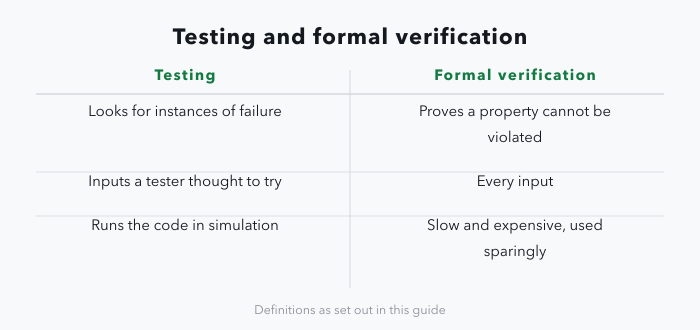
- Formal verification: using mathematical proofs to show that a property holds for every input, rather than for the inputs a tester thought to try. It is slow and expensive, so it is normally reserved for the parts of a system where being wrong is unaffordable.
- Governance review: examining who can change what. Admin keys, upgrade paths, timelocks and voting thresholds are all attack surface, and a flawed voting mechanism in a DAO can hand control to whoever can accumulate or borrow enough tokens.
Each component finds a different class of problem. Static analysis catches coding errors, dynamic testing shows how those errors behave when exercised, formal verification gives confidence in the logic itself, and a governance review covers the part of the system that is not code at all. An audit that only does the first of these is a code review, not an audit.
Why Audits Matter
The Threat Landscape
Reentrancy attacks, where a malicious contract calls back into a vulnerable one before the first call has finished updating its state, are the oldest pattern in the book and still appear in new code. Flash loan attacks use the instant, uncollateralized loans available in DeFi to move a price, exploit a contract that trusts that price, and repay the loan inside one transaction.
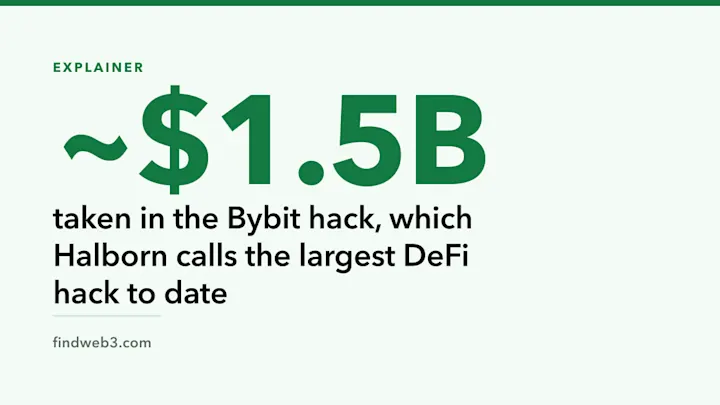
The bigger losses have moved off-chain. Halborn, in a 2025 post on operational risk, argues that compromised private keys and social engineering now sit behind many of the largest DeFi thefts, and points to the Bybit hack, which it calls the largest DeFi hack to date, at roughly $1.5 billion, as a case where signers were tricked into approving a malicious transaction that drained cold wallets. A smart contract audit would not have caught it. Read Halborn's post.
That is the argument for auditing the operational layer alongside the code: key custody, deployment permissions, the signing flow, and the people who use it.
Trust and Transparency
A published audit report is one of the few pieces of evidence a user has that anyone independent has looked at the code. Exchanges, counterparties and investors often ask to see one before they commit, and a report that lists what was found and what was fixed is more persuasive than any badge on a landing page.
What a Thorough Audit Includes
Smart contract bugs, 51% attacks and private key leaks are different problems with different fixes, which is why a real audit works in layers rather than running one tool and exporting the output.
Formal Verification
Testing looks for instances of failure; formal verification tries to prove that a stated property cannot be violated. For a lending market, that property might be that the sum of user balances always equals the pool's holdings. Proving it requires the property to be written down precisely, which is often where the exercise earns its money: teams discover during specification that they disagree about what the contract is supposed to guarantee.
Governance Evaluation
Governance is the attack surface teams most often leave out of scope. An upgradeable contract is only as secure as the multisig that can upgrade it, and a token vote is only as secure as the cost of acquiring the votes. An audit should say plainly who can move funds, who can change the code, and how quickly either can happen.
Learning From Real Exploits
Good auditors work from the record of what has actually gone wrong. The reentrancy pattern that drained The DAO in 2016 is still being rediscovered in new contracts, and most audit findings are variations on failures that have already happened somewhere else. A report that only lists theoretical risks, with no reference to how that class of bug has been exploited before, is a weaker report.
Blockchain security audit components
| Audit Component | Primary Purpose | Common Vulnerabilities Found |
|---|---|---|
| Smart Contract Audit | Verify the logic and security of smart contracts | Reentrancy attacks, integer overflow/underflow, logic errors |
| Consensus Mechanism Review | Evaluate the robustness and security of the consensus algorithm | 51% attacks, Sybil attacks, double-spending |
| Cryptography Assessment | Analyze the strength and implementation of cryptographic primitives | Weak key generation, insecure randomness, cryptographic backdoors |
| Governance Model Analysis | Assess the security and resilience of the governance structure | Centralization risks, voting manipulation, administrator key compromise |
| Platform Security Review | Examine the underlying blockchain platform for vulnerabilities | Denial-of-service attacks, network exploits, data breaches |
Standards and Certifications
Formal standards for blockchain security are recent and still thin on the ground. The Blockchain Security Standards Council published its first four in May 2025: a Node Operation Standard, a Token Integration Standard, a Key Management Standard, and a General Security and Privacy Standard covering baseline risk management for all participants. Help Net Security's report on the launch lists what each one covers. Standards work also runs through ISO, whose technical committee on blockchain and distributed ledger technologies publishes terminology and governance standards, and through industry consortiums.
Which Certifications Matter
A certification badge is a summary of a document. The document is what matters. Before treating any mark as evidence, ask for the report behind it, check the date, check which version of the code was reviewed, and check whether the findings were fixed and retested. An audit of a contract that has been upgraded twice since tells you very little.
Choosing an Auditor
The cheapest way to judge a security firm is to read its work. Several publish their finished reports: Trail of Bits keeps its audit reports and papers in a public repository, and Consensys Diligence lists its audits on its site. Find two or three reports for systems that resemble yours and read the findings. Depth of explanation, the severity calls, and whether the report engages with the design rather than just the syntax will tell you more than any sales call.
Other signals worth weighing: whether the firm maintains open-source security tools, whether its people publish research or speak at security conferences, and whether the team includes specialists in the areas your system actually depends on, such as cryptography, the specific chain, or the language you are writing in.
Cost, Duration and Red Flags
Audit pricing is quoted per engagement and depends on scope, lines of code, complexity and how much formal verification is involved, so there is no useful published rate card. Get written quotes from more than one firm and compare what is in scope, not just the number.
Be wary of unusually low prices or very short turnarounds. A thorough review takes time, and a rushed one produces a document rather than security. A high price does not guarantee the opposite. Ask which vulnerability classes they target, which tools they use, how findings are ranked, whether a retest of fixes is included, and what the report will look like. A firm that is vague about its methodology is telling you something.
Long-Term Relationships
A single audit describes one version of the code at one moment. Projects that ship continuously need a relationship rather than a certificate: review before each significant deploy, a monitoring setup, and an agreed route for disclosing bugs found by outsiders. This is cheaper than an incident.
Turning Findings Into Fixes
An audit report is worth only what gets done about it.
Prioritize by Likelihood and Impact
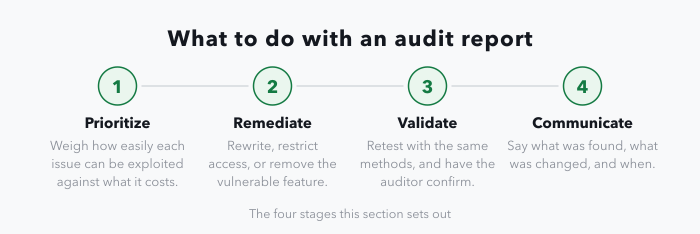
Severity scores are a starting point, not a ranking. A high-severity issue that requires an improbable set of preconditions can matter less than a medium-severity one that anyone can trigger from a public function. Weigh how easily each issue can be exploited against what it costs if it is, and fix in that order.
Remediation
Fixes range from rewriting a contract to removing the vulnerable feature altogether. Common structural changes include moving funds behind a multi-signature wallet so that no one person can sign a transfer, adding a timelock to upgrades, and tightening access controls so that no single key can move value.
Validate the Fix
A patch that resolves the reported symptom can leave the underlying weakness in place, or introduce a new one. Retest the fixed code using the same methods that found the problem, and have the auditor confirm it. Most firms offer a fix review; use it, and publish the result alongside the original report.
Communicate Clearly
Say what was found, what was changed, and when. Users can handle a disclosed and fixed bug far better than a discovered and hidden one, and a clear remediation note is more credible than silence.
Where Audits Are Heading
Automation
Automated analysis keeps improving, and machine-assisted review is now part of how several firms work. It is good at scale, at flagging known patterns across a large codebase, and at monitoring deployed contracts continuously. It is not good at judging whether a system does what its designers intended, which is where most serious findings come from. Treat it as triage that frees up human attention, not as a replacement for it.
Distributed Review
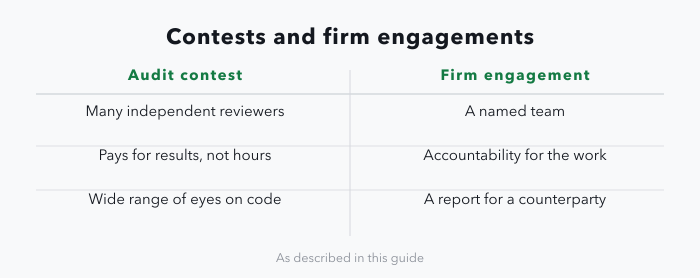
Audit contests and bug bounty programs put many independent reviewers on the same code and pay for results rather than hours. They work well alongside a firm engagement: a contest surfaces a wide range of eyes on the code, while a firm provides accountability, a named team and a report you can hand to a counterparty.
Post-Quantum Preparation
Most chains authenticate transactions with elliptic curve signatures, which a sufficiently large quantum computer would break. That machine does not exist yet, but the migration will be slow, and NIST finalized its first three post-quantum encryption standards on 13 August 2024, giving projects something concrete to plan against. NIST's announcement sets out the algorithms.
Cross-Chain Risk
Bridges and cross-chain messaging are a recurring source of large losses, because they combine contracts on two chains with an off-chain relayer or validator set in between, and each part trusts the others. If a system spans chains, the audit has to cover the gaps between them, not just each side.
Governance
DAO governance is being redesigned to hold up under attack without abandoning the point of decentralization: quorum rules that cannot be met by one large holder, timelocks that leave room to react, and security review of proposals before they can execute.
Blockchain security roles are listed under blockchain jobs, and median pay by role, taken from listings that state a salary, is on the salaries page.