Cryptography Career Path: Skills, Degrees and Jobs
The degrees and programming languages employers look for, how to pick a specialization, and where cryptography roles are advertised.

A career in cryptography is about designing and analyzing the systems that keep data private and communications authentic. It has two halves of the same craft: building ciphers, key exchanges and protocols, and attacking them to find where they break.
Why a Career in Cryptography Is More Relevant Than Ever
Cryptography is what lets you bank online, send a private message, or pay by card without the details being readable in transit. Cryptographers design those systems, and test whether they hold.
The Forces Driving the Demand for Cryptographers
The demand comes from several directions at once:
- Financial services: Banks and fintech firms need encryption that protects transactions and customer records, and key management that survives an audit.
- Big tech: Cloud infrastructure, operating systems and messaging apps all have cryptography at their core, built and maintained in-house.
- Government and defense: Agencies hire cryptographers to protect classified material, build secure communications, and analyze foreign systems.
- Emerging tech: Web3, blockchain and the Internet of Things pushed cryptographic engineering into new places — decentralized networks, and large fleets of small devices with little compute to spare.
More Than Just a Job—A Lasting Career
The work is adversarial by nature. Designs get attacked, attacks get defended against, and the state of the art moves, so the learning does not stop at the end of a degree.
On pay, this site publishes what Web3 employers actually advertise: salary medians taken from listings that state a figure, and a Web3 jobs report tracking hiring by month and category.
Building Your Foundational Cryptography Skills
The entry bar is academic. A bachelor's degree is the usual minimum, and the coursework on the transcript matters more than the name of the degree.
Choosing Your Academic Path
Few universities offer a bachelor's in cryptography itself. Three majors lead into it:
- Computer science: The most direct route. Algorithms, data structures, and secure software development.
- Mathematics: Pure or applied math gives you the theory to understand why a scheme is secure and what its security actually rests on.
- Computer engineering: Blends hardware and software, down to how a cipher is implemented in silicon.
Whichever you pick, the transcript needs discrete mathematics, number theory, linear algebra, and advanced algorithm analysis. Those are the mathematical base for everything else.
Mastering the Right Programming Languages
Cryptography is an applied field. You have to build, test and implement the systems, which means writing code.
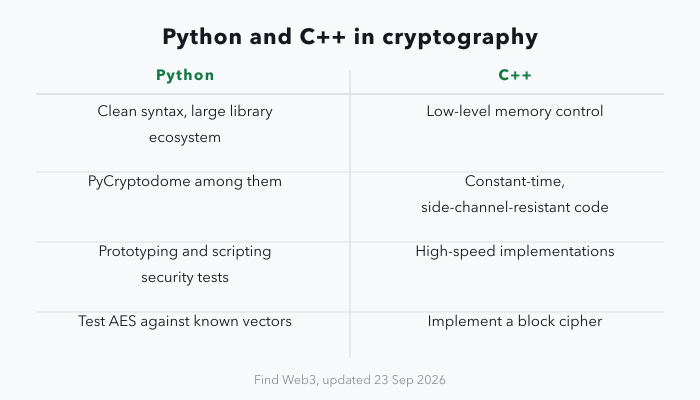
- Python: Clean syntax and a large library ecosystem, PyCryptodome among them. Good for prototyping, scripting security tests, and cryptanalysis work.
- C++: Low-level memory control, for high-speed implementations and for the constant-time code that resists side-channel attacks.
Rust turns up often in newer security codebases and is worth adding once you have one of the other two.
A portfolio with work in more than one language is worth more than either alone: implement a block cipher such as AES in C++, then write Python to test it against known vectors.
Many cryptographic ideas show up in decentralized systems, where the vocabulary is its own hurdle. The Web3 dictionary covers the terms.
When to Pursue an Advanced Degree
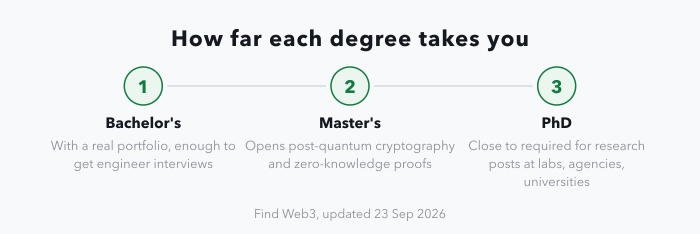
For hands-on roles such as cryptography engineer, a bachelor's plus a real portfolio is often enough to get interviews.
A master's degree opens specialized work — post-quantum cryptography, zero-knowledge proofs — and makes you a stronger candidate for teams building new primitives rather than using existing ones.
A PhD is close to a requirement for research positions at corporate labs, government agencies and universities, where the job is to contribute new results and not only apply known ones. Academic cryptography is published through the International Association for Cryptologic Research, whose conferences and ePrint archive show what that work looks like.
Turning Theory Into Real-World Experience
Coursework opens the door; demonstrated work gets the offer. Employers want evidence that you can build, break and secure real systems.
Internships and co-op programs are the most direct route — at a tech company, a security consultancy, or a government agency — and they show you the daily shape of the job as well as the technical work.
Gain an Edge with Hands-On Projects
If an internship isn't available, personal projects carry the weight. A well-documented repository is direct evidence of what you can do.
- Build a classic cipher from scratch: Implement an algorithm like AES or DES in C++ or Python rather than importing a library. You have to deal with substitution-permutation networks, key scheduling and block modes. This is a learning exercise, not something to ship.
- Develop a secure messaging app: A client-server application with end-to-end encryption exercises key management, protocol implementation, and the whole security lifecycle.
- Contribute to open-source crypto libraries: OpenSSL or a smaller, more modern library. Even bug fixes and documentation show you can work inside a large, security-critical codebase.
Sharpen Your Skills in the Arena
Breaking things is half the discipline. Capture the Flag (CTF) competitions are the usual training ground: teams solve security puzzles under time pressure, and many of the categories are cryptanalysis — spotting weak parameters, exploiting flawed implementations, reverse-engineering custom protocols. Writing up your solutions publicly shows your reasoning, not just the answer.
Find Your Niche by Exploring Specializations
Cryptography is broad, and steering your projects toward one area makes you legible to the teams hiring for it.
Comparing Cryptography Specializations
| Specialization | Primary Focus | Key Skills | Typical Application |
|---|---|---|---|
| Symmetric-Key Cryptography | Designing and analyzing algorithms where the same key is used for encryption and decryption (e.g., AES). | Deep knowledge of block ciphers, stream ciphers, and cryptanalysis techniques like linear and differential attacks. | Securing data at rest (disk encryption) and high-speed data streams. |
| Asymmetric-Key Cryptography | Working with key pairs (public and private) for tasks like digital signatures and key exchange (e.g., RSA, ECC). | Strong foundation in number theory, algebraic geometry, and complexity theory. | Secure web browsing (TLS), digital identity verification, and cryptocurrency transactions. |
| Post-Quantum Cryptography (PQC) | Developing cryptographic systems that resist attacks from future quantum computers. | Advanced mathematics, including lattice-based, code-based, and hash-based cryptography. | Long-term data protection for government, finance, and critical infrastructure. |
| Cryptographic Protocol Design | Creating secure communication protocols that combine cryptographic primitives to achieve a security goal. | Formal verification, security modeling, and a strong grasp of network security principles. | Designing secure voting systems, authentication mechanisms, and privacy-preserving technologies. |
Landing Your First Cryptography Job
The market is split across large tech companies, government agencies, and startups. The cultures and the problems differ, and so does what a strong application looks like.
Where to Look for Cryptography Roles
Big tech hires to secure its own infrastructure and products. Government bodies, particularly in defense and intelligence, hire for national-security work. In Web3, teams building blockchain protocols, decentralized finance platforms and wallets need cryptographic expertise directly rather than as a supporting function.
Specialized job boards show who is hiring and what they ask for: the crypto job listings here, and the companies hiring page behind them.
Differentiating Between Key Job Titles
Three titles come up repeatedly, and they describe different days.
- Cryptography Engineer: A builder's role. Implementing cryptographic libraries, developing protocols, and integrating encryption into software and hardware, usually in C++, Rust or Python.
- Cryptanalyst: A breaker's role. Stress-testing systems, algorithms and protocols to find weaknesses first. Needs an adversarial mindset and a deep theoretical grasp of how schemes fail.
- Security Researcher (cryptography focus): Blends the two — new schemes one month, new classes of attack the next. Common at large tech companies and research labs, and often asks for a master's or PhD.
Crafting a Resume That Gets Noticed
In a field this technical, your projects are your credibility, so describe them with the detail that shows the skill.
Instead of "built a secure messaging app," write: "Designed and implemented an end-to-end encrypted chat application using the Signal Protocol, demonstrating key exchange, forward secrecy, and authenticated encryption." One is a statement; the other is evidence.
Keep the linked repository clean and documented. It will be read.
Nailing the Technical Interview
Cryptography interviews test foundations and reasoning, usually over several stages that can include whiteboard problems and take-home assignments. Expect:
- Mathematical questions: Number theory, abstract algebra, and probability.
- Algorithmic challenges: Standard coding problems, often with a security twist.
- System design questions: Prompts such as "design a secure password manager" or "outline a secure voting protocol," testing architectural judgment.
Practice explaining cryptographic concepts out loud, as if to a colleague. Interviewers weigh how you reason about a scheme's assumptions as much as whether you reach the answer.
What's Next? The Future of Cryptography and Your Career Path
The principles you learn now are a starting point. A few shifts already underway will shape the next decade of the field, and they are where new roles are being created.
Preparing for the Quantum Leap
A large enough quantum computer would break the public-key cryptography in everyday use, including RSA and elliptic-curve schemes. That is what drives post-quantum cryptography (PQC).
PQC has already moved from research into deployment. NIST published its first three post-quantum standards on 13 August 2024 — FIPS 203 (ML-KEM) for key encapsulation, and FIPS 204 (ML-DSA) and FIPS 205 (SLH-DSA) for digital signatures — with further algorithms, including HQC and Falcon, still in standardization. That turns PQC from a research topic into migration work inside systems that already exist, which is where the hiring is.
Two other areas are moving out of the lab:
- Homomorphic Encryption: Computation on encrypted data without decrypting it. A cloud service could compute over health records without seeing them.
- Zero-Knowledge Proofs (ZKPs): Proving a statement is true without revealing what makes it true. Used for blockchain privacy and scaling, and for authentication schemes.
The Blockchain and DeFi Revolution
Blockchains are built out of cryptographic primitives. Hash functions chain the blocks, digital signatures authorize transactions, and newer systems lean on zero-knowledge proofs for privacy and for rollups. Cryptography is a first-order skill on these teams rather than a supporting one.
For what that hiring looks like month to month, and which categories are growing, see the Web3 jobs report.
Charting Your Career Trajectory
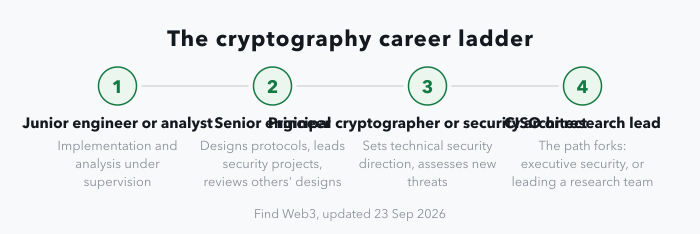
The path through the field usually runs something like this:
- Junior Cryptography Engineer/Analyst: Implementation and analysis under supervision — working with established libraries, supporting security audits, learning how theory behaves in shipped code.
- Senior Cryptography Engineer: More autonomy. Designing protocols for new products, leading security projects, and reviewing other people's designs.
- Principal Cryptographer/Security Architect: Setting technical security direction for the organization, assessing new threats, sometimes contributing to industry standards.
- Chief Information Security Officer (CISO) or Research Lead: The path forks between an executive security role and leading a research team.
Movement along it depends on continued study — conferences, specialist certifications, and open-source work all count as evidence.
Common Questions About a Career in Cryptography
Do You Need a PhD?
It depends on the work. For inventing cryptographic algorithms or doing foundational research at a university or a corporate research lab, a PhD is effectively required. For most other jobs it is not. Companies need practitioners who can implement and integrate secure systems, and a bachelor's or master's paired with a strong portfolio and solid coding skills covers that.
What's the Difference Between a Cryptographer and a Cryptanalyst?
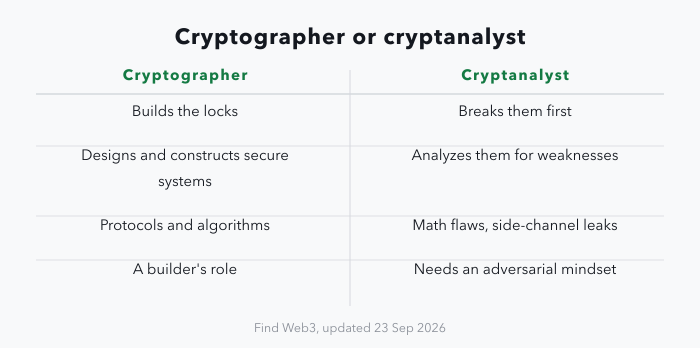
Builders and breakers.
A cryptographer designs and constructs secure systems, protocols and algorithms — the locks.
A cryptanalyst analyzes them for weaknesses before an attacker finds them: mathematical flaws, implementation errors, side-channel leaks. Neither role works without the other.
How Important Is Programming?
Central. Modern cryptography is an applied science that lives in code. The foundations are mathematical, but the job is translating them into software that is secure and efficient in practice.
Expect to work in Python, C++ or Rust, for three reasons:
- Implementation: Building software that uses cryptographic primitives correctly.
- Integration: Fitting established crypto libraries into larger applications.
- Analysis: Writing your own scripts and tools to stress-test systems.
Can You Get Hired With No Formal Work Experience?
Yes, if the portfolio does the talking. Write-ups from Capture the Flag competitions, your own implementations of classic ciphers, and contributions to an open-source security project all show skill that a thin resume cannot.
Find Web3 lists cryptography, engineering and other roles at blockchain and crypto companies. Browse the job board to see what is open now.