How to Become a Web3 Developer: Skills, First dApp, Jobs
The languages and tooling Web3 roles expect, a walkthrough of building and deploying a first dApp, then a 90-day plan for the job hunt.
Understanding The Web3 Developer Landscape (And Why It Matters)
Web3 development differs from ordinary web development mainly in where the state lives. Instead of an application's data sitting in a database the company controls, it sits on a public blockchain that anyone can read and that no single party can quietly rewrite. That one constraint shapes the rest of the job: what can be changed after launch, what a user has to sign and pay for, and what a bug costs when it ships.
The roles follow from that. Smart contract engineers write the on-chain logic, the code that holds funds and enforces rules, most visibly in DeFi. Frontend developers build the interface that connects a user's wallet to that logic and makes signing a transaction comprehensible. Most teams need both, and plenty of people cross between them.
For what is actually being advertised, rather than a projection: the Web3 jobs report breaks hiring down by month and category, and companies hiring lists the employers currently posting.
Navigating The Diverse Ecosystem
The ecosystem covers decentralized finance, NFTs, gaming and the metaverse, and decentralized autonomous organizations (DAOs). The base skills overlap, but the specifics do not: a DeFi protocol is an exercise in adversarial financial logic, an NFT marketplace is mostly indexing and front end, and a DAO is governance plumbing. It is worth picking one early, because job adverts are written for one of them at a time.
Essential Technical Skills That Actually Matter
The core stack is small. Solidity for the contracts, JavaScript or TypeScript with React for the interface, and a library to connect the two. Almost everything else is a variation on those three.
Core Programming Languages and Frameworks
- Solidity: the language most smart contracts are written in, and the one most Ethereum and EVM-chain job adverts name. It is where the money logic lives, so most of the security burden sits here too.
- JavaScript or TypeScript, with React: the front end, plus the scripts and tests around a contract. TypeScript is the default in most new Web3 codebases.
- Ethers.js or viem: the libraries that let a browser read from and write to a blockchain. ChainSafe sunset web3.js on 4 March 2025 and archived the repository, so new work uses Ethers.js or viem instead. Older tutorials still teach web3.js; skip them.
Streamlining Your Workflow With Essential Tools
- Hardhat: Hardhat compiles, tests and deploys contracts, and runs a local chain you can reset at will.
- Testing frameworks: contract tests are usually written with Mocha and Chai through Hardhat. A deployed contract often cannot be patched, so tests carry more weight here than in most web work.
- Git and GitHub: Git and a public GitHub profile double as your portfolio in a field where most of the code is open source.
Essential Web3 programming languages and their applications
| Language | Primary use | Where to learn it |
|---|---|---|
| Solidity | Smart contracts on Ethereum and other EVM chains | The official Solidity documentation |
| JavaScript / TypeScript | dApp front ends, deployment scripts, contract tests | MDN Web Docs, freeCodeCamp |
| Rust | Non-EVM chains, including Solana programs, and blockchain client software | The Rust Programming Language book, Rust documentation |
Building Your First Decentralized Application (The Right Way)
Reading about contracts gets you a long way and then stops. The rest is mechanical: set up the environment, deploy something small, and watch what breaks.
Setting Up Your Development Environment
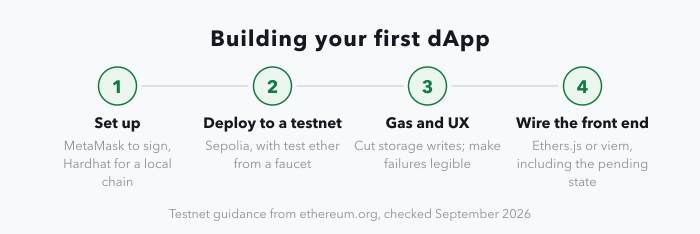
Two pieces do most of the work. MetaMask is the browser wallet you will use to sign transactions and to test what a user sees. Hardhat gives you a local chain, a compiler and a deployment script, so you can iterate without touching a public network.
Deploying to Testnets (Without Breaking the Bank)
Deploy to a testnet before you deploy anywhere real. A testnet behaves like the live chain but the ether has no value, so mistakes cost nothing.
Use Sepolia. Ethereum's own network documentation (ethereum.org, checked September 2026) names Sepolia as the default testnet for application development, and lists Goerli, Ropsten, Rinkeby and Holesky as deprecated. Tutorials that tell you to deploy to Goerli are out of date. Test ether comes from a faucet rather than an exchange.
Tackling Gas Optimization and User Experience
- Gas: every write to the chain costs the user money, and storage writes cost the most. Cutting storage operations, packing variables and avoiding loops over unbounded arrays are the usual wins.
- User experience: wallet connection, clear transaction prompts and legible error messages. A user who cannot tell why a transaction failed usually just leaves.
Integrating Smart Contracts and Front-End Interfaces
Connecting the two is the skill most interviews probe. The front end uses Ethers.js or viem to read contract state, send transactions and handle the wait while a transaction is pending. Handling the pending and failed cases well is most of the work.
The Market Opportunity (And What It Really Pays)
Salary Expectations and Specializations
Pay varies with seniority, specialization and whether the employer is a protocol, an exchange or a service company. Rather than quoting a range, Find Web3 publishes median pay by role, taken from the listings that state a salary across 15 roles, so you can see what is currently advertised rather than what a survey projects.
Smart contract and DeFi work tends to sit at the higher end, on the argument that the code holds funds directly.
Where the Jobs Are: Companies Hiring Web3 Talent
The employers split roughly into crypto-native startups, established exchanges and infrastructure firms, and traditional companies running a blockchain team. Companies hiring lists who is posting now; the open roles are on the jobs board. Contract and freelance work is common in the space, particularly for audits and one-off integrations.
Navigating Geographic Differences and Remote Work
Many Web3 roles are advertised as remote, and a lot of teams are distributed by default. Listings state their location and whether remote is allowed, which is the only reliable way to compare, since a remote role at a US company and a local role in the same city can be priced very differently.
Job Security and Career Stability: An Honest Look
Crypto hiring moves with the crypto market, and it falls as well as rises. The Web3 jobs report tracks postings by month, which is a better guide to the current state than any forecast. The skills transfer, though: Solidity is specific, but backend, frontend and security engineering are not.
Mastering Blockchain Fundamentals Without Getting Lost
You do not need to be a cryptographer. You need enough of the model to predict what your code will cost and what it can guarantee: how a transaction gets included, what finality means on the chain you chose, and where the fees go.
Ethereum switched from proof of work to proof of stake in September 2022, in the upgrade known as the Merge, and has not been mined since. Layer 2 networks such as Polygon and Arbitrum settle to Ethereum while executing transactions more cheaply, which is where a lot of application deployment now happens.
Choosing the Right Blockchain for Your Project
The practical criteria are transaction cost, how quickly a transaction is final, the quality of the tooling, and how many other developers are there to answer questions. A high-fee chain rules out anything with frequent small transactions; a slower chain is fine for something that settles in the background. The Web3 statistics page collects adoption figures with their sources.
Understanding Tokenomics and Governance
Tokenomics is the supply, distribution and incentives attached to a token. Governance is how decisions get made, often by token-weighted vote. Both are design decisions you may be asked to implement, and both fail in ways that look obvious afterwards: rewards that pay people to leave, or a vote that one holder can decide alone. Knowing enough to raise the question is part of the job.
How Consensus Mechanisms Differ
Consensus is how a network agrees on its state. Proof of work, used by Bitcoin, spends computation to validate transactions: secure, and energy-intensive. Proof of stake, used by Ethereum since 2022, has validators stake tokens instead, which cuts energy use and raises questions about concentration among large stakers.
This matters practically. Block time and finality differ between chains, and a dApp built on a proof of stake network may need to account for staking or delegation in its own design.
Career Advancement And Future-Proofing Your Skills
Emerging Trends: The Next Big Thing
- Web3 gaming: on-chain items and in-game economies. Adverts here usually want game development alongside blockchain integration, often Unity plus Solidity.
- Decentralized identity: verifiable credentials and wallet-based sign-in. The work sits close to cryptography and security.
- Metaverse and 3D: a narrower field than it was in 2021, but still a listed category, and still asks for 3D and game engine skills more than contract skills.
Building Your Professional Network in Web3
- Contribute to open source. Most Web3 code is public, which means your contributions are public too, and a merged pull request to a protocol repository is stronger evidence than a line on a résumé.
- Be present where the developers are. Protocol Discords, developer forums and hackathons are where teams notice people before they post a role.
Blockchain-specific roles are collected on the blockchain jobs page.
Continuous Learning and Leadership Development
The tooling changes often enough that a two-year-old tutorial can be actively wrong, as the web3.js and Goerli examples above show. Following the documentation of the chains and libraries you use is more reliable than following courses.
Web3 developer career path progression
| Career level | Typical responsibilities | Skills usually asked for |
|---|---|---|
| Junior developer | Implementing defined features, fixing bugs, writing tests under supervision | Solidity, JavaScript, a contract library, basic blockchain concepts |
| Mid-level developer | Writing and testing contracts, integrating front ends, owning a component | Solidity, sometimes Rust, chain architecture, experience across more than one platform |
| Senior developer | Designing systems, reviewing others' contract code, technical mentorship | Contract security, dApp architecture, Go or Rust for infrastructure work |
| Lead or architect | Technical strategy across a project, working with founders and auditors | Broad protocol experience, scalability, communication with non-technical stakeholders |
Pay at each level is on the salary page, which uses medians from advertised roles rather than estimates.
Your Action Plan To Start Building Today
A Six-Month Study Plan
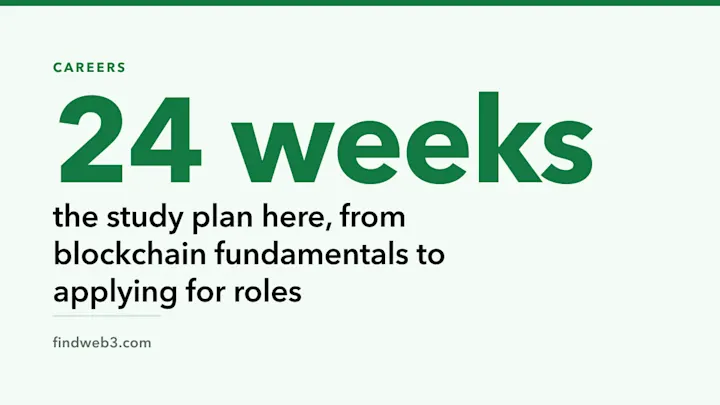
- Weeks 1-4: fundamentals. Blockchain architecture, consensus, what a smart contract is and what it cannot do. Send transactions on Sepolia by hand.
- Weeks 5-8: Solidity. Work through the Solidity documentation and write small contracts: a token, a vote, an escrow.
- Weeks 9-12: front end. JavaScript and React, then wire a contract to a page with Ethers.js or viem.
- Weeks 13-16: the parts that bite. Gas costs, common contract vulnerabilities, decentralized storage, and testing properly in Hardhat.
- Weeks 17-20: build one whole thing. A complete dApp, deployed to a testnet, with a README that explains the design decisions.
- Weeks 21-24: document and apply. Tidy the code, write up the project, start applying and practicing how you explain it.
After that, the useful work is specializing in one area, contributing to an open-source project in it, and keeping the portfolio current while you interview.
Choosing the Right Learning Path
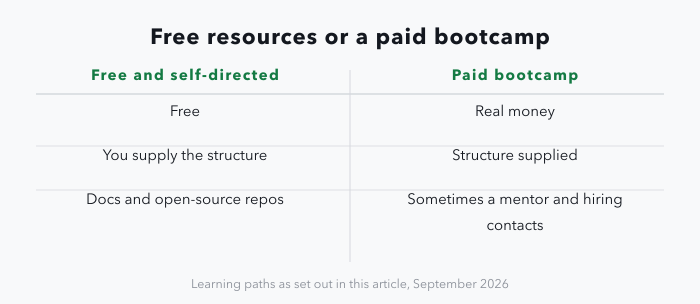
Free resources, official documentation and open-source repositories will teach you everything on that list, but you supply the structure. Paid bootcamps supply the structure and sometimes a mentor and hiring contacts, for real money. Judge a paid program on its curriculum and who teaches it, and ask what its career support actually consists of.
Building a Compelling Portfolio
- Build things that do something. A small dApp that solves one real problem beats three tutorial clones.
- Document the decisions, not just the code. Why this storage layout, why this access control. That is what a reviewer reads.
- Contribute to open source. Public commits on a repository someone else maintains are the closest thing to a reference you can get before your first job.
Acing Your Web3 Developer Interviews
Expect to be asked how a transaction reaches the chain, where gas goes, and how you would attack your own contract. Be able to walk through your project line by line, including the parts you would now do differently.
Landing Your First Role
Without direct blockchain experience, lead with what transfers: backend, frontend, security, testing. Then show the on-chain work you have done on your own. The field is young enough that self-taught developers with public code get read.
Find Web3 lists Web3 roles across crypto, NFT, DeFi, DAO, metaverse and blockchain. See the open jobs.