Layer 2 Scaling Solutions: Rollups, Channels, Sidechains
How rollups, state channels and sidechains take load off a base chain, and where optimistic and zero-knowledge rollups differ.
A layer 2 is a separate network that processes transactions away from a main blockchain and then posts the results back to it. The main chain — layer 1 — stays the record of what happened and the source of security. The layer 2 handles the volume. On Ethereum, most transaction activity now happens this way.
Why layer 2 exists
Every Ethereum block has a fixed gas limit, so there is only so much room in each one. That space is sold by auction: when more people want a transaction included than the block can hold, the price goes up and confirmation takes longer. Small transfers and routine app interactions stop being worth the fee.
The constraint is usually described as the blockchain trilemma — scalability, security and decentralization, with progress on one tending to cost you another. Raising throughput on layer 1 by simply processing more per block raises the cost of running a node, which narrows the set of people who can independently verify the chain.
Layer 2 works around the trade rather than solving it. The execution moves off the main chain, and a compressed summary or a proof comes back. Layer 1 does the part it is good at — ordering and finalizing — once per batch instead of once per transaction.
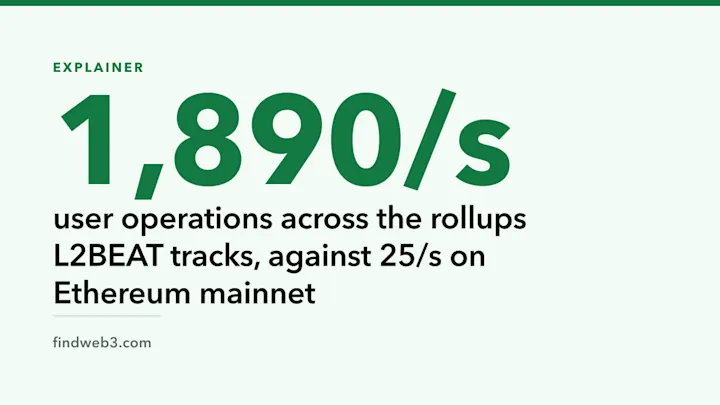
The gap this opens is wide. On 23 September 2026, L2BEAT measured Ethereum mainnet at about 25 user operations per second over the previous day, against roughly 1,890 per second across the rollups it tracks.
The split is between doing and recording. Layer 2s do the transactions; layer 1 records the outcome and secures it.
If a term here is unfamiliar, the Web3 dictionary covers the vocabulary.
The main layer 2 designs
Each design makes a different choice about what gets sent back to the main chain, and how much the operator has to be trusted in the meantime.
Rollups
A rollup bundles many transactions into a single batch and posts that batch to layer 1 in compressed form. The cost of the one layer 1 transaction is shared across everyone in the batch, which is where the fee saving comes from.
Because the data goes on chain, anyone can rebuild the rollup's state from Ethereum alone — which is what lets a user exit through the layer 1 contract if the rollup's operators stop cooperating. Rollups are the dominant design, and they split into two families, optimistic and zero-knowledge, covered below.
State channels
Two or more parties lock funds in a layer 1 contract, then transact directly between themselves as often as they like, signing an updated balance each time. Only the opening and the final state touch the main chain, so everything in between is instant and free.
This suits a fixed set of participants exchanging many small payments: micropayment systems, turn-based games. The limits are real, though. Someone has to stay online to catch an old, more favorable state being submitted as the final one, and a channel is not a place to run general-purpose smart contracts.
Sidechains
A sidechain is an independent blockchain running alongside the mainnet, with its own validators, its own consensus and a bridge for moving assets across. It does not post its transaction data to layer 1.
That buys flexibility — its own fees, block times and rules — but it means the sidechain does not inherit layer 1's security. Funds on it are as safe as its own validator set, and assets crossing to it are as safe as the bridge. For this reason many people do not count sidechains as layer 2 at all.
Plasma
Plasma anchors child chains to the main chain, committing only a periodic root hash of each child chain's state, with an exit mechanism so users can withdraw to layer 1 if a child chain misbehaves. It never worked well for general-purpose smart contracts: exits are awkward, and the data you need to prove your own balance lives off chain. Rollups replaced it.
Optimistic rollups and ZK rollups
The two rollup families differ in how they convince layer 1 that an off-chain batch was processed correctly. Withdrawal times, cost and build complexity all follow from that one choice.
Optimistic rollups
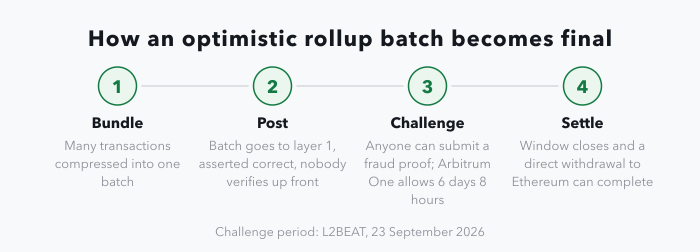
An optimistic rollup posts its batch and asserts that it is correct. Nobody verifies it up front. Instead there is a window in which anyone can challenge the result with a fraud proof; if a challenge succeeds, the state is rolled back and the proposer loses their stake.
The window is a protocol parameter, and on the large chains it is roughly a week — L2BEAT lists Arbitrum One's challenge period as 6 days 8 hours as of 23 September 2026. That is also how long a direct withdrawal to Ethereum takes. Third-party bridges quote minutes instead, by fronting the money and absorbing the wait themselves for a fee.
ZK rollups
A ZK rollup proves it up front. It generates a validity proof — a zk-SNARK or a zk-STARK — that the batch was executed according to the rules, and layer 1 verifies that single small proof instead of re-running the transactions.
Once the proof is verified, the batch is final, so withdrawals do not wait on a challenge window. The cost sits on the other side: generating proofs is computationally expensive, and the systems are harder to build and to audit. The "zero-knowledge" name is about how little the verifier has to redo, not about privacy — on a public rollup the transaction data is posted to Ethereum like everyone else's.
Optimistic rollups vs ZK rollups
| Feature | Optimistic Rollups | Zero-Knowledge (ZK) Rollups |
|---|---|---|
| Verification Model | Assumes validity by default. Relies on fraud proofs submitted during a challenge period. | Proves validity up front. Layer 1 verifies a mathematical validity proof. |
| Transaction Finality | Delayed until the challenge period expires — roughly a week (Arbitrum One: 6d 8h, per L2BEAT, 23 Sep 2026). | Reached as soon as the proof is verified on layer 1. |
| Withdrawal Time | Days for a direct withdrawal, tied to the challenge period. | Minutes, once a proof covering the transaction is verified. |
| Complexity | Lower. Easier to make compatible with existing Ethereum tooling. | Higher. Proving systems are cryptographically involved and harder to audit. |
| Cost | Little off-chain computation; cheap unless a challenge is raised. | Proof generation is expensive, but the cost is spread across the batch. |
Choosing between them is a question of priorities. An application whose users can tolerate a withdrawal delay may prefer the simpler optimistic design; one where people expect to move money out quickly fits a ZK rollup.
Where layer 2 stands today
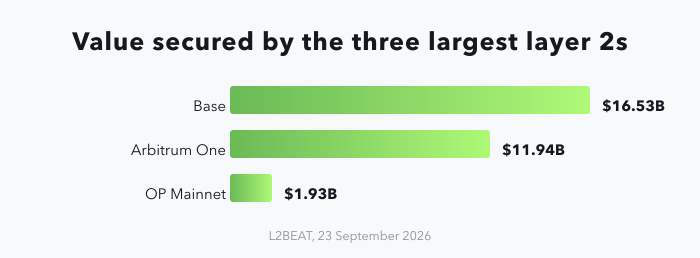
The largest layer 2s are now substantial networks in their own right. On 23 September 2026, L2BEAT put the value secured by Base at $16.53 billion, Arbitrum One at $11.94 billion and OP Mainnet at $1.93 billion. All three are optimistic rollups; the largest ZK rollups on the same list are an order of magnitude smaller.
Activity has moved the same way. L2BEAT recorded Base alone at about 116 user operations per second over the previous day, against Ethereum mainnet's 25.
Cheaper transactions changed what is worth building:
- DeFi. Trading, lending and yield strategies that involve many small transactions are viable at layer 2 fees in a way they are not on mainnet.
- NFTs and gaming. Minting, trading and in-game actions can happen often enough to feel like a game rather than a series of payments.
- Consumer and social apps. Posting, following and tipping do not each have to be worth a mainnet gas fee.
For the numbers behind that activity, this site keeps its own: DeFi statistics, Web3 statistics and the Web3 jobs report. Roles at companies working on this are listed under DeFi jobs.
What is still unresolved
Fragmentation. Dozens of layer 2s run independently, so assets and liquidity sit in separate pools. Moving funds between them means bridging, which costs time, fees and — depending on the bridge — trust.
Sequencer centralization. Most rollups still rely on a single sequencer to order transactions. It is fast, but it is a single point of failure and a possible point of censorship. L2BEAT grades rollups from Stage 0 to Stage 2 by how many of these training wheels have come off; on 23 September 2026 most of the networks it lists, Base, Arbitrum One and OP Mainnet included, were at Stage 0 or Stage 1.
Data capacity. Rollups pay to publish data to Ethereum, so their fees depend on what that costs. EIP-4844, proto-danksharding, gave rollups a dedicated and cheaper form of data storage called blobs; it shipped with the Dencun upgrade on 13 March 2024, according to ethereum.org's fork history. The same record shows Pectra following on 7 May 2025 and Fusaka on 3 December 2025, both of which continued the work on data availability for rollups.
Decentralized sequencers and interoperability. Work on both is ongoing: shared or rotating sequencer sets to remove the single operator, and standards for messaging between layer 2s so that moving across them stops feeling like leaving one network for another.
Layer 3s
A newer idea is to build on top of a layer 2 rather than beside it. A layer 3, or app-chain, is a chain dedicated to one application — a game, a single DeFi protocol — that settles to a layer 2, which settles to Ethereum. The appeal is control and dedicated capacity; the open question is whether the extra hop is worth the added complexity and the extra bridge.
Common questions
Are layer 2 solutions as secure as the main blockchain?
It depends on the type, and on how far along it is. Rollups are designed to inherit layer 1's security: because the data or the proof goes back to Ethereum, a user should be able to exit through the layer 1 contract even if the rollup's own operators disappear. In practice most rollups are not fully there — this is what L2BEAT's stage labels track — and a security council or similar trusted party can still intervene on the large ones. Sidechains make no such claim in the first place: their security is their own validator set.
What is the difference between a sidechain and a layer 2?
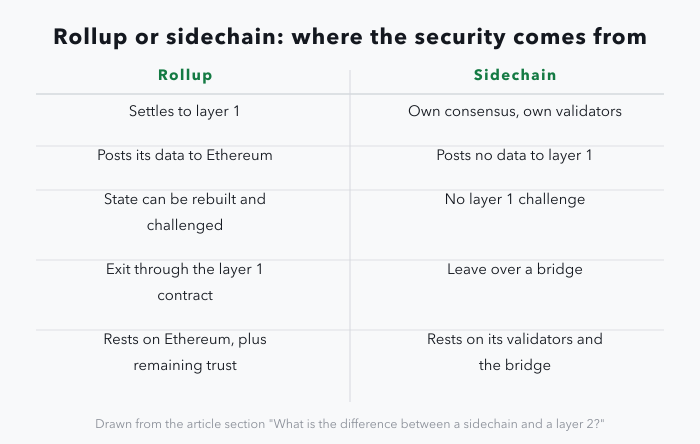
Where the security comes from. A rollup settles to layer 1 and posts enough information for its state to be reconstructed and challenged there, so its guarantees ultimately rest on Ethereum. A sidechain is a separate blockchain with its own consensus, connected by a bridge; its guarantees rest on itself, and on the bridge.
The practical consequence: when you move assets to a rollup you are relying on Ethereum plus the rollup's remaining trust assumptions. When you move them to a sidechain you are relying on that chain's validators.
Why are there so many layer 2s?
Partly because the trade-offs are genuine — finality, cost, tooling compatibility and how hard a chain is to build on all pull in different directions, and different applications weigh them differently. Partly because launching one has become straightforward: shared frameworks let a team deploy a rollup with settlement, bridging and sequencing already written, which is why several of the largest networks share the same underlying stack.