NFT Marketing in 2026: Channels, Costs and What Works
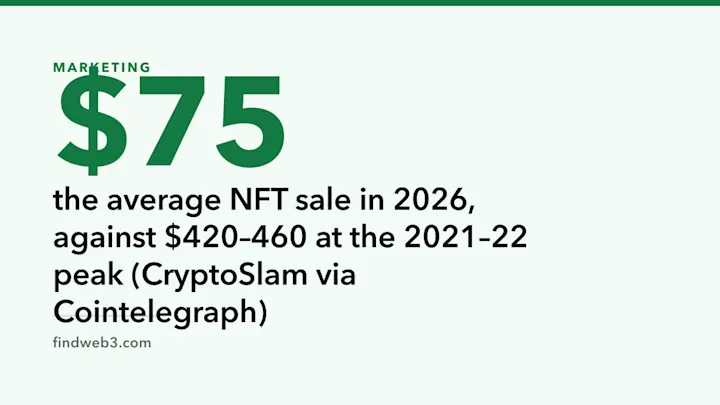
The average NFT sale is now $75, against $420–460 at the 2021–22 peak. What NFT marketing actually works in that market, with every figure sourced and dated.
Most advice about marketing an NFT project was written between 2021 and early 2023, when a collection could sell out on Discord hype and a celebrity tweet. That market is gone. Marketing a project now means working a much smaller audience that has already watched a lot of people lose money, and doing it under disclosure rules that still bite.
This page covers what the current market looks like, which channels and marketplaces still exist, what you can and cannot promise, and how to measure whether any of it worked.
The market you are marketing into
Every figure below is from our NFT statistics page, which names a publisher and a date for each one.
| Measure | Figure | Source |
|---|---|---|
| NFT sales, 2026 to 22 September | $1.92 billion | CryptoSlam |
| NFT sales, 2022 peak year | $23.8 billion | CryptoSlam |
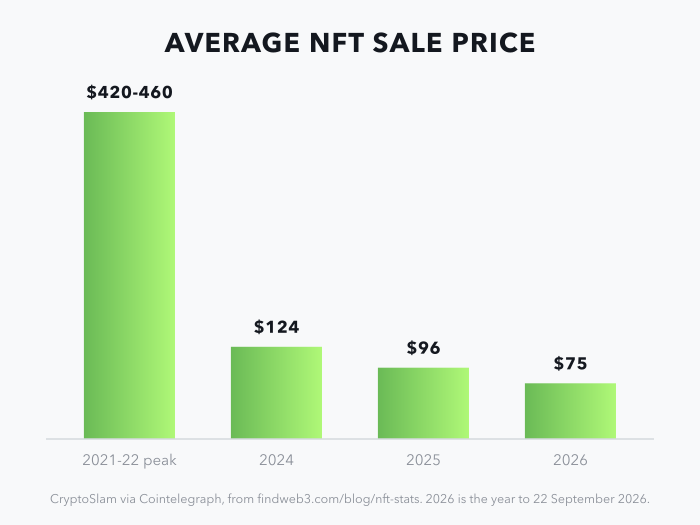
| Average sale price, 2026 year to date | $75 | CryptoSlam via Cointelegraph |
| Average sale price, 2021–22 peak | $420–460 | CryptoSlam via Cointelegraph |
| NFTs in existence, end of 2025 | more than 1.34 billion | CryptoSlam via Cointelegraph |
| NFTs in existence, 2021 | about 38 million | CryptoSlam via Cointelegraph |
Setting a part year against a full year overstates the fall, so it is worth doing the arithmetic in the open. Annualized, 2026 is running at roughly $2.6 billion against $23.8 billion in 2022, a drop of about 89%. Compare the part year directly with the full year and you get 92%. Both are Find Web3's arithmetic on CryptoSlam's numbers rather than a published statistic, and either way the market is a fraction of what it was.
Two things follow for anyone planning a campaign. First, the average NFT changes hands for $75, so a marketing plan whose economics need a four-figure sale price does not work. Second, supply grew while demand shrank. About 38 million NFTs existed in 2021 against more than 1.34 billion at the end of 2025, so you are launching into a market with more than thirty times the objects and a fraction of the buyers.
Check that your marketplace still exists
A surprising amount of NFT marketing advice still names venues that have closed. Before you build a launch around a platform, confirm it is trading.
| Platform | Status |
|---|---|
| OpenSea | Trading, as OS2 across multiple chains |
| Blur | Trading, Ethereum |
| Magic Eden | Trading on Solana only. Announced on 27 February 2026 that its Ethereum, Polygon, Base, Bitcoin Ordinals and Runes marketplaces would close; support for them ended on 9 March 2026 |
| Tensor | Trading, Solana. Coinbase bought the team's memecoin trading app in November 2025; the marketplace and its token passed to the independent Tensor Foundation |
| MakersPlace | Closed. Announced 15 January 2025 |
| Nifty Gateway | Closed. Gemini announced the closure on 23 January 2026; the platform shut on 23 April 2026 |
| Foundation | Closed. Its own site has read "Foundation is offline" since 27 April 2026, after a sale of the platform fell through |
OpenSea, Blur and Tensor were checked directly on 23 September 2026 and are trading; MakersPlace, Nifty Gateway and Foundation each serve a closure notice instead of a marketplace. Magic Eden's site sits behind bot protection, so its entry rests on its own February 2026 announcement and the reporting of it rather than on a page load. Closure dates are from our NFT statistics page and the platforms' own notices.
Note what OpenSea's own mix says about where attention went. In the first half of October 2025, during its strongest run since 2021, it traded $1.6 billion of crypto tokens against $230 million of NFTs, on the figures gathered on our NFT statistics page. The company now titles its home page "OpenSea, exchange everything — token trading and NFT marketplace." The largest NFT marketplace is mostly a token exchange, and it says so itself.
Royalties no longer fund the roadmap
This is the single change that breaks most pre-2023 marketing plans, and it is worth stating plainly.
The standard 2021 pitch was: mint the collection cheaply, fund development from a 5% to 10% royalty on every secondary sale, and market that roadmap to buyers. OpenSea made creator fees optional for new collections from 31 August 2023 and switched off the Operator Filter that had enforced them; collections still relying on that filter were covered only until 29 February 2024. OpenSea's help center now states that it enforces creator earnings only for contracts compatible with the ERC-721-C and ERC-1155-C standards, which enforce payment at the contract level, and that otherwise "any creator earnings you've set in your collection settings will be optional."
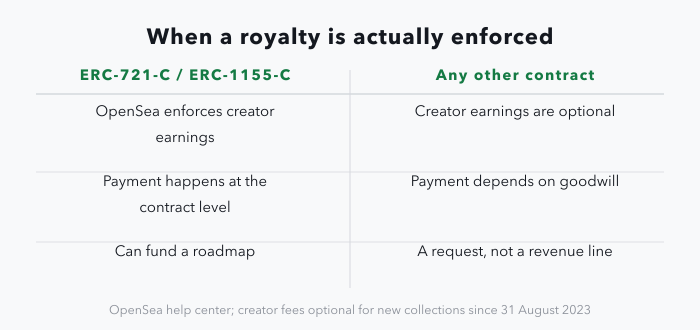
If your collection is not on an enforcing standard, secondary royalties are a request, not a revenue line. Any roadmap you market on the strength of them is a promise you may not be able to keep. Either deploy on a standard that enforces payment, or fund the work another way and say so.
Community, sized honestly
Discord is still where most NFT projects run their community, and it is still large: more than 90 million daily active users as of Q4 2025 on Discord's own internal data, a last-stated figure of over 200 million monthly active users from Discord in February 2026, and 21 million active servers reported by Business of Apps for 2023. Those figures and their sources are on our Discord statistics page.
What has changed is the cost side. A project Discord in 2026 needs moderation against wallet-drainer scams from the day it opens, and that is staffing, not a growth tactic. Budget for a moderator rota before you budget for a launch party.
The crypto-native alternatives are smaller than their coverage suggests. Farcaster, the most discussed of them, publishes no audited user numbers, and the daily active user counts quoted for it in 2026 trace back to community dashboards rather than to the company, so no figure for it is given here. Nothing published for any crypto-native social network comes close to Discord's scale. Treat them as places to talk to developers, not as launch channels.
Sell the thing, not the ticker
The projects still moving units in 2026 are the ones selling something a buyer wants for its own sake, marketed through ordinary consumer channels rather than crypto ones.
Pudgy Penguins is the clearest example. It put plush toys into physical retail — 2,000 Walmart locations by September 2023 and 2,000 Walgreens stores by June 2025, passing a million units sold and more than $13 million in retail sales by 2024 — and each toy carries a code that brings the buyer into the digital product. Those figures come from a CoinDesk Research report published 30 December 2025 and updated 28 February 2026, which carries the line "Commissioned by Pudgy Penguins" at its head; treat them as the company's account of its own performance. Higher store counts circulate for 2026, but the sources repeating them state no methodology, so they are not reproduced here.
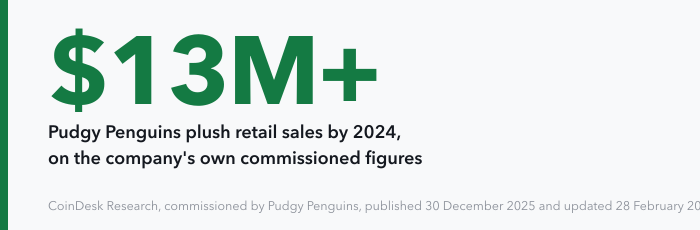
The point stands regardless of the exact numbers. The buyer does not need a wallet, or to know what an NFT is, to become a customer. The sequence is the reverse of the 2021 one: retail first, crypto second.
NBA Top Shot is the other long-running case, still trading in 2026 and selling sports highlights to sports fans. Dapper Labs states on its own site that the platform has "1.6M+ collectors" and "$1.2B+ in sales" to date. That is self-reported and unaudited, and no third party publishes an equivalent figure.
The pattern in both is that the product is legible to someone who does not care about blockchains. If the only reason to buy your NFT is that it might be worth more later, you are not doing marketing, and the next section explains why that is also a legal problem.
Paid promotion is a compliance question now
The FTC's Endorsement Guides require disclosure of a material connection between an endorser and the thing endorsed. Payment, free product, affiliate commission, equity and personal relationships all count. The FTC's Disclosures 101 for Social Media Influencers tells endorsers to place the disclosure so it is "hard to miss," and warns against burying it on a profile page, at the end of a video, behind a MORE link, or in a block of hashtags.
For crypto specifically, the anti-touting provision of the securities laws applies on top. The SEC charged Kim Kardashian on 3 October 2022 for promoting EthereumMax's EMAX token without disclosing that she had been paid $250,000 to do it; she agreed to pay $1.26 million, comprising about $260,000 in disgorgement and interest and a $1 million penalty, and not to promote crypto asset securities for three years. The SEC's position was that anyone promoting a crypto asset security "must disclose the nature, source, and amount of compensation they received in exchange for the promotion." That was a token rather than an NFT, but the rule does not turn on the asset's format.
The other cost of influencer launches is the tail. Logan Paul's CryptoZoo, the standard example of an influencer-fronted NFT project, ran a buyback program for holders in early 2024. The class action, Holland v. CryptoZoo, was dismissed on 29 October 2025, but 26 of its 27 counts were dismissed with leave to amend; plaintiffs filed a second amended complaint on 12 November 2025, Paul moved to dismiss that complaint on 30 January 2026, briefing finished in the spring, and no ruling had been reported as of September 2026. Whatever the eventual outcome, that is more than three years of a project's name attached to litigation.
If you use paid promotion, put the disclosure in the post, keep the contract, and do not let the endorser make claims about price.
Your marketing copy is evidence
The most useful case for a marketer is Friel v. Dapper Labs. On 22 February 2023, Judge Victor Marrero of the Southern District of New York refused to dismiss a claim that NBA Top Shot Moments had been sold as unregistered securities. Part of his reasoning was Dapper's own social media: as Skadden summarized the ruling, tweets showing market performance with rocket ship, money bag and stock chart emojis "objectively mean one thing: a financial return on investment." Dapper Labs agreed a $4 million settlement in 2024, approved that October, while maintaining that Moments are not securities.
The SEC also brought two NFT cases on the same theory of marketing creating an expectation of profit: Impact Theory settled on 28 August 2023 for $6.1 million in disgorgement and penalties, and Stoner Cats on 13 September 2023 for a $1 million penalty plus a fund to repay purchasers.
Federal enforcement has since eased considerably. The SEC closed its investigation into OpenSea in February 2025 without charges, and closed its three-year Yuga Labs investigation without charges in March 2025. The Digital Asset Market CLARITY Act, which would draw a statutory line between securities and digital commodities, passed the House on 17 July 2025 by 294 votes to 134 and cleared the Senate Banking Committee 15–9 on 14 May 2026, but a cloture vote failed 50–49 on 15 September 2026, short of the 60 needed. It is not law as of 23 September 2026.
Read those together. The agency's appetite changed; the statute did not, and private plaintiffs never needed the SEC. Friel was a class action. The practical rule for a marketer is unchanged: a rocket emoji next to a price chart is an argument that you sold an investment. Write copy you would be content to have read back to you in court.
Measure demand, not volume
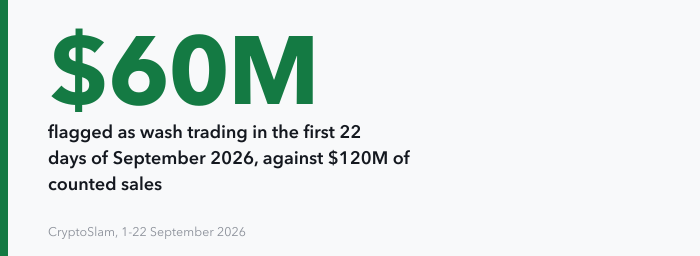
Reported trading volume is the worst metric available for an NFT project, because a large share of it is not real. Between 1 and 22 September 2026, CryptoSlam excluded about $60 million of flagged wash trading against about $120 million of counted sales, a figure recorded on our NFT statistics page. That is one flagged dollar for every two counted, or a third of gross activity being somebody selling to themselves.
Marketplace token incentives pushed the same way, and their history matters because it is still sitting in the benchmarks. OpenSea ran a points-for-trading rewards program in OS2 and lined up a SEA token to be distributed against those points. Chief executive Devin Finzer postponed the token indefinitely on 16 March 2026, and the same announcement ended the rewards waves; the final wave closed on 30 March 2026, and OpenSea's help center states that no further waves are planned. Volume farmed for an airdrop that never arrived was never demand for anyone's collection.
Metrics that are harder to fake, and more useful:
- Unique holders over time, not wallets. Distinguish new holders from existing ones splitting inventory.
- Sell-through on a primary drop, stated as a percentage of supply and a number of distinct buyers.
- Retention at 30 and 90 days: what share of buyers still hold.
- Non-trading engagement: for a product with actual utility, how many holders used the thing.
- Floor price with volume attached. A floor quoted with no depth behind it tells you nothing.
Who does this work, and what it pays
If you are hiring for this or looking for the job, here is what our own listings show.
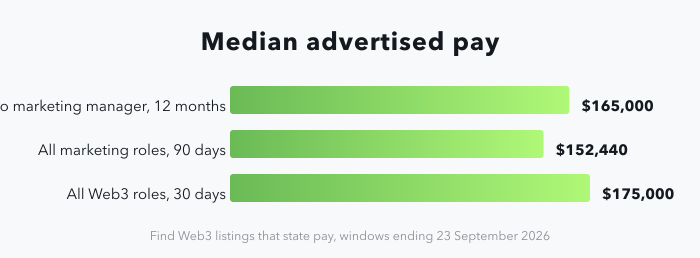
- Crypto marketing manager: $165,000 median, across 97 listings that state pay, posted in the last 12 months (salary page).
- Marketing as a category: 201 roles posted in the last 90 days at a $152,440 median (Web3 jobs report).
- Across all categories: 2,172 roles posted in the last 30 days, at a $175,000 median from the 1,185 listings that state a figure.
NFT work is a small slice of that. The term "NFT" appears in 84 of the 4,212 job adverts counted in our Web3 dictionary for the year to 23 September 2026, and "airdrop" in 6. Employers with NFT or consumer-crypto products hiring right now include Magic Eden, Animoca Brands and Axie Infinity, among the 104 companies with roles posted in the last 30 days as of September 2026.
The practical read: a marketer who can run a consumer product launch has far more crypto employers to choose from than one who only knows mint mechanics.
What we removed from this article
This page was previously a list of seven tactics written for the 2021–22 market. The following claims were cut because they could not be sourced, were no longer true, or described a market that no longer exists.
- Case studies built on Bored Ape Yacht Club, CryptoPunks, Azuki, DeGods, Moonbirds, Wolf Game, Loot and Forgotten Runes as live marketing models. Most describe 2021–22 conditions. Yuga Labs has since divested Meebits, CryptoPunks and, on 30 May 2025, the Moonbirds IP, which went to Orange Cap Games.
- The claim that Nike's RTFKT acquisition demonstrates an ongoing brand strategy. Nike wound RTFKT down by the end of January 2025 and the site is now an archive.
- Adidas "Into the Metaverse," Time magazine's NFT covers and Taco Bell's NFT drop as current brand-collaboration examples. All are 2021–22 campaigns presented without dates.
- Advice to build a launch around influencer endorsement, with no mention of FTC disclosure requirements or the securities anti-touting rule.
- Endorsement examples naming Snoop Dogg, Paris Hilton, Eminem and Jimmy Fallon, offered as evidence that celebrity promotion works, with no source for any effect on sales.
- CryptoZoo described as highlighting "the immense potential of influencer-driven NFT projects," omitting the buyback program and the litigation.
- All references to royalties as a sustainable revenue stream, which have not been enforced by default on OpenSea since August 2023.
- Every reference to marketplaces that have closed or withdrawn.
- A 2023 conference panel video on NFTs and gaming, embedded in a section about marketing.
- Three decorative illustrations whose subjects did not match the sections they headed.
- Approximately 3,200 words of unsourced generalization about "credibility transfer," "FOMO," "viral potential" and similar, along with a comparison matrix whose ratings had no basis.