Solidity Tutorial for Beginners: From Setup to Deployment
Set up a Solidity environment, learn the value and reference types, then write, test and deploy a first contract to a testnet.
Why Solidity Matters
Solidity is the main language for writing smart contracts on Ethereum. A smart contract is a program stored on the blockchain that runs when someone calls it, and smart contracts are what decentralized applications (dApps) are built from.
Solidity borrows its syntax from C++, JavaScript and Python, so most of the structure is familiar: curly braces, typed variables, functions, inheritance. What is new is everything specific to the blockchain — gas costs, code that cannot be changed once deployed, storage that persists between calls, and the fact that anyone can call your public functions.
Real-World Applications and Career Impact
Solidity contracts run decentralized finance (DeFi) protocols, NFT collections and on-chain governance. Behind a token, a lending market or a DAO vote, a Solidity contract is doing the work.
That makes it a marketable skill. Find Web3 publishes median pay by role, taken from listings that state a salary, and a monthly hiring report by category. Terms you will meet in job adverts are defined in the Web3 glossary.
Setting Up Your Development Environment
Choosing the Right Environment
You have two realistic starting points.
- Online IDE (Remix): a browser environment with nothing to install. The compiler, debugger and deployment tools are all in one page, which makes it the fastest way to compile your first contract.
- Local IDE (VS Code + Hardhat): more setup, more control. Hardhat handles compiling, testing and deploying across networks, and it is what most production projects use.
| Development Environment | Setup Difficulty | Key Features | Best For | Limitations |
|---|---|---|---|---|
| Remix | Easy | Browser-based, all-in-one platform, compiler, debugger, deployment tools | Beginners, quick prototyping | Limited customization, relies on an internet connection |
| VS Code + Hardhat | Moderate | Local development, scriptable compiling, testing and deployment, version control | Larger projects, work you intend to ship | Requires installation and configuration |
Setting Up a Local Development Environment
Install VS Code, then add the Solidity extension for syntax highlighting and code completion. Install Node.js and npm, which the Solidity tooling runs on. Then install Hardhat through npm and create a Hardhat project — that gives you a contracts folder, a test folder and a config file to work in. A linter such as Solhint is worth adding early; it catches style problems and some unsafe patterns before you compile.
Selecting a Network: Testnet vs. Mainnet
Deploying to mainnet spends real ether. Testnets use test ether from a faucet, which has no monetary value, so you can deploy and redeploy freely.
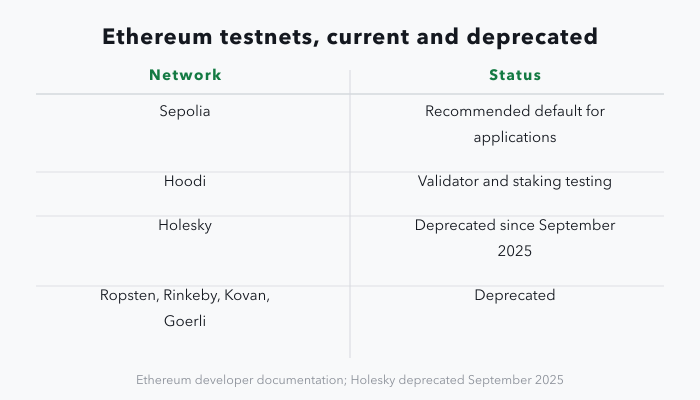
Be careful with older tutorials here, because most of the testnets they name are gone. Ethereum's developer documentation lists Ropsten, Rinkeby, Kovan and Goerli as deprecated, and Holesky as deprecated since September 2025. Sepolia is the recommended default testnet for application development; Hoodi is the current network for validator and staking testing.
Troubleshooting and Avoiding Common Pitfalls
Two problems account for most first-day failures. The first is a compiler version mismatch: the pragma line in your file has to be satisfied by the compiler version configured in Hardhat or selected in Remix. The second is missing dependencies — if an import cannot be resolved, check that the package is actually installed in the project rather than globally.
Solidity Fundamentals: Data Types
Solidity is statically typed: every variable has a declared type, and the type affects both what the variable can hold and what it costs to use.
Value Types: The Building Blocks
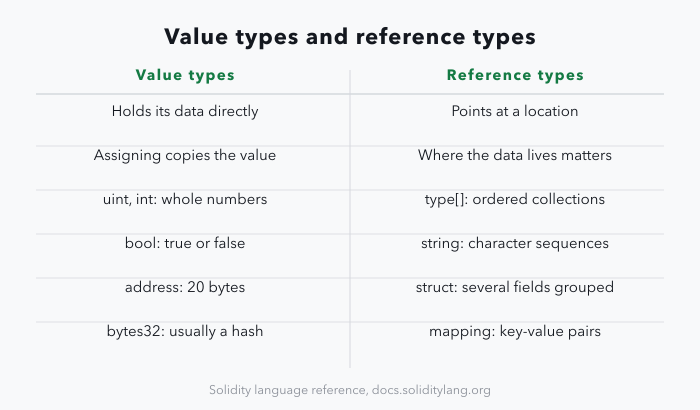
A value type holds its data directly. Assigning one, or passing it to a function, copies the value.
- Integers (
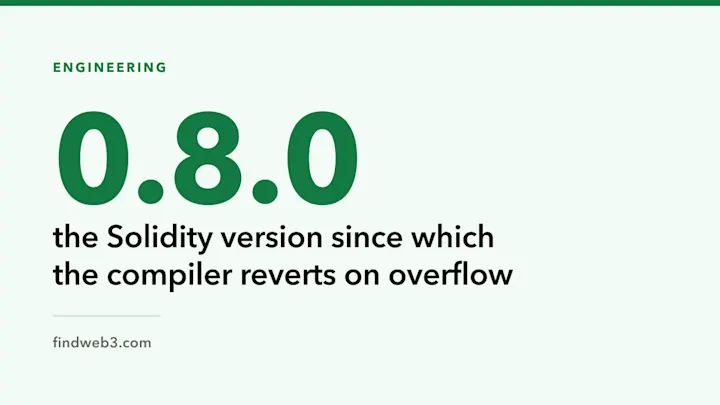
int,uint): whole numbers.uintis unsigned (non-negative),intallows negatives. The suffix is the width in bits —uint8holds 0 to 255,uint256is the default and the cheapest to work with. Since version 0.8.0 the compiler reverts on overflow and underflow by default. - Booleans (
bool):trueorfalse. - Addresses (
address): a 20-byte Ethereum address, identifying a wallet or a contract.address payableis the variant that can receive ether. - Bytes (
bytes1,bytes32, etc.): fixed-size byte arrays.bytes32is the usual home for a hash. For variable length, usebytes.
In a contract tracking ownership of digital assets, a uint256 would hold each asset's ID and an address would hold its owner.
Reference Types: Managing Collections
A reference type points at a location rather than carrying the data, so where it lives matters.
- Arrays (
type[]): ordered collections of one type, either fixed-size (type[n]) or dynamic (type[]). - Strings (
string): sequences of characters. Solidity has almost no built-in string manipulation, so comparisons are usually done by hashing. - Structs (
struct): custom types grouping several fields — a product with a name (string), a price (uint256) and availability (bool). - Mappings (
mapping(keyType => valueType)): key-value pairs, like a dictionary. A token contract stores balances in a mapping fromaddresstouint256. Mappings cannot be iterated and have no length; if you need to list the keys, you have to track them separately.
Storage Locations: Understanding Where Your Data Lives
Solidity has three data locations: storage, memory and calldata. Storage is permanent state kept on-chain between transactions. Memory is scratch space that exists only for the duration of a function call. Calldata is the read-only area holding the arguments of an external call.
The cost order is the point to remember: storage is by far the most expensive, memory is cheaper, and calldata is cheapest. Reading a large array into memory to work on it, rather than reading and writing storage repeatedly, is one of the easiest gas savings available to a beginner.
Building Your First Smart Contract
Here is a minimal token contract, built one piece at a time.
Structuring Your Smart Contract
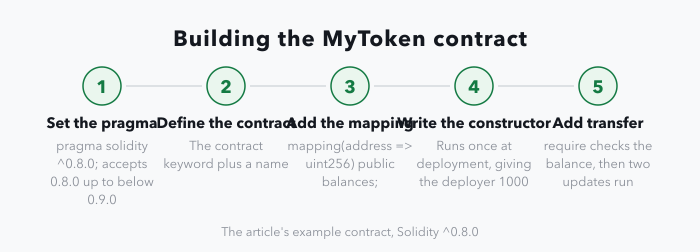
- Specify the compiler version: the
pragma soliditydirective controls which compilers will accept the file.pragma solidity ^0.8.0;means 0.8.0 or later, but below 0.9.0. - Define the contract: the
contractkeyword plus a name. Everything between the braces belongs to the contract.
Implementing Essential Functionality
- Define the balances mapping:
mapping(address => uint256) public balances;links each address to a balance. Thepublickeyword makes the compiler generate a getter so the value can be read from outside. - Create the constructor: the constructor runs once, at deployment.
constructor() { balances[msg.sender] = 1000; }gives the deploying account the entire initial supply. - Implement the transfer function:
requirechecks the sender's balance before the two updates run. If the check fails, the whole transaction reverts and no balance changes.
Annotated Code Example
pragma solidity ^0.8.0;

contract MyToken {
 mapping(address => uint256) public balances;

 constructor() {
 balances[msg.sender] = 1000;
 }

 function transfer(address _to, uint256 _amount) public {
 require(balances[msg.sender] >= _amount, "Insufficient balance");
 balances[msg.sender] -= _amount;
 balances[_to] += _amount;
 }
}
This compiles and works, but it is a teaching example rather than a real token. It is not ERC-20 compliant: there is no Transfer event, no approve or transferFrom, and no name, symbol or decimals, so wallets and exchanges will not recognize it. For anything real, start from the OpenZeppelin ERC-20 implementation instead of writing your own.
From here the natural next steps are token standards, access control, and the security patterns below. Blockchain engineering roles that use this work are listed on Find Web3.
Testing and Deploying Your Contracts With Confidence
Why Testing Matters in Solidity
Deployed contract code is immutable. There is no patch release. A bug that reaches mainnet stays there, and if the contract holds assets, someone else may find it first. Testing is not a formality in Solidity; it is the only chance you get.
Essential Testing Frameworks
- Hardhat: Hardhat runs a local Ethereum network, compiles, and runs tests written in JavaScript or TypeScript.
- Foundry: Foundry takes a different approach — tests are written in Solidity itself, and it is considerably faster. It includes Anvil, a local node, and built-in fuzz testing.
Older tutorials will point you at Truffle and Ganache. Consensys announced their sunset in September 2023 and the repositories are now public archives, so start with Hardhat or Foundry instead.
Writing Effective Test Cases
- Test critical functionality: confirm the core paths do what they should. For the token above, that means a successful transfer moves exactly the right amount between exactly the right two balances.
- Cover edge cases: zero-value transfers, transfers to the zero address, a transfer of the sender's entire balance, a transfer of one more than the balance.
- Test the attack cases: reentrancy, where a called contract calls back into yours before the first call finishes, and access control, where a function that should be restricted turns out not to be.
Local Environments and Testnet Deployments
Develop against a local node first — Hardhat Network or Anvil — where there are no gas costs and you can reset state instantly. Move to Sepolia once the contract works, because a testnet exposes the things a local node hides: real block times, real gas estimation, and the deployment process itself.
Deployment Workflow
| Network Type | Purpose | Gas Costs | Deployment Speed | When To Use |
|---|---|---|---|---|
| Local (Hardhat Network, Anvil) | Development and testing | None | Instant | Initial development and debugging |
| Testnet (Sepolia) | Simulated mainnet environment | Test ether from a faucet, no monetary value | Normal block times | Final testing before mainnet deployment |
| Mainnet | Live blockchain | Real ether | Normal block times | Production deployment |
Professional Patterns That Save Time and Prevent Disasters
Factory Pattern: Streamlining Contract Deployment
A factory is a contract that deploys other contracts. If your application lets every user create their own token or vault, a factory contract handles the deployment on demand and keeps a record of what it created, instead of you deploying each instance by hand.
Proxy Pattern: Enabling Contract Upgrades
Because contract code cannot be changed, upgrades are handled by separating logic from storage. A proxy contract holds the storage and the address users interact with, and forwards calls via delegatecall to a logic contract that can be replaced. This is powerful and easy to get wrong — storage layout must stay compatible between versions, and whoever controls the upgrade controls the contract. Use an audited implementation such as OpenZeppelin's rather than writing your own.
Guard Checks: Reinforcing Transaction Security
require statements enforce conditions before the rest of a function runs, and revert the entire transaction if the condition fails. Checking that the caller has the balance, has the permission, or passed a sane argument is the cheapest security you can write. The related convention is checks-effects-interactions: validate first, update your own state second, and call out to other contracts last, which is what prevents reentrancy.
Taking Your Next Steps in Blockchain Development
Build Practical Projects
Start small and finish things: a voting contract, a simple escrow, a multi-signature wallet. Finished small projects teach more than abandoned large ones, and they give you something to show.
Level Up Your Solidity Expertise
Move on to inheritance, libraries and interfaces, then to the security material — the Solidity documentation's security considerations section, and the known vulnerability classes. Specializing helps: DeFi protocol design and NFT platform architecture are different enough that people hire for one or the other.
Contribute to Open Source
Solidity projects on GitHub take contributions, and reading a mature codebase teaches patterns no tutorial covers. Start with documentation fixes and small bugs.
Participate in Hackathons
Hackathons force you to build something end to end in a fixed window, which surfaces the gaps in your knowledge quickly. They are also where a lot of Web3 hiring conversations begin.
Full reference documentation lives at docs.soliditylang.org. When you are ready to look at roles, Find Web3 lists blockchain and crypto jobs.