Web3 Development Courses: What You Can Still Join in 2026
Five Web3 development courses open when we checked in September 2026, what each costs and assumes, and three that lists still recommend but you cannot join.
Five courses still running, and three you cannot join
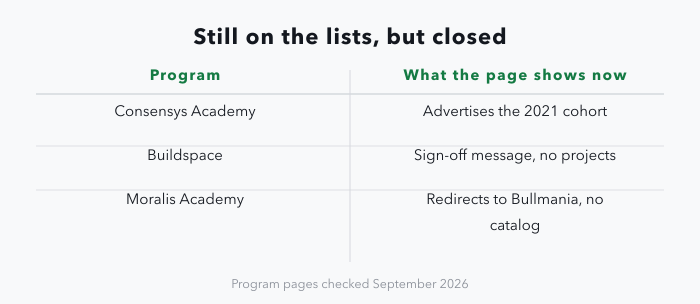
Web3 course lists go stale fast. Three of the programs that appear on almost every one of them — Buildspace, Moralis Academy and Consensys Academy's bootcamp — can no longer be joined in the form they get recommended in. The five below were open and taking students when this page was checked in September 2026. Each entry says what the course covers, what it costs, and what it assumes you already know.
1. Alchemy University Ethereum Bootcamp
Alchemy University's Ethereum Bootcamp covers EVM development from the ground up: how accounts, transactions and the virtual machine work, then Solidity, contract deployment, and building a dApp against a node provider. Alchemy's own page lists 91 lessons and no fee (checked September 2026). There is no application round and no income share agreement, despite older write-ups that describe both.
The material leans on Alchemy's developer platform, its node infrastructure, APIs and testnet tooling. That is a fair reflection of how most dApp front ends are actually built, and also a reason to try an alternative provider afterwards so you can tell the platform from the protocol. Be comfortable with JavaScript before you start; the course moves past general programming quickly.
Cost: free. Site: alchemy.com/university
2. Ethereum and Solidity: The Complete Developer's Guide (Udemy)
Stephen Grider's Udemy course is the default self-paced option. It starts with blockchain fundamentals and works through Solidity, contract testing and deployment, and connecting contracts to a React front end, which is the whole path to a working dApp rather than a contract in isolation. The main build is a crowdfunding contract in the style of Kickstarter.
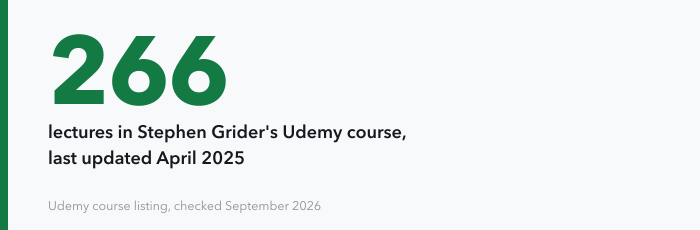
Udemy's listing shows 266 lectures and 23 hours 58 minutes of video, last updated April 2025 (checked September 2026). It is a one-time purchase with lifetime access, and Udemy's list price moves constantly with its own sales, so check what it costs on the day rather than trusting a quoted figure. There is no cohort and no direct instructor time; questions go to the course Q&A.
Site: Ethereum and Solidity: The Complete Developer's Guide
3. Chainlink Developer Bootcamp
Chainlink runs recorded, instructor-led bootcamps that are free to register for. They teach Solidity alongside the problem Chainlink exists to solve: getting off-chain data into a contract. That means price feeds and Verifiable Random Function for things like dynamic NFTs and provably fair draws, with separate tracks for CCIP, Solana and the Chainlink Runtime Environment.
Sessions are on demand, so you can start any time, and Chainlink states that no software engineering background is required, though some helps. Content is available in several languages including Spanish, Portuguese, Mandarin and Vietnamese. The obvious limit is scope: everything is taught through Chainlink's own stack, so pair it with a more general course rather than making it your first and only one.
Cost: free. Site: chain.link/bootcamp
4. Metaschool
Metaschool is built around shipping a project and picking up the concepts on the way: an NFT marketplace, a token, a small game. It covers more chains than anything else here, including Ethereum, Polygon, Solana, Aptos, Sui and ZKsync, and has since expanded into AI projects alongside Web3. Most courses are free, with paid content on longer paths.
The trade-off is structure. There is no set syllabus and no cohort, so it works well if you want portfolio pieces and badly if you want to be told what to learn next. Some of the later projects assume you already know Solidity, so expect to fill gaps from elsewhere.
Site: metaschool.so
5. Web3 University
Web3 University is a free library of tutorials and learning roadmaps, including the ten-week Road to Web3 track. It is run as a collaboration between several organizations with Alchemy as lead partner, rather than as an Alchemy product.
The caveat matters more than the content: the newest articles on the site are dated July 2023 (checked September 2026). The fundamentals still hold, but library versions, APIs and tooling have moved on since, so treat it as background reading and check any command or dependency against current documentation before you rely on it. There is no certificate and no formal structure.

Site: web3.university
Three you cannot join
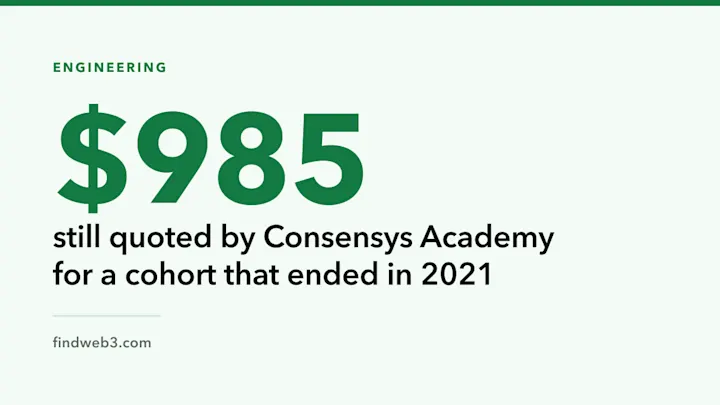
Consensys Academy. The bootcamp — contract development, smart contract security, token standards and dApp architecture, run by the company behind MetaMask and Infura — is the one people are most often still pointed at. Its page is live and still quotes $985 with certification for a 10 to 12 week cohort, but the cohort it advertises is the 2021 one, final projects on it were due in December 2021, and the single registration link on the page points at courses.consensys.net, a hostname that no longer resolves anywhere (checked September 2026). The course may come back; at the time of writing there is no way to enrol in it.
Buildspace. Free project cohorts with NFT completion credentials, widely recommended and now gone. buildspace.so shows a sign-off message and nothing else; there are no projects to join. Any course list that still includes it has not been checked in years.
Moralis Academy. Formerly Ivan on Tech Academy. academy.moralis.io now redirects to Bullmania's academy, which does not publish a course catalog or prices and asks prospective students to email support about the next cohort. The $29 to $49 a month subscription quoted in older reviews no longer applies, and the Moralis tooling integration that was the reason to pick it is no longer the pitch.
How the five compare
| Program | Format | Cost | Assumes |
|---|---|---|---|
| Alchemy University Ethereum Bootcamp | Self-paced, 91 lessons | Free | JavaScript |
| Ethereum and Solidity: The Complete Developer's Guide (Udemy) | Self-paced video, ~24 hours | One-time purchase, price varies | JavaScript, some React |
| Chainlink Developer Bootcamp | Recorded sessions, on demand | Free | No engineering background required |
| Metaschool | Self-directed projects, multi-chain | Free and paid tiers | Basic programming; later projects assume Solidity |
| Web3 University | Free tutorials and roadmaps | Free | Basic programming; content dated 2023 |
After the course
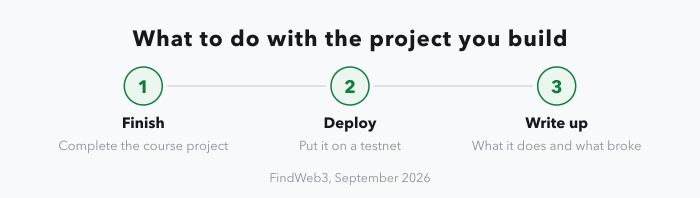
No Web3 employer hires on a certificate. What gets read is a deployed contract, a verified address, a repository with tests in it and a front end someone can click. Every program here produces at least one; finish the project, deploy it to a testnet, and write up what it does and what broke.
For what the work pays and who is hiring, this site keeps its own numbers rather than borrowing market forecasts: median pay by role, taken from listings that state a salary, the Web3 jobs report for hiring by month and category, and the companies currently hiring. Open developer roles are at findweb3.com/jobs/blockchain.