What Are Smart Contracts and How Do They Work?
How a smart contract executes itself on a blockchain, how it differs from a written contract, and where industries already use one.
A smart contract is a piece of code that carries out an agreement automatically once its conditions are met. It runs on a blockchain, and no intermediary has to approve the outcome.
The closest everyday comparison is a vending machine. You put in the money, and the machine releases the snack. No cashier decides whether you deserve it. A smart contract works the same way: the terms are written as code, and the code runs when the conditions are satisfied.
Getting to the Core of Smart Contracts
Instead of writing terms in legal language and relying on a court or a company to enforce them, a smart contract writes them as a program. Once deployed, that program lives on a blockchain — a shared record that all participants can read and that no single party can quietly rewrite.
The logic is "if this happens, then do that."
A contract might hold a single rule: if a delivery is confirmed on the chain, release the payment to the seller. The network checks whether the condition has been satisfied and executes the code exactly as written. There is no step where someone decides whether to honor the agreement.
If some of this terminology is new, the Web3 dictionary covers the basics.
Smart Contracts vs. Traditional Contracts at a Glance
Both kinds of contract define the rules of an interaction. How they are enforced, changed and paid for is where they diverge.
| Feature | Smart Contract | Traditional Contract |
|---|---|---|
| Enforcement | The code executes itself once conditions are recorded on-chain | Depends on lawyers, courts or arbitration |
| Speed | Settles in seconds or minutes once conditions are met | Days to months |
| Trust | Placed in the code, and in whoever reports outside facts to it | Placed in intermediaries and the legal system |
| Cost | No intermediary fees, but every execution costs a network fee | Legal fees and administrative overhead |
| Transparency | Code and transactions are public on most chains | Usually private to the parties involved |
| Amendment | Fixed after deployment, unless it was built to be upgradeable | Can be amended whenever both sides agree |
The trade-off runs both ways. A smart contract will not stall, forget or renege. It also cannot be reasoned with: it does what it says, including when what it says is wrong.
How a Smart Contract Actually Works
Take a worked example. A freelance designer, Alex, agrees to make a logo for a startup, Innovate Co. In the ordinary arrangement, Alex has no guarantee of being paid on time and Innovate Co. does not want to pay before seeing the work.
They deploy a smart contract on a chain like Ethereum instead. The agreement reduces to one rule: when the logo is confirmed as delivered, transfer 1 ETH from the contract to Alex's wallet.
The Life Cycle of an Agreement
- Creation and funding. The agreed terms are written as code and deployed. Innovate Co. sends 1 ETH into the contract itself, where it sits in escrow. Both parties can see the balance on the chain, and neither can move it except through the contract's own rules.
- Delivery. Alex finishes the logo and hands over the files.
- Confirmation. This is the step most explanations skip. A blockchain cannot see a file being uploaded — it only knows what has been written to it. So the delivery has to be reported on-chain: either Innovate Co. signs a transaction confirming receipt, or an agreed outside data source, called an oracle, reports it. Whoever plays that role is trusted, which is where some of the trust the arrangement was meant to remove comes back in.
- Settlement. Once the condition is recorded, the contract releases the 1 ETH to Alex's wallet. There is no invoice to chase and no accounts payable queue to sit in.
The Blockchain as an Unbiased Enforcer
What makes this work is not the code alone but the ledger it runs on. Every step — funding the contract, confirming delivery, releasing the payment — is written as a permanent transaction that both parties and anyone else can inspect.
Two properties do most of the work:
- Immutability: once the contract is deployed, its code cannot be edited. Innovate Co. cannot decide to pay less, and Alex cannot change the delivery requirements after the fact.
- Transparency: on a public chain, both sides can check the contract and the state of the funds at any time, which removes the argument about whether the conditions were met.
Cryptography and a distributed set of validators mean no single participant can rewrite the record of what happened. What the parties still have to agree on is what the code should say and who is allowed to report outside facts to it.
The Real Payoffs of Smart Contracts
Smart contracts attack three weak points in ordinary agreements: the time they take, the people who have to be paid along the way, and the possibility that one side simply does not follow through.
Speed
Traditional contracts stall in paperwork, email chains and manual sign-offs. An international property sale can take weeks, most of it waiting on banks and lawyers.
A smart contract executes as soon as its conditions are recorded, and a blockchain network does not keep business hours: it settles at three in the morning on a public holiday exactly as it would on a Tuesday. Transferring ownership of a digital asset, which can take days through intermediaries, finishes in minutes.
Cost
Every party in the middle of a conventional deal — lawyer, broker, banker, escrow agent — takes a cut. Removing them from the execution step removes their fees. What is left is the network fee for running the transaction, which on a busy chain is not always trivial but is generally far below professional fees.
Royalties are a clear case. Rather than a publisher collecting and distributing payments quarterly, a contract can send a payment to an artist's wallet each time a defined event is reported.
Security and Transparency
A deployed contract's code is immutable, so the terms cannot be altered afterward, and every action against it is logged where anyone can audit it.
It is worth being precise about what that secures. The chain itself is extremely hard to tamper with. The contract running on it is only as good as the code someone wrote, and that code is permanent too. Most large losses in this field have come from flaws in contracts, not from broken blockchains.
Autonomous Execution
A smart contract does exactly what it was programmed to do, every time, without anyone pressing a button. That removes the interpretation, the delay and the discretion that human enforcement introduces — which is the point when the two parties are strangers who have no basis for trusting each other.
Smart Contracts in Action Across Industries
Finance
Decentralized finance, or DeFi, is the largest working example. Lending protocols and automated exchanges are built entirely from self-executing code.
On a DeFi lending protocol, a smart contract stands in for the bank. A borrower locks digital assets as collateral, and the contract releases a loan against them. It then handles interest and, if the collateral's value falls below a set threshold, liquidates the position — all without anyone approving the steps. For how large that sector has become, see the key DeFi statistics on this site.
Supply Chains
Moving a product from a factory to a doorstep involves many parties and a great deal of paperwork, which makes delays and disputes hard to resolve. A smart contract can hold a single shared record of a shipment's journey.
For a shipment of coffee beans traveling from a farm to a café, the contract can log the harvest, record a customs sign-off, and release payment to each party when delivery is scanned at the other end. Every party sees the same record and no one can quietly alter it after the fact.
The caveat is the same one as before: the chain only knows what has been reported to it. A scanner, a sensor or a customs official still has to submit the data honestly, and the contract cannot tell whether the box actually contains coffee.
Insurance
Filing an ordinary insurance claim means forms, a manual review and a wait. Parametric policies replace that with a rule that can be checked automatically.
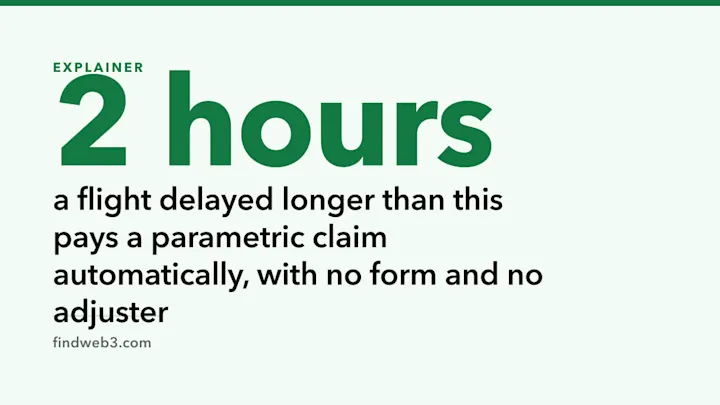
Flight delay cover is the standard example. The policy holds one condition: if the flight is delayed by more than two hours, pay the claim. An oracle feeds the contract flight data from an agreed source, and when a qualifying delay is reported, the payout goes to the traveler's wallet. There is no form and no adjuster — but the policy only covers what can be measured this way, which is why parametric insurance works for flight delays and not for a disputed medical claim.
Choosing the Right Platform for Smart Contracts
Every smart contract needs a chain to run on, and the choices differ in cost, speed and maturity.
The conversation usually starts with Ethereum, the first blockchain built to run general-purpose contract code. It has the largest developer community, the most deployed contracts and the most battle-tested tooling. Its native language, Solidity, was designed for the job, and the volume of documentation and libraries around it makes it the usual starting point.
Ethereum
Ethereum's strengths are its decentralization and the size of the validator set securing it, which make it reliable and hard to censor. The cost of that is congestion: when the network is busy, transactions slow down and gas fees rise. It still hosts the majority of DeFi and NFT activity.
Other Major Platforms
Solana was designed for throughput and low fees, which suits applications that cannot tolerate delay, such as on-chain games and trading venues. Its programs are written mainly in Rust.
Cardano takes a more academic approach, with an emphasis on formal verification — mathematically proving that code behaves as intended. That focus appeals to high-stakes financial applications where a single bug is expensive. Contracts are written in Plutus, which is based on Haskell.
Polkadot is built for interoperability: letting separate chains exchange messages and value rather than forcing a project to pick one isolated network. Contracts run on the parachains connected to it rather than on the central relay chain.
As these platforms have matured, hiring has specialized along with them; the blockchain development roles on this site are usually posted for a specific chain and language rather than for blockchain experience in general.
Comparing Top Smart Contract Platforms
| Platform | Primary Language | Key Advantage |
|---|---|---|
| Ethereum | Solidity | Largest ecosystem, most deployed contracts |
| Solana | Rust | High throughput and low fees |
| Cardano | Plutus (Haskell-based) | Emphasis on formal verification |
| Polkadot | Rust (ink!) | Cross-chain messaging between parachains |
Published throughput figures are left out here deliberately: the headline numbers platforms quote are theoretical maximums measured under ideal conditions, and they are not comparable across chains. There is no single best platform. An NFT project generally wants Ethereum's audience; a game making thousands of small transactions wants whichever chain charges least per transaction.
Challenges and the Future of Automated Agreements
Code immutability cuts both ways. A deployed contract cannot be edited, which is what makes it tamper-proof — and also means a bug is permanent. There is no undo, which is why auditing before deployment is not optional.
Scalability is the second constraint. When a network is busy, transactions slow and gas fees rise, which makes smart contracts impractical for anything that depends on large numbers of small, cheap interactions.
The Real-World Data Problem
The oracle problem is the hardest of the three. Blockchains are closed systems: they cannot fetch the price of gold, the weather in Tokyo or a football result on their own. Getting outside data in requires an oracle.
That reintroduces a trusted party into a system built to avoid one. If an oracle reports bad data, by error or by design, the contract will act on it and pay out accordingly — correctly, by its own logic, and wrongly in every sense that matters. Building oracles that are hard to corrupt is one of the open problems in the field.
Legal status is still unsettled. Whether a smart contract is binding, and what happens when the code and the parties' intentions diverge, is being worked out jurisdiction by jurisdiction.
What Is Being Built
- Layer-2 scaling: rollups and sidechains process transactions off the main chain and post the results back to it, which brings costs down substantially and addresses the throughput limit directly.
- Safer languages: newer contract languages are designed with the common and expensive failure modes in mind, making certain classes of bug harder to write.
Common Questions About Smart Contracts
Are Smart Contracts Legally Binding?
It depends where you are. Some jurisdictions have passed legislation recognizing them; others have not addressed the question. In practice, a smart contract's legal standing usually turns on whether the underlying arrangement meets the ordinary requirements of a contract — offer, acceptance and consideration — rather than on the fact that it is written in code.
Can a Smart Contract Be Changed or Updated?
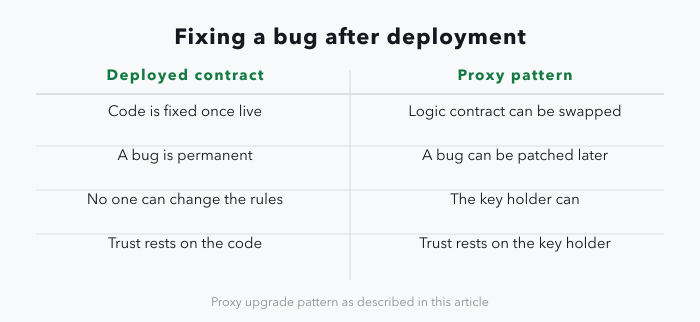
Not directly. Once deployed, the code is fixed, which is the security property the whole model rests on.
Developers work around this with upgrade patterns. A proxy contract keeps the address and the stored data while pointing at a separate contract holding the logic, so the logic can be replaced. This is a genuine trade-off rather than a free fix: whoever controls the upgrade can change the rules, so an upgradeable contract is only as trustworthy as the people or governance process holding that key.
What Is the Biggest Risk?
A bug in the code. Smart contracts are permanent and often hold valuable assets, so a vulnerability can be exploited and the losses are generally irreversible. This is why audits and testing by security specialists are standard practice before anything holding real money is deployed, and why auditing is now its own career track: blockchain security engineer is one of the fifteen roles tracked on the salaries page.
Find Web3 lists Web3 and blockchain roles, including smart contract development and auditing. Current openings are at findweb3.com/jobs.