What Is a DAO? How Decentralized Governance Works
What a DAO is, how a proposal actually passes — forum, Snapshot, on-chain vote, timelock — and where DAO law stands in 2026 after Ooki, Lido and the DUNA statutes.
A DAO — a decentralized autonomous organization — is a group of people who hold money together and decide what to do with it by voting on a blockchain. There is no CEO and no board. The rules sit in smart contracts, the treasury sits in a wallet those contracts control, and every proposal, vote and payment is public.
That is the design. In practice, the large DAOs running in 2026 also have delegates, a multisig, a registered legal entity, and a small group of people who do most of the work. This guide covers both: the mechanism as it is meant to work, and what it looks like now.
What a DAO Is
Think of a co-op — a grocery store owned by the people who shop there — moved onto the internet. Members vote on what to stock, what to charge, and what to do with the surplus. Nobody owns the place outright.
A DAO does the same thing with two pieces of machinery in place of a management team:
- Governance tokens. Holding the token gives you a vote, usually in proportion to how much you hold. Uniswap has UNI, Aave has AAVE, ENS has ENS. If a term here is new, the Web3 dictionary defines it.
- Smart contracts. Code on a blockchain that holds the treasury and carries out whatever passes. Once a vote clears, the contract moves the funds; nobody countersigns.
The result is an organization whose books are open by default. Anyone can read the proposals, the votes and the transfers without asking permission. That is the real and unusual advantage.
Company vs DAO
| Feature | Traditional company | DAO |
|---|---|---|
| Who decides | Executives and a board | Token holders, in practice mostly through delegates |
| How decisions take effect | Signed off by named officers | Executed by a contract, or by a multisig acting on a vote |
| Books | Private, audited periodically | Public, transaction by transaction |
| Joining | Hired or invited | Buy the token |
| Legal status | Incorporated; members shielded from liability | No default form; DUNA and LLC wrappers now available in several states |
The last row has changed more than any other since 2021, and it is covered below.
How a DAO Actually Works
The full path from idea to executed transaction has four stages in most large DAOs.
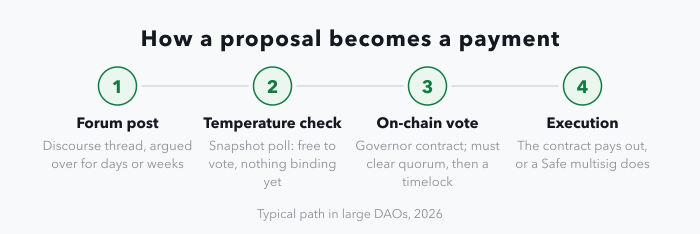
1. Forum post. Someone writes up the idea on a discussion forum — Discourse, usually — and it is argued over for days or weeks. Almost all of the real deliberation happens here, not in the vote.
2. Off-chain temperature check. A poll runs on Snapshot, which reads token balances at a fixed past block and costs nothing to vote in. Nothing is binding yet, but a proposal that loses here rarely goes further.
3. On-chain vote. The proposal goes to a governor contract as executable code, and token holders or their delegates vote with a transaction. It has to clear a quorum — Uniswap's is 40 million UNI — and then sit through a timelock before it can run.
4. Execution. Either the governor contract executes the transaction itself, or a multisig wallet — usually a Safe — carries out what the vote instructed. Large treasuries are held in Safes with named signers, which is less autonomous than the word "autonomous" suggests and considerably harder to drain.
Delegation Is the Part That Changed
The 2021 picture of a DAO was every holder voting on everything. That is not what happens. Token voting costs gas, requires reading long proposals, and competes with everyone's actual job, so holders delegate their voting power to someone who will do the reading.
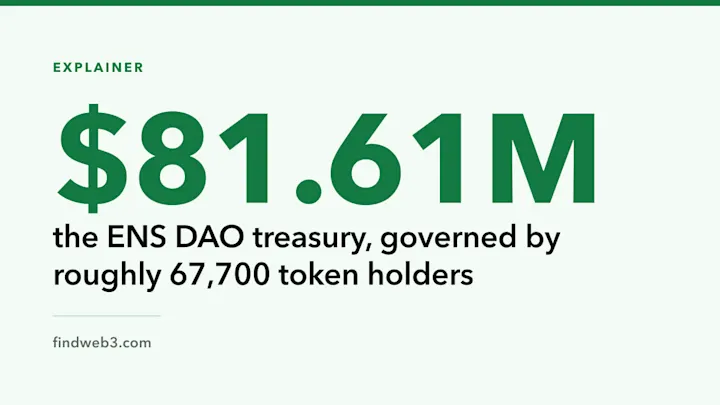
The scale of it is visible on any governance dashboard. Tally's ENS page, checked on 23 September 2026, showed an $81.61 million treasury, 75 proposals to date, roughly 67,700 ENS holders, and a public directory of delegates any of them can hand their votes to. The delegates who accumulate the most voting power end up functioning as a de facto legislature, which is a long way from one token, one vote.
Some DAOs have split voting power off from token holdings altogether. The Optimism Collective runs two chambers: a Token House, where OP holders and their delegates vote in proportion to what they hold, and a Citizens' House, where membership is earned — by chains and apps that clear revenue or gas thresholds, and by long-standing Superchain users who pass a proof-of-personhood check — and each member gets one vote whatever their balance.
Where DAOs Came From
The first serious attempt was called, simply, The DAO — a community-run venture fund on Ethereum, funded in the spring of 2016. That June an attacker exploited a reentrancy bug in its withdrawal code and began draining it.
The response mattered more than the hack. Ethereum hard-forked at block 1,920,000 on 20 July 2016 to move the money into a recovery contract; the Ethereum Foundation's post that day put the amount at roughly 12 million ether and said about 85% of miners followed the new chain. The minority that refused kept running the original one, which is why Ethereum Classic exists. The lesson was not only that unaudited code is dangerous, but that "the code is the rulebook" holds only until enough people decide otherwise.
DAOs That Are Actually Running in 2026
Lists of DAOs age badly. Before trusting one, open the DAO's own governance page and look at the date on the most recent executed proposal. DeepDAO, the aggregator most such lists were built from, has stopped: its front page says the last update was 24 November 2025 and tells visitors not to use the site "for research, analysis, or decision-making."
Here is what verification looks like on four that are demonstrably active.
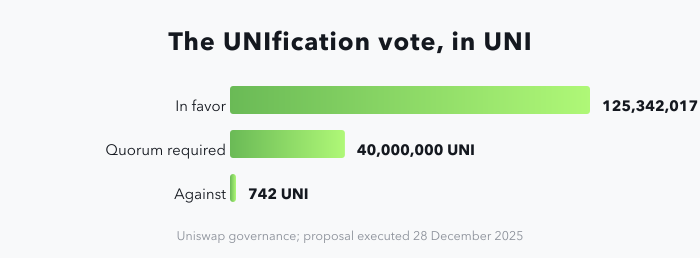
Uniswap is the clearest example of a DAO doing something consequential. On 28 December 2025 its governance executed UNIfication, which passed with 125,342,017 UNI in favor and 742 against, against a 40 million UNI quorum. It switched on protocol fees, retroactively burned 100 million UNI from the treasury, and moved most of the Uniswap Foundation's staff to Uniswap Labs, leaving a lean team on grants. A DAO voting to fold up most of its own foundation is not the picture of DAO governance most explainers paint, and it happened.
Sky is the one most 2023-era articles get wrong: it is what MakerDAO renamed itself in August 2024. MKR is being retired in favor of SKY at 24,000 SKY per MKR, and to move the last holders along, governance attached a delayed-upgrade penalty that started at 1% on 22 September 2025 and rises a percentage point every three months. About 81% of MKR had already converted by 19 September 2025, The Block reported. The DAI stablecoin now has a counterpart called USDS, which DAI holders can upgrade to one for one.
ENS DAO governs the naming system behind .eth addresses and is the cleanest demonstration of delegate-led governance, with executed proposals dated as recently as 31 August 2026 on its Tally page.
Friends With Benefits shows that DAOs are not only a finance thing. It is a membership community that puts its budget to a token vote and publishes every result: the most recent, an H2 2026 budget, ran from 15 to 19 August 2026 and passed with 129,077 votes cast. It has also changed shape over five years — CoinDesk reported in April 2025 that it now has a chief executive and a product roadmap — which is a fair illustration of where a lot of social DAOs ended up.
The Legal Position in 2026
This is the section that has moved furthest, and it moved because DAO members started getting sued.
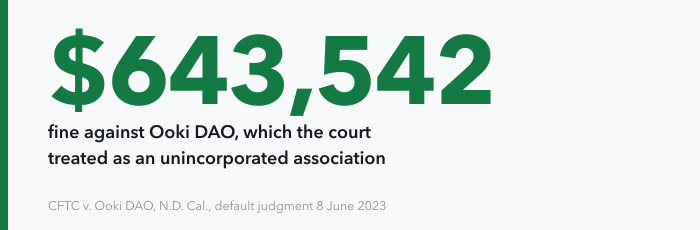
Two US cases set the stakes. In CFTC v. Ooki DAO, a federal court in the Northern District of California entered default judgment on 8 June 2023, treated the DAO as an unincorporated association under California law, fined it $643,542 and ordered its website taken down.
In Samuels v. Lido DAO, the same court ruled on 18 November 2024 that the plaintiff had adequately alleged Lido is a general partnership under California law — meaning investors who actively took part in its governance could be on the hook as general partners for what the DAO owes. That case has not produced a final answer. The court denied a motion to compel arbitration on 3 September 2025, the defendants appealed to the Ninth Circuit, and the district case has been stayed pending that appeal since October 2025, with the parties filing a status report every 120 days — the most recent on 18 June 2026.
An unwrapped DAO, in other words, may be a partnership whose partners have unlimited liability. That is the risk the statutes are designed to remove:
- Wyoming created the DAO LLC in 2021, then the DUNA — decentralized unincorporated nonprofit association — under Senate File 50, signed 7 March 2024 and effective 1 July 2024. A DUNA needs at least 100 members, can contract, hold property, sue and be sued and pay tax, and shields members from the association's liabilities. It may earn money, but the profits have to go back into its purposes rather than out to members.
- Alabama became the second DUNA state when SB 277 was signed on 2 April 2026, effective 1 October 2026, per The Block. West Virginia followed in the same session with Senate Bill 670, now chapter 36, article 13 of its code.
- Older wrappers remain in use: Vermont's blockchain-based LLC (2018), Utah's limited liability decentralized organization (2023), and the Marshall Islands DAO LLC, which is where a lot of non-US DAOs incorporate.
The largest test so far is Uniswap's. On 12 September 2025 its governance executed a proposal to become DUNI, a Wyoming DUNA, on 52,968,177 votes in favor and effectively none against. Holding UNI and voting now makes you a member of a registered association rather than, potentially, a partner in an unregistered partnership. Expect more of this. The direction of travel is toward DAOs that are legally legible, not away from it.
What DAOs Are Good At, and Where They Struggle
They are genuinely good at transparency. Every transfer from the treasury is a public transaction. No company discloses at that resolution.
They are good at pooling capital across borders. No jurisdiction check, no minimum, no broker.
They are bad at turnout. A DAO's quorum is a decent measure of what its own governance considers realistic participation: Uniswap's is 40 million UNI, against the 1 billion UNI minted at genesis. Delegation is the workaround, and it works, but it concentrates voting power in a small number of addresses. Every DAO publishes its own vote records, so check them before assuming broad participation.
They are slow, by design. Forum, temperature check, on-chain vote, timelock. That is weeks. It is the price of not having anyone who can act unilaterally, and it is a bad fit for anything urgent.
Large holders can decide outcomes. One token, one vote is plutocratic when the token is concentrated. Quadratic voting, delegate caps and non-token chambers like Optimism's Citizens' House are all attempts at this, and none has settled the question.
The code is still the biggest single risk. A bug in a contract that holds a nine-figure treasury is a nine-figure bug, and there is no chargeback. Audits are table stakes; so is a timelock long enough for someone to notice.
How to Get Involved
You do not need to be a developer. Most of the work in a DAO is writing, design, community management, operations, treasury and legal.
- Pick one and lurk. Read the forum and the last ten proposals. You will learn more about a DAO in an hour of its governance archive than from any description of it.
- Set up a self-custody wallet. MetaMask or Rainbow. This is your identity across governance tools.
- Vote, or delegate. Snapshot votes are free. If you hold tokens but won't follow the debates, delegate to someone who does — that is a real contribution, not a cop-out.
- Take a bounty. Most active DAOs pay for discrete pieces of work, and it is the usual way in for people who end up being paid by one.
If you are looking for paid work, be realistic about the size of the market. On 23 September 2026 the Find Web3 board listed DAO roles from two companies in the previous 30 days — Aave and Windranger Labs — against 104 crypto companies hiring overall. The pay, where it is stated, is in line with the rest of the sector: a Web3 developer median of $200,000 across 278 listings on the salary pages, same date. DAOs are an interesting place to contribute and a thin place to job-hunt.
Frequently Asked Questions
Is it safe to join a DAO?
Joining a forum and voting costs you nothing but time. Putting money in is a different question. The risks are contract bugs, treasury mismanagement and — if the DAO has no legal wrapper — the possibility that active participation makes you something like a partner, as the Lido litigation argues. Check whether the contracts have been audited, whether there is a timelock, and whether the DAO is registered as a DUNA, LLC or foundation.
Do I have to be a coder?
No. Governance, treasury, writing, design, community and legal work make up most of what DAOs pay for. Developers build the contracts; they are a minority of contributors.
Are DAOs legal?
A DAO is not illegal, but an unwrapped one has no clear legal form, and US courts have been willing to treat a DAO as an unincorporated association and to let a claim proceed that one is a general partnership. Wyoming, Alabama and West Virginia now offer the DUNA; Vermont, Utah, Wyoming and the Marshall Islands offer LLC-style wrappers. Rules vary by country, and none of this is legal advice.
What is the difference between a DAO and a multisig?
A multisig is a wallet that needs several signatures to spend. A DAO is a decision-making process. Most DAOs use a multisig to execute what the process decides, so they are layers, not alternatives.
Can a DAO shut down?
Yes, and plenty have — quietly, by nobody proposing anything. A DAO with no proposals in a year is effectively closed even if its contracts still work. The date on the last executed proposal is the single most useful thing to check.