What Is Distributed Ledger Technology? DLT Types and Uses
How a shared ledger reaches agreement without a central authority, how public, private and consortium DLTs differ, and where each is used.
Distributed ledger technology (DLT) is a shared, synchronized database that lives across a network of computers instead of on one organization's server.
Imagine a group of people who each hold a copy of the same notebook. When someone adds an entry, every copy updates. Nobody can quietly erase or rewrite what is already there. The result is a single agreed record with no single party in charge of it.
Unpacking the Core Idea of DLT
DLT is an answer to a problem of trust. Conventional record-keeping depends on an intermediary — a bank, a land registry, a clearing house — to verify transactions and hold the authoritative copy. DLT spreads that job across everyone on the network.
Each participant, called a node, holds an identical copy of the ledger. Before a new transaction is added, enough nodes have to agree that it is valid. That agreement, rather than the authority of any one party, is what makes the record hard to falsify.
The Three Pillars of DLT
Three ideas do most of the work. If you hit other unfamiliar terms, the Web3 dictionary covers them.
- Decentralization: There is no single point of control. The ledger is copied across many computers, so the network keeps running if one of them fails.
- Transparency: Participants may be pseudonymous, but the transactions themselves are generally visible to everyone on the network.
- Immutability: Once a record is added, cryptography makes it impractical to alter or delete, leaving a permanent audit trail.
DLT Core Concepts at a Glance
| Concept | Simple Explanation | Key Benefit |
|---|---|---|
| Decentralization | No single person or server is in charge; the ledger is shared. | Resists censorship and single points of failure. |
| Transparency | Transactions are visible to all participants on the network. | Creates accountability without a middleman. |
| Immutability | Once recorded, data cannot be changed or removed. | Gives a permanent, tamper-evident record of events. |
How Distributed Ledger Technology Actually Works
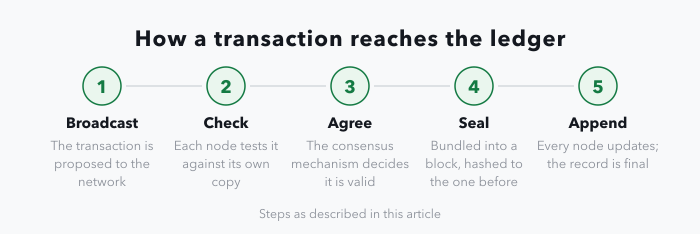
A transaction begins as a proposal broadcast to the network. Every node receives it and checks it against its own copy of the ledger: does the sender hold what they claim to hold, and is the instruction well formed?
Reaching a Digital Agreement
The network then has to agree that the transaction is valid before it is recorded. The rule set for reaching that agreement is the consensus mechanism, and different ledgers use different ones.
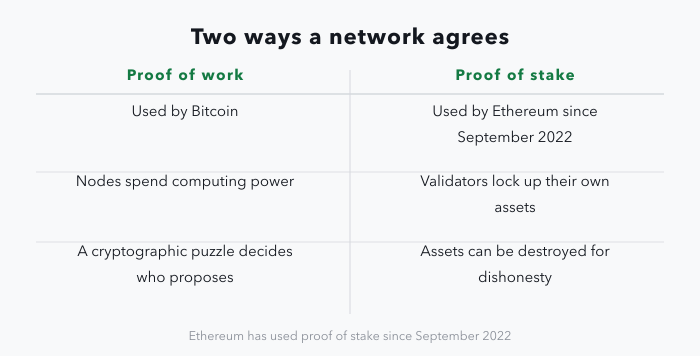
Bitcoin uses proof of work: nodes spend computing power on a cryptographic puzzle to earn the right to propose the next block. Proof of stake, which Ethereum has used since September 2022, instead requires validators to lock up their own assets, which can be destroyed if they validate dishonestly. Permissioned ledgers, where the participants are known to each other, can use much lighter schemes because they do not have to defend against anonymous attackers.
Sealing the Deal with Cryptography
Once a transaction is validated, it is bundled with other recent transactions into a block and stamped with a hash — a fixed-length fingerprint of the block's contents. The hash is calculated from the data in the new block and the hash of the block before it, which chains the blocks together in order.
Key Takeaway: Because of that chaining, altering an old transaction changes its block's hash, which breaks every hash that follows. The rest of the network sees the mismatch immediately.
That is what people mean when they call a ledger immutable.
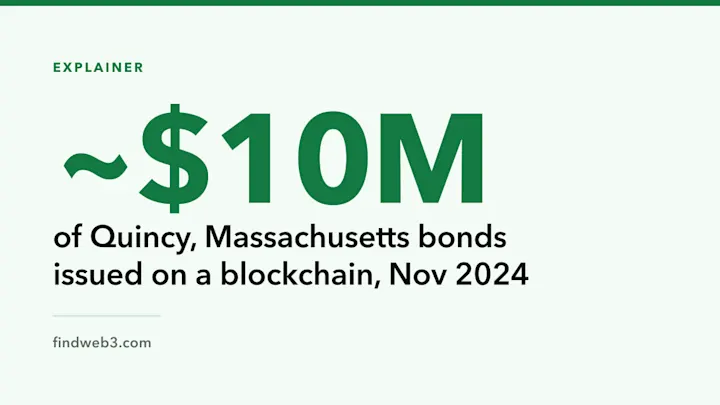
The technique is in production use. JPMorganChase said in November 2024 that the City of Quincy, Massachusetts, had issued roughly $10 million of bonds on Kinexys Digital Assets, the bank's permissioned blockchain platform — the first live municipal bond in the United States issued, settled and recorded on a blockchain.
The final steps are:
- Adding the block: The hashed, verified block is appended to the shared ledger.
- Network update: Every node updates its own copy to include the new block.
- Finalization: The transaction is now part of the record, visible to everyone with access to the ledger.
The Different Flavors of DLT: Public, Private, and Consortium
Not all distributed ledgers are built the same way, and the main difference comes down to one question: who is allowed in? The answer changes how decentralized the network is, how private it is, and how fast it runs.
Public Ledgers: Open for Business
A public DLT is permissionless. Anyone with an internet connection can run the software, join the network, read the full transaction history, and help validate new entries. Bitcoin and Ethereum are the best-known examples.
That openness is what makes public ledgers hard to censor or shut down. The cost is throughput: getting a large, anonymous network to agree is slower than getting a handful of known parties to agree, and under proof of work it also consumes a great deal of electricity.
Private Ledgers: By Invitation Only
A private DLT is permissioned and run by a single organization — closer to a company's internal database, with the ledger replicated across machines that the organization controls. An administrator decides who joins, what they can see, and who may validate transactions.
Because the participants are known and few, private ledgers are fast. They suit a company tracking its own supply chain or internal assets, where privacy and speed matter more than open participation.
Key Insight: The trade-off for that speed and control is decentralization. With one entity in charge, the censorship resistance that makes public ledgers robust is gone.
Consortium Ledgers: The Best of Both Worlds
A consortium DLT sits between the two. It is not open to the public and it is not controlled by one company; a pre-selected group of organizations governs it together — several banks sharing a settlement network, for example.
- Shared control: Governance is spread across members, so no single member is a point of failure.
- Kept under wraps: Commercially sensitive data stays among the participants rather than on a public chain.
- Efficiency: With a limited set of known validators, transactions confirm far faster than on a public network.
R3's Corda is one platform built for this pattern, and consortium models are common where an industry wants a shared record without publishing it.
Public vs Private vs Consortium DLTs Compared
| Feature | Public DLT (e.g., Bitcoin) | Private DLT (e.g., Hyperledger Fabric) | Consortium DLT (e.g., R3 Corda) |
|---|---|---|---|
| Access | Permissionless (Anyone can join) | Permissioned (Access is restricted by one organization) | Permissioned (Access is restricted by a group of organizations) |
| Participants | Anonymous or pseudonymous | Known and identified | Known and identified |
| Centralization | Highly decentralized | Highly centralized (controlled by one entity) | Partially decentralized (controlled by a group) |
| Data Privacy | All transactions are public and transparent | High degree of privacy; data is only visible to authorized participants | High degree of privacy; data is visible only to relevant parties in a deal |
| Transaction Speed | Relatively slow (due to complex consensus) | Very fast | Fast |
| Immutability | Very high; practically impossible to alter | High, but the central entity could potentially make changes | High, but the governing consortium could theoretically agree to changes |
| Best For | Cryptocurrencies, public records, voting systems | Internal business processes, supply chain management, asset tracking | Inter-bank transfers, insurance claims, industry-wide collaborations |
None of the three is better in the abstract. Each one trades transparency, privacy and performance against each other in a different ratio.
The Core Benefits of DLT
Distributing the ledger across many computers removes the single point of failure that a conventional database has. There is no one server whose compromise rewrites the record.
Creating Trust with Transparency and an Unbreakable Record
Most systems ask you to trust a central authority. A distributed ledger replaces that with something you can check: every participant reads the same ledger, so a discrepancy is visible rather than hidden in someone else's system.
The record is also durable. Once a transaction is validated and sealed into a block, changing it means rewriting everything after it, in view of the whole network. That gives a tamper-evident audit trail, which is useful for financial reconciliation and for tracking goods through a supply chain.
Key Takeaway: Removing intermediaries such as correspondent banks and clearing houses can shorten settlement. Processes that take days on paper-and-reconciliation rails can settle in minutes on a shared ledger.
A Quick Rundown of DLT's Advantages
- Security: There is no single copy to breach. Rewriting a public ledger means controlling a majority of the network's consensus power, not compromising one server.
- Transparency: Everyone works from one shared record rather than reconciling separate ones.
- Efficiency: Smart contracts automate steps that would otherwise be manual, and removing intermediaries removes their fees and delays.
- Traceability: An asset carries a complete, ordered history from its origin to its current holder.
For where the industry itself stands, this site keeps its own numbers in the Web3 statistics roundup.
Real-World DLT Applications Across Industries
A Clearer View for Supply Chain Management
A typical supply chain is a set of siloed records. The grower, the shipper, the warehouse and the retailer each keep their own, and nobody holds the whole picture. That makes it slow to trace a product's origin, confirm its authenticity, or find where a problem started.
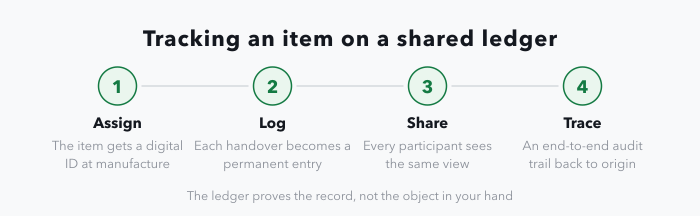
A shared ledger gives every participant the same view. Each handover is logged as a permanent entry, producing an end-to-end audit trail. A luxury brand can assign a digital ID to an item at manufacture and record every step until it reaches a customer — which makes a fake harder to pass off, though the ledger proves the record, not the object in your hand.
The same pattern applies elsewhere:
- Food safety: Tracing a crate of produce back to a specific field, so the source of a contamination can be isolated in hours rather than weeks.
- Pharmaceuticals: Recording chain of custody and storage temperature for drugs that fail if either is broken.
- Ethical sourcing: Documenting where raw materials such as cobalt or diamonds came from.
Key Insight: A shared ledger does not make participants honest. It makes what they record visible to each other and difficult to revise afterwards.
Remaking Finance and Healthcare
In finance, DLT is aimed at processes that are slow because they involve many parties reconciling separate books. A cross-border payment can take days to move through a chain of intermediary banks; on a shared ledger, both sides can settle against a single record, cutting the time the money spends in transit and the risk that one side fails to deliver.
In healthcare, the interest is in patient control of records. A ledger can hold the permissions — which clinician may read which record, and when — while the medical data itself stays encrypted elsewhere. That supports coordinated care without handing a single vendor custody of everything.
These applications are a large part of the demand for blockchain jobs. Current hiring by month and category is in the Web3 jobs report, and typical pay by role is on the salaries page.
What's Next? The Challenges and Future of DLT
DLT has real limits, and three of them are structural rather than cosmetic.
- Scalability: Public ledgers are slow by the standards of card networks. Bitcoin settles a few transactions per second, orders of magnitude below what a payment network handles.
- Interoperability: Ledgers largely operate as separate systems. Moving value or data between them relies on bridges built for that purpose.
- Regulatory uncertainty: Rules differ by jurisdiction and are still changing, which makes large institutions cautious about committing to a platform.
The Road Ahead
Two directions are worth watching.
The first is combining DLT with automation: machines and sensors writing directly to a shared ledger so that supply chains or energy grids can settle between themselves without a human reconciling anything.
The second is tokenization — representing an asset such as a building, a fund share or a bond as a transferable record on a ledger. The Quincy bond above is an early example of a regulated instrument issued this way. The attraction is that assets that are slow and expensive to transfer today could change hands as quickly as a ledger entry.
Common Questions
Is Blockchain Just Another Name for DLT?
No. Distributed ledger technology is the parent category: the broad idea of a shared, replicated database with no central owner.
Blockchain is one type of DLT — the one that groups data into cryptographically linked blocks. All blockchains are distributed ledgers; not all distributed ledgers are blockchains. Other designs, such as hashgraph and directed acyclic graphs, reach agreement without a chain of blocks.
How Is DLT Different from a Regular Database?
The difference is control.
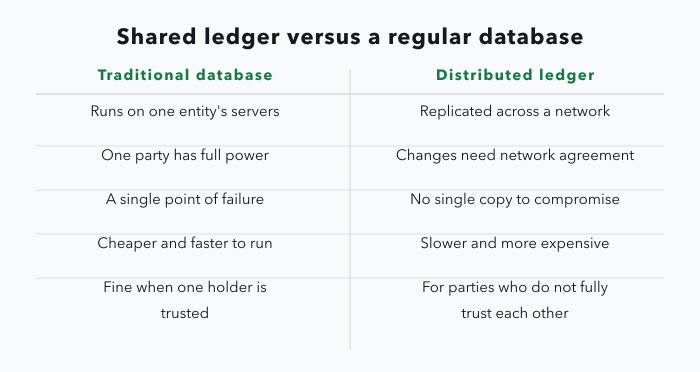
A traditional database is centralized. It runs on servers managed by one entity, which is both a single point of failure and a single party with full power over the data.
A distributed ledger is decentralized. The ledger is replicated across a network, and changing it requires agreement from enough of that network. That makes it slower and more expensive than a normal database, which is why it is worth using only when the participants do not fully trust each other.
Do You Need Cryptocurrency to Use DLT?
No. Public ledgers such as Bitcoin use a token to pay and incentivize the anonymous validators who secure the network.
Private and consortium ledgers do not need one. Their participants are already identified, and their obligations to each other rest on contracts and regulation rather than on a token.
Find Web3 lists roles in blockchain, crypto and DeFi. Browse current openings on the jobs board, or see which companies are hiring.