AI Statistics 2026: Users, Spending and Adoption
 Jackson Pegg
Most AI statistics in circulation are three years old, and a surprising number were never true. The page you are reading used to say ChatGPT had 100 million weekly users and that GPT-4 ran on 1.76 trillion parameters. The first is off by a factor of ten; the second is a number OpenAI has never published, traceable to a podcast remark.
This is the rewrite. Every figure below names who published it and when the data is from, separates what a company disclosed from what somebody modelled, and leaves out the ones that could not be traced to anything. Where an old favourite has been deleted rather than updated, the last section says which and why.
Last checked 23 September 2026.
You Might Also Like
Contents
Top 10 AI Statistics (Editor’s Picks)
How Many People Use AI?
How Many Businesses Use AI?
The Money
Market Size, and Why the Forecasts Disagree
Compute and Energy
AI and Jobs
What the AI Labs Have Stopped Publishing
Top 10 AI Statistics (Editor’s Picks)
ChatGPT passed 1 billion weekly active users, stated by OpenAI on 31 August 2026, up from “more than 900 million” in February.
Gemini passed 1 billion monthly users, stated by Google on 11 August 2026.
49% of US adults have used an AI chatbot and 24% use one every day, from Pew Research fieldwork in February 2026.
Only 19.8% of US businesses used AI to produce goods or services, from the Census Bureau’s survey ending 3 May 2026 - against 37% of firms with 250 or more employees.
Nearly 9 in 10 organisations report using AI somewhere, but only 37% can attribute any profit impact to it, and that share has not moved in a year (McKinsey, fielded May-June 2026).
OpenAI said it was making $2 billion a month in March 2026, when it raised $122 billion at an $852 billion valuation.
Nvidia’s data centre segment took $89.0 billion in a single quarter, up 117% year on year, in the three months to 26 July 2026.
Meta’s free cash flow fell to $784 million in the June 2026 quarter after $31.1 billion of capital spending, and it is guiding to $130-145 billion for the year.
Private AI investment reached $581.7 billion in 2025, up 130%, with US investment 23 times China’s (Stanford HAI).
Data centres used about 485 TWh of electricity in 2025, and the IEA projects that to roughly double to 950 TWh by 2030 - about 3% of global demand.
How Many People Use AI?
Two companies have published a billion-user figure, and they measure different things. OpenAI says ChatGPT has more than 1 billion weekly active users, stated on 31 August 2026; it had said “more than 900 million” in February. Google says the Gemini app passed 1 billion monthly users, stated on 11 August 2026. Weekly and monthly are not comparable, and neither company says which week or month it counted.
Surveys give the firmer ground, because they say who they asked and when. Pew Research found 49% of US adults have used an AI chatbot and 24% use one daily, from fieldwork among 5,119 adults in February 2026. ChatGPT is the one they have used: 44% of US adults, against 24% for Gemini and 17% for Copilot.
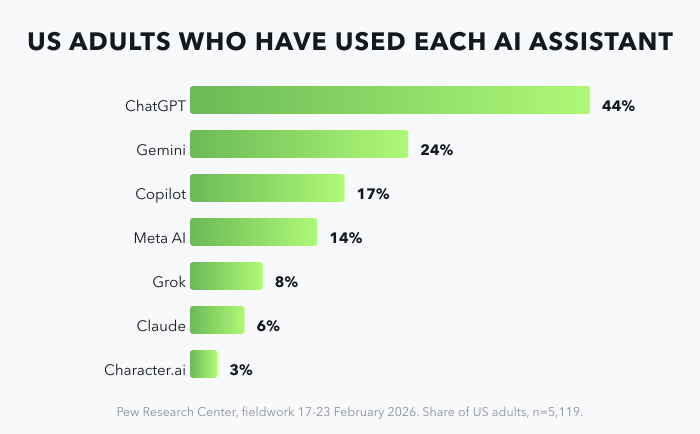
Two other readings point the same way. Menlo Ventures and Morning Consult found 64% of US adults have used AI and 25% use it daily, in July 2026 polling, with 55% of AI users now paying for at least one product. Epoch AI’s polling with Ipsos found near-daily use rising from 8% to 19% between March and August 2026 - the sharpest move in any of these series.
Outside the US, Ofcom found 54% of UK adults had used a generative AI tool, rising to 79% of 16-to-24-year-olds, in fieldwork to November 2025. For news specifically, the Reuters Institute found 10% of people worldwide use AI chatbots for news each week, up from 7%, but only 1% call it their main source - and just 4% say they click through to the original article, against 19% from search.
Sources: OpenAI, Google, Pew Research Center, Menlo Ventures, Ofcom, Reuters Institute.
How Many Businesses Use AI?
Anywhere between 20% and 88%, depending on what you count. The three best-sourced measures of 2026 are not in conflict; they are answering different questions, and pages that quote the highest one as “business AI adoption” are the reason this looks confusing.
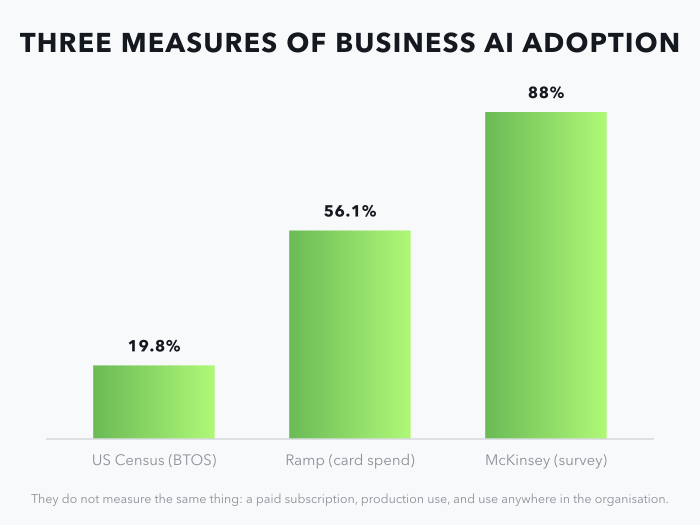
19.8% of US firms used AI to produce goods or services, from the Census Bureau’s Business Trends and Outlook Survey for the period ending 3 May 2026. It reaches 37% among firms with 250 or more employees and under 20% among those with fewer than 20, and it runs from 39.7% in Information to about 14% in Retail.
56.1% of US businesses paid an AI vendor, from Ramp’s index of card, invoice and ACH transactions at more than 70,000 firms. That is a purchase, not a deployment: one subscription counts.
Nearly 9 in 10 organisations report regular AI use in at least one business function, from McKinsey’s survey of 1,719 respondents across 97 nations, fielded 4 May to 8 June 2026.
The interesting number in McKinsey’s survey is not the adoption figure. Only 37% of organisations attribute any EBIT impact to AI, and about 6% qualify as high performers - both essentially unchanged from a year earlier, while the share saying AI is scaling across the enterprise rose from 38% to 44%. More companies are using it; the same proportion can show it in the accounts.
Sources: US Census Bureau, Ramp Economics Lab, McKinsey.
The Money
What the AI companies earn
OpenAI: $2 billion a month, stated on 31 March 2026 alongside a $122 billion raise at an $852 billion post-money valuation. Enterprise is more than 40% of it. The company also reports more than 50 million consumer subscribers and more than 9 million paying business users (February 2026), and says ChatGPT advertising reached $1 billion in under 200 days.
Anthropic: a run rate above $47 billion, crossed in May 2026 and stated in its Series H announcement.
Microsoft: more than 30 million paid Microsoft 365 Copilot seats, up from 20 million a quarter earlier, with GitHub Copilot at 50 million users and one in three GitHub pull requests now involving an agent (quarter ended 30 June 2026).
What it costs to serve
The spending is the part with audited numbers behind it. Nvidia’s data centre segment reported $89.0 billion of revenue in the quarter to 26 July 2026, up 117% year on year, on a 75% gross margin, and guided to $108 billion for the next one.
On the other side of those invoices: Microsoft spent $115.9 billion in its 2026 financial year, Alphabet $80.6 billion in the first half of 2026 alone against $91.4 billion for all of 2025, Amazon $54.2 billion in the June quarter, and Meta is guiding to $130-145 billion for 2026. Meta’s free cash flow fell to $784 million in the June quarter and its operating margin from 43% to 31%.
Behind all of it, private AI investment reached $581.7 billion in 2025, up 130% year on year, with US investment at $285.9 billion against China’s $12.4 billion.
Sources: OpenAI, Anthropic, NVIDIA (SEC filing), Meta, Stanford HAI AI Index 2026.
Market Size, and Why the Forecasts Disagree
Gartner forecasts $2.67 trillion of AI spending in 2026. IDC forecasts $497 billion. Both are named firms publishing in the same quarter, and they differ by more than five times. Neither is wrong: Gartner is counting all AI spending including services and AI-capable devices, IDC is counting infrastructure. A page that quotes one as “the AI market” without saying which is not telling you anything.
The one number in that family with observation behind it is IDC’s: $89.7 billion was actually spent on AI infrastructure in the first quarter of 2026, up 33% year on year. Everything after the current quarter is a model, and this page marks it as one.
Compute and Energy
Epoch AI tracks the physical build-out, which is harder to spin than a market forecast. As of 22 September 2026 it counts 91 AI data centre sites holding 13.7 million H100-equivalents and 13.2 GW of IT power across 19 owners. The largest single site, Colossus 2 in Memphis, holds about 1.1 million H100-equivalents on its own, and five hyperscalers own 71% of global AI compute.
Its trend work puts frontier training compute at 5x a year since 2020, chip performance per dollar improving 49% a year since 2023, and the cost of a gigawatt-scale data centre at roughly $38 billion, taking about 2.1 years to build.
For electricity, the IEA estimates data centres used about 485 TWh in 2025 and projects that to roughly double to 950 TWh by 2030, about 3% of global electricity demand, with AI-specific consumption tripling. Note what that is not: a measurement of AI's own consumption, which nobody publishes.
Sources: Epoch AI data centres, Epoch AI trends, International Energy Agency.
AI and Jobs
4.2% of US job postings mentioned AI in December 2025, an all-time high on Indeed’s tracker: postings that mention it were 134% above their February 2020 level while postings overall were up 6%.
The displacement evidence is narrower than the forecasts. Stanford’s AI Index reports employment among software developers aged 22 to 25 has fallen nearly 20% since 2024 while headcount among older developers grew. The World Economic Forum’s current projection is 170 million jobs created and 92 million displaced by 2030, a net gain of 78 million - a survey of employer expectations, not a measurement.
The longer version of this, including what the people counting rather than forecasting have found, is in How Many Jobs Will AI Replace? And if you are looking for work in crypto specifically, the Web3 jobs report counts hiring on this board by month and category.
Sources: Indeed Hiring Lab, Stanford HAI, World Economic Forum.
What the AI Labs Have Stopped Publishing
The industry is getting less transparent as it gets bigger. Stanford’s Foundation Model Transparency Index fell to an average of 40, from 58 a year earlier, with labs keeping training code, dataset sizes and parameter counts to themselves. That is why several of the statistics you will find elsewhere cannot be checked - and why they are not here:
Model parameter counts. “GPT-4 has 1.76 trillion parameters” appears on hundreds of pages. OpenAI has never published it; it traces to a 2023 podcast remark.
Meta AI users. Meta’s last absolute figure was about 1 billion monthly actives in 2025. Its July 2026 disclosure was relative only: a 60% increase in daily interactions after the assistant was rebuilt.
Microsoft Copilot monthly actives. No such Microsoft statement exists. The company reports paid seats, which is the figure quoted above.
Benchmark bragging. Gemini Ultra’s 90.04% MMLU score was December 2023 launch marketing, and the comparison it made was not like for like.
“97% of people use AI daily without realising it.” No originating study exists for any version of this claim, and the 84% variant traces to a 2017 consumer survey about chatbots.
Also gone from this page: the old market-size figures (a model output presented as observation), “AI engineers earn $100,000 globally” (no source, and a single global average for the title is meaningless), and the 2025 job forecasts whose deadline has passed.
Conclusion
The honest summary of AI in 2026: usage is enormous and still growing, spending is growing faster, and profit from it is not yet showing up in most companies’ accounts. A billion people a week use ChatGPT, a fifth of US businesses use AI in production, nine in ten large organisations use it somewhere, and the same 37% as last year can point to what it did to earnings.
Every figure here names its publisher and its date. Where a number is gone, it is because nobody who would know is publishing one - which is a more useful thing for a statistics page to say than a confident guess.