Blockchain Developer Roadmap: From Fundamentals to dApps
The two developer tracks, the five stages between them and a job, the tooling that has been retired since 2023, and what the roles pay on this board.
Most blockchain developer roadmaps are a list of technologies. This one starts from what employers are actually advertising for, because the gap between the two is wide enough to waste a year of study.
Two different jobs share the title
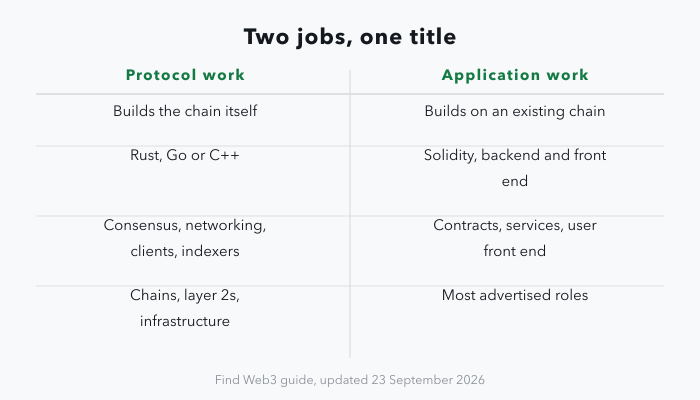
"Blockchain developer" covers two kinds of work that share almost no day-to-day overlap.
Protocol work means building the chain itself: consensus, networking, execution clients, node software, indexers. It is systems programming, usually in Rust, Go or C++, and it is closer to database and distributed-systems engineering than to anything web-shaped. Teams hiring for it are chains, layer 2s and infrastructure companies.
Application work means building on a chain that already exists: smart contracts, the services around them, and the front end users touch. It is Solidity plus ordinary backend and front-end engineering. Most advertised roles are this one.
The roadmap below is written for the application track, with a section at the end on the protocol and Solana routes. Pick one before you start. Trying to learn both at once is the most common reason people stall.
What the adverts actually ask for
Find Web3 counted every term below across 4,212 job adverts on the board, updated 23 September 2026.
| Term in the advert | Adverts | Share |
|---|---|---|
| Web3 | 1,115 | 26% |
| Smart contract | 246 | 6% |
| EVM | 140 | 3% |
| Layer 2 | 130 | 3% |
| Solidity | 97 | 2% |
| Rollup | 61 | 1% |
| Zero-knowledge | 58 | 1% |
Source: Find Web3 Web3 dictionary, counted 23 September 2026.
Two things follow from that table.
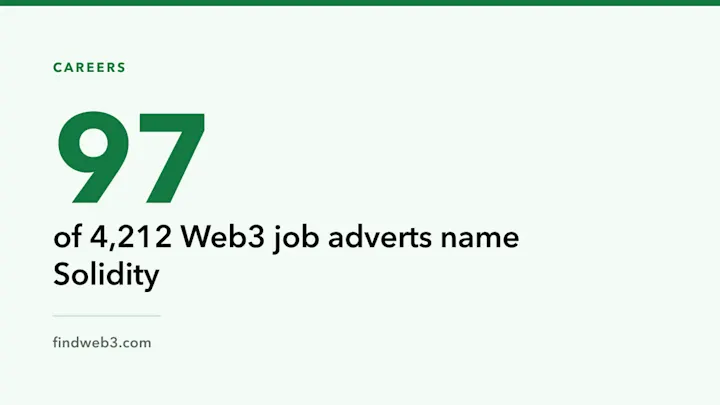
The first is that Solidity is a smaller share of the market than roadmaps imply. It appears in 97 adverts out of 4,212. Smart contract work is real and well paid, but a plan built only around Solidity is aimed at roughly one advert in forty-three.
The second is that most of the work around a chain is ordinary software engineering. On the Find Web3 jobs report, the most common skill tags on listings published in the 90 days to 23 September 2026 were Compliance (465), Python (291), DeFi (212), AI (209), Trading (187) and SQL (185). Rust appeared on 100, TypeScript on 99 and Go on 89. Solidity does not appear in the report's top fifteen tags at all. Read the Rust figure with care: Rust is widely used outside crypto, so a share of those adverts are conventional backend roles at crypto companies rather than on-chain programming.
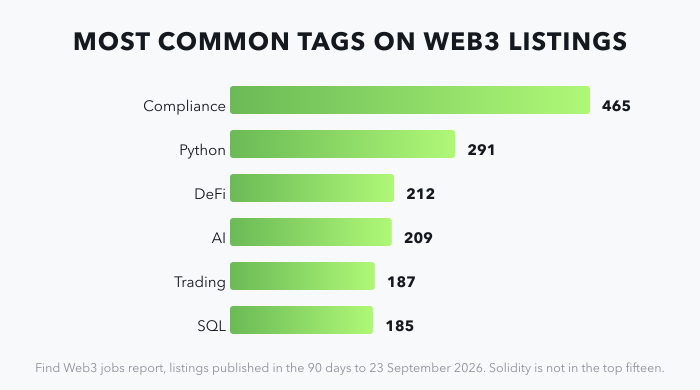
The practical reading is that a blockchain developer who can also write a normal service, query a database and ship a front end is employable across far more of the board than one who can only write contracts.
Stage 1: the programming underneath
Nothing here is blockchain-specific, and skipping it is what makes later stages painful.
- TypeScript. Almost every dApp front end, deploy script, test suite and indexer is TypeScript. Learn the language and its async model properly.
- One backend language. Python or Go. Both appear constantly on the board; Python is the more common tag of the two.
- Data structures, hashing and binary data. Merkle trees, byte arrays, hex encoding and fixed-width integers come up daily. You do not need a cryptography course; you need to be comfortable with a hash function as a tool.
- Git, testing and the command line. Smart contract work is unusually test-heavy, because the cost of a bug is money rather than a bug report.
Existing engineers transferring in already have most of this. The transfer is faster than the "learn everything from scratch" framing suggests: the new material is the execution model, not the craft.
Stage 2: how a chain works, as of 2026
Several widely circulated roadmaps still describe the 2021 network. The corrections that matter:
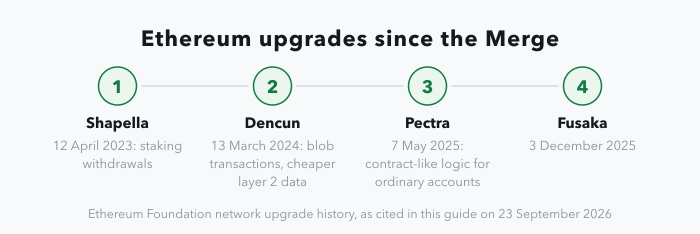
- Ethereum has used proof of stake since 15 September 2022, when the Paris upgrade — The Merge — replaced mining. Material that describes Ethereum mining, or that treats proof of stake as forthcoming, predates that. (Ethereum Foundation, network upgrade history)
- "Ethereum 2.0" is not a thing. The name was retired; the old
ethereum.org/eth2page now redirects to the roadmap. There is one Ethereum, upgraded in stages. - The stages since then changed what you build. Shapella (12 April 2023) enabled staking withdrawals. Dencun (13 March 2024) added blob transactions, giving layer 2s a cheaper way to post their data back to Ethereum, and is a large part of why most new application work now targets a layer 2 rather than Ethereum directly. Pectra (7 May 2025) let ordinary accounts execute contract-like logic. Fusaka followed on 3 December 2025.
- Binance Smart Chain is now BNB Smart Chain, part of BNB Chain alongside opBNB and Greenfield. The Beacon Chain that carried the old name has been sunset.
What to understand at this stage, in this order: accounts and state; transactions and gas; what a block actually contains; why a contract cannot call the outside world; and what a layer 2 is doing when it posts back to Ethereum. The Ethereum developer docs cover all of it and are kept current.
Stage 3: Solidity and the 2026 toolchain
Solidity is on version 0.8.37, released 10 September 2026. Read the current documentation rather than one of the version-pinned pages that tutorials tend to link, which stop at whatever release was current when the tutorial was written.
The tooling has turned over more than the language has. This is the state of it:
| Tool | Use | Status, 23 September 2026 |
|---|---|---|
| Foundry | Build, test, deploy; tests written in Solidity | Active. v1.8.3, 15 September 2026. The common default for contract work |
| Hardhat | Build, test, deploy; TypeScript and Solidity tests | Active. Version 3, with a Rust-powered runtime; 3.17.0, September 2026 |
| Remix | Browser IDE | Active. Still the fastest way to compile a first contract |
| OpenZeppelin Contracts | Audited standard implementations | Active. Latest tagged release v5.7.0, July 2026; npm still installs 5.6.1 by default |
| viem / wagmi | TypeScript chain access, React hooks | Active. The current default for new front ends |
| ethers.js | TypeScript chain access | Active. v6.17.0, June 2026 |
And the tools that older roadmaps still list, which you should not start with:
- Truffle and Ganache were sunset by Consensys, which announced the sunset alongside a Hardhat partnership. trufflesuite.com now redirects to an archive page, the GitHub repository was archived in February 2024, and the last published release was Truffle 5.11.5 in September 2023.
- web3.js was sunset on 4 March 2025 by ChainSafe. Its GitHub repository was archived the following day. Use viem or ethers.
- Embark is dormant. Its last published release was 6.0.0 in April 2020, and its main branch has had no commits since October 2020.
- Brownie states in its own documentation that it is no longer actively maintained and points Python developers to Ape instead.
Choosing between Foundry and Hardhat is the only real decision here. Foundry has you write tests in Solidity and is fast; Hardhat 3 keeps you in TypeScript end to end and fits better if the same repository holds your application code. Teams commonly run both. Either is a defensible answer in an interview.
Stage 4: security, which is where the money is
This is the stage that separates a developer who can write a contract from one who gets hired to own it. On Find Web3, blockchain security engineer roles showed a median of $204,000 from 21 listings stating pay in the twelve months to 23 September 2026 — above the $170,000 median for blockchain developer roles over the same window.
The categories worth being able to explain, and to find in code:
- Reentrancy. A contract calls out before updating its own state, and the callee calls back in. Order state changes before external calls.
- Access control. Functions that should be restricted but are not, and admin keys with more power than the documentation admits.
- Arithmetic and rounding. Solidity 0.8 checks overflow by default, which removed one class of bug and left rounding and precision loss behind.
- Oracle and price manipulation. A contract that reads a price from a source someone can move within a single transaction.
- Upgradeability. Proxy patterns separate logic from storage so a contract can be fixed. They also add storage-collision bugs and concentrate power in whoever can trigger the upgrade.
Two free exercises teach this faster than reading about it: Ethernaut, which is a set of contracts to break, and Damn Vulnerable DeFi, which does the same at protocol level.
Stage 5: build things that run
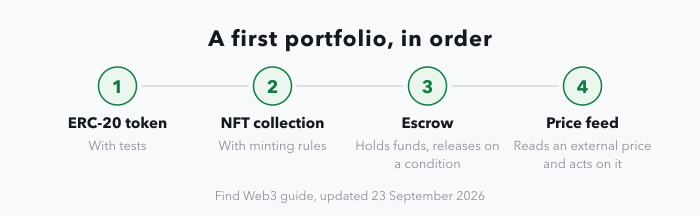
A portfolio of deployed, tested contracts does more than any certificate. Reasonable first projects, in order: an ERC-20 token with tests; an NFT collection with minting rules; an escrow that holds funds and releases them on a condition; something that reads an external price and acts on it. Deploy each to a testnet and write the tests you would want if it held real money.
Free resources that were live on 23 September 2026:
- CryptoZombies — the gentlest introduction to Solidity syntax.
- Speed Run Ethereum and Scaffold-ETH — a sequence of build challenges with a working full-stack template.
- Cyfrin Updraft — free courses on Solidity, Vyper, security and auditing, beginner to advanced.
- The Ethereum Foundation's tutorials and learning tools list.
The Solana and Rust route
If you would rather write Rust than Solidity, Solana is the main alternative. Programs are written in Rust, usually with the Anchor framework, and the account model is genuinely different from Ethereum's: state lives in accounts passed into the program rather than in the contract itself, which changes how you design almost everything. The Solana docs are the starting point.
The same warning applies as above: Rust appears on more listings than Solidity, but a large share of those adverts want Rust for backend services and infrastructure at crypto companies, not for on-chain programs. Read what the role actually builds before assuming the two are the same market.
What the work pays
All figures below come from pay stated by employers in their own listings on Find Web3, over the twelve months to 23 September 2026, and are recounted daily.
| Role | Median | Listings stating pay |
|---|---|---|
| Web3 developer | $200,000 | 278 |
| Blockchain security engineer | $204,000 | 21 |
| Blockchain developer | $170,000 | 21 |
On the blockchain developer page, the middle half of listings falls between $137,500 and $205,000, the mid-level median is $147,500 and the senior median is $200,000. The seniority step is larger than any language choice.
Across the whole board, engineering roles posted in the 90 days to 23 September 2026 numbered 805, with a median of $200,000 among the 313 that stated pay, and 104 companies had roles open in the preceding 30 days. Treat the small-sample rows above as indicative: 21 listings is a real number, but it is 21 listings.
A realistic timeline
No honest version of this has a fixed duration, because the starting points differ so much. What is reasonably stable is the order and the relative effort.
| Stage | For a working engineer | From no programming background |
|---|---|---|
| Stage 1, programming | Already done | The long stage, measured in months |
| Stage 2, how chains work | Days | Weeks |
| Stage 3, Solidity and tooling | Weeks | Weeks, after stage 1 |
| Stage 4, security | Ongoing | Ongoing |
| Stage 5, projects | Weeks, in parallel | Weeks, in parallel |
Stages 4 and 5 never finish, and that is the point: the tooling table above would have looked different two years ago, and will look different again.
Open roles are on the blockchain jobs and DeFi jobs pages, and the terms adverts use are defined in the Web3 dictionary.
What was removed from this guide
This article was rewritten on 23 September 2026. The following was deleted rather than updated, because none of it could be sourced:
- Market-size and growth claims — a blockchain market of $18.3 billion in 2024 at a 53.6% CAGR, a separate $28.93 billion to $49.18 billion at a 70.0% CAGR, $1.76 trillion added to global GDP by 2030 and a market of $12,895 billion by 2033. The three sets contradicted each other, none had a stated methodology, and none said anything about hiring.
- A salary table giving ranges for four job titles with no source. Replaced with medians from listings on this board, each with its listing count and date.
- A claim that a portfolio contract "processed 10,000 transactions per day with zero security incidents", presented as an example but written as fact.
- An infographic captioned as illustrating blockchain's three layers, and two further images with no caption. None were measurements of anything.
- Links to an unrelated product roadmap page and to an "onchain domains" article whose domain now redirects to an unrelated site.
- Descriptions of Truffle, Ganache, web3.js, Embark and Brownie as current tooling, and of "Ethereum 2.0" as a live network. All were out of date; the replacements and their status are in the tooling table above.