How to Create an NFT in 2026: Steps, Tools and Costs
The three transactions that mint a token, which platforms still accept new work, and what the fees actually come to, checked in September 2026.
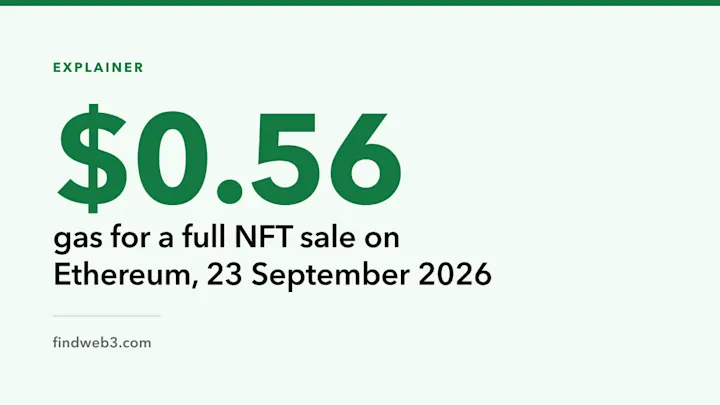
Creating an NFT is three transactions: deploy a contract, mint a token into it, and approve the collection the first time you list an item for sale. The tools are no-code, and the network fees on Ethereum now come to a few dollars.
Most guides on how to create an NFT were written in 2021 and 2022, and they are wrong in both directions. They overstate the cost, because Ethereum gas has collapsed since then. They understate the difficulty, because several of the platforms they recommend have shut down. Every service below was opened and checked on 23 September 2026, except where the last section says a page could not be reached.
Step 1: Set up a wallet
A crypto wallet holds the keys that prove you own an address. Everything else in this process runs through it: it pays the gas, it signs the contract deployment, and the minted token lands in it.
MetaMask is the usual starting point, as a browser extension or a phone app, and now describes itself as covering Bitcoin, Ethereum and Solana from one install. It is not the only option: Rarible's connect dialog on 23 September 2026 offered Coinbase Wallet, passkeys, WalletConnect and Bitget Wallet alongside it.
Two rules, and they matter more than anything else on this page:
- Write the seed phrase on paper. It is the only way back into the wallet, and anyone who has it has your tokens.
- No marketplace will ever ask for it. OpenSea's own guidance is blunt about this: it will never message you first on social media, and never asks you to send funds to it to sell an item or resolve a failed transaction (OpenSea help center, updated 12 May 2026).
You will also need a small amount of the chain's own token to pay gas: ETH on Ethereum and Base, POL on Polygon, SOL on Solana.
Step 2: Choose a chain
This is the step where old guides do the most damage. The standard 2022 advice was that Ethereum was unaffordable and beginners should mint on Polygon. Ethereum gas has since fallen far enough that the advice no longer holds.
| Chain | Gas price, 23 Sep 2026 | Reference transaction cost | Source |
|---|---|---|---|
| Ethereum | 0.337 gwei | $0.56 for an NFT sale; $0.02 for a standard transaction | Etherscan gas tracker, 10:01 UTC |
| Base | 0.005 gwei | $0.003 for a swap; $0.001 for a token transfer | BaseScan gas tracker, 09:58 UTC |
| Polygon PoS | 275.8 gwei, paid in POL | $0.006 for a swap; $0.002 for a token transfer | PolygonScan gas tracker, 09:58 UTC |
| Solana | n/a | ~0.003 SOL per mint with Metaplex Core, against ~0.022 SOL with the older Token Metadata standard | Metaplex documentation |
At $117.32 a SOL and $2,733.69 an ether (CoinGecko, 23 September 2026), a Solana mint is about 35 cents and an Ethereum transaction is cents to low dollars.
Two corrections worth carrying away. Polygon's gas token has been POL, not MATIC, since 4 September 2024: Polygon Labs' own migration notice says every transaction on Polygon PoS from that date uses POL as the native gas token. Some marketplace documentation still says MATIC, including OpenSea's. And Ethereum has run on proof of stake since September 2022, which cut its energy use by roughly 99.9%, so the environmental objection quoted in guides from before that date is describing a network that no longer exists. The NFT statistics page covers that in more detail.
Pick Ethereum if you want your work sitting next to the collections people actually trade. Pick Base or Polygon if you plan to mint hundreds of items and want the fees to round to nothing. Pick Solana only if your audience is already there, because the EVM tools below will not follow you.
Step 3: Choose a tool that still exists
Several of the platforms that 2022-era guides recommend no longer take new work.
| Platform | Status on 23 Sep 2026 | What it costs the creator |
|---|---|---|
| OpenSea Studio | Live. No-code, deploys a contract you own | No OpenSea fee to create a collection; 10% on mints in a primary drop; 1% on sales |
| Manifold Studio | Live. Deploys a Creator Core contract you own, on Ethereum, Optimism, Base or Shape | Free for creators; the collector pays 0.0005 ETH per claim, 0.0008 ETH on allowlisted mints |
| Rarible | Live. Create flow offers 16 chains | Not confirmed — see the last section |
| SuperRare | Live. Curated; some formats need approval | Not confirmed — see the last section |
| Foundation | Offline permanently since 27 April 2026 | — |
| Magic Eden (Ethereum, Polygon, Base, Bitcoin) | Closed, announced 27 February 2026 | — |
| Zora | Pivoted. Its front page is now a coin market, not an art marketplace | — |
Foundation's closure is the one to read in full. Its letter of 27 April 2026 says the sale of the platform fell through, the team that built and maintained it is no longer in place, and it will not reopen. Anyone with work listed through Foundation's contracts has to delist it manually, and Foundation will keep its IPFS gateway running only until 27 April 2027. Magic Eden's exit from Ethereum, Polygon, Base and Bitcoin, announced on 27 February 2026, is covered on the NFT statistics page alongside the other closures.
Manifold's help center lists publishing on Ethereum, Optimism, Base and Shape, plus the Sepolia testnet (Manifold help center, updated 24 October 2025). Rarible's create flow offered 16 chains on 23 September 2026, including Ethereum, Polygon, Base, Arbitrum and its own RARI Chain. OpenSea's compatibility page documents 29 chains, from Ethereum and Base to Ronin, Abstract and Monad (OpenSea help center).
On fees, OpenSea charges 1% on a sale, included in the price shown to buyers, 10% for minting in a primary drop, and nothing for swaps (OpenSea help center, 12 May 2026). Creating a collection through Studio carries no OpenSea fee at all — you pay gas and nothing else (Creator FAQ, 21 July 2025).
Manifold publishes its numbers just as plainly: Studio is free to use, and a mint costs the collector 0.0005 ETH, or about $1.37 at today's ether price (Manifold help center, updated 16 April 2025).
Lazy minting is not what it was
Older walkthroughs lean on lazy minting: create the item for free, and let the buyer's purchase put it on chain. OpenSea now refers to it in its own documentation as its "former lazy minting tool", and says you cannot mint further items into collections made with it. Anything you create through OpenSea Studio today is a real transaction that you pay for, at the moment you make it.
Step 4: Prepare the file and decide where it will live
OpenSea Studio accepts JPG, PNG, GIF and SVG, plus MP4. The limit is 50MB for a single item and 5GB for a drop. A Studio collection holds up to 10,000 items, and a single item can have up to 20,000 copies (Creator FAQ, 21 July 2025).
The part worth slowing down for is metadata — the record that points from the token to the artwork. The token lives on the chain. The image usually does not. OpenSea now labels every item with where its metadata sits, and lets you filter collections by the same field (OpenSea help center, 2 February 2026):
- Fully onchain — metadata and media both stored on the blockchain. CryptoPunks, Nouns, Loot and Autoglyphs work this way.
- Onchain metadata — the record is onchain, the media is served from elsewhere.
- Decentralized — stored on IPFS or Arweave.
- Centralized — stored on an ordinary web server, and available only for as long as that server is.
Foundation's shutdown is the argument for caring. The tokens survive because the contracts are onchain, and work pinned to IPFS can be re-pinned somewhere else — which is exactly why Foundation gave a year's notice on its gateway. Work whose image sits on a company's server has no such second life.
Step 5: Deploy the contract, then mint
The OpenSea Studio flow, as its documentation describes it (22 August 2025), runs in two parts.
Part one, the contract. Open Studio and click Create new, then Create Collection. Add a logo, a contract name and a token symbol, typically four to seven characters, then pick an EVM chain. The name and symbol are written on chain and cannot be changed afterwards. Publish the contract and approve the transaction; this one costs gas.
Part two, the token. Upload the file, name the item and set the supply — set it to 1 for a unique piece. Add a description, an external link and traits if you want them. Click Mint and approve the second transaction.
Studio offers two routes, and they produce different things (OpenSea help center, 24 September 2025, with the fees from the fee page above):
| Scheduled drop | Collection or item | |
|---|---|---|
| Token standard | ERC-721 | ERC-1155 |
| Who mints | Collectors mint from your drop page | You mint into your own wallet |
| Visible before sale | No, until you reveal | Yes, immediately |
| Bulk upload | Yes | No |
| OpenSea fee | 10% of the mint | None |
If this is a first NFT, take the second route. Nothing depends on anyone showing up.
One limit to know before you commit: OpenSea Studio is EVM only. You cannot create a Solana NFT on OpenSea, even though it trades a selected group of Solana collections — Solana minting runs through Metaplex-based tools instead.
Step 6: List it, and set creator earnings
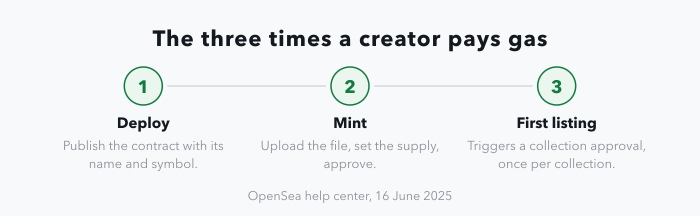
A creator pays gas three times: deploying the contract, minting, and the first listing in a collection, which triggers a collection approval. Listings after that are gas-free. When the item sells, the buyer pays gas on a fixed-price purchase, and you pay it if you accept an offer (OpenSea help center, 16 June 2025).
Creator earnings — royalties, in older language — are the part that changed most since 2022, and the change is not the one people expect. On OpenSea they are now either enforced or optional, and which one you get depends on your contract (OpenSea help center, 20 January 2026):
- Contracts deployed through Studio after 2 April 2024, and custom contracts compatible with ERC-721C or ERC-1155C, can enforce earnings. The payment is checked at the point of sale through Seaport 1.6.
- Older Studio contracts and custom contracts without that standard can only suggest a percentage. The seller chooses whether to pay it.
The same page adds the catch: contracts that enforce earnings this way can only be sold on OpenSea and other marketplaces running LimitBreak's Payment Processor. A royalty is a property of the contract and the venue together, not a setting you tick once.
What it actually costs
At the gas prices above, the arithmetic is small enough to do in your head. A million units of gas at 0.337 gwei is 0.000337 ETH, about $0.92 at $2,733.69 an ether. For scale, Etherscan priced a full NFT sale at $0.56 at that gas price.
Your wallet shows the gas limit for each transaction before you confirm it. Multiply it by the gas price on the tracker and you have the real cost — a number in single digits of dollars on Ethereum today, and a rounding error on Base, Polygon or Solana. Gas is volatile; the Ethereum figure above moved between 0.265 and 0.337 gwei in the half hour it took to check these pages, so read the tracker on the day rather than trusting any figure written in advance, including these.
Mistakes that cost money
- Minting work you do not own the rights to. A marketplace can delist the collection; the tokens stay on the chain either way.
- Building a 10,000-item collection first. Mint one. The market described below does not reward volume.
- Storing the art on a server you control and then letting it lapse. Use IPFS or Arweave, and check the storage label after minting.
- Answering a stranger who says your listing is broken. That is the standard phishing script, and OpenSea names it explicitly in its own help pages.
- Paying for promotion. Nothing in the minting process requires a paid service, a "verification" fee, or a wallet signature from a site you reached through a DM.
Is it worth minting at all?
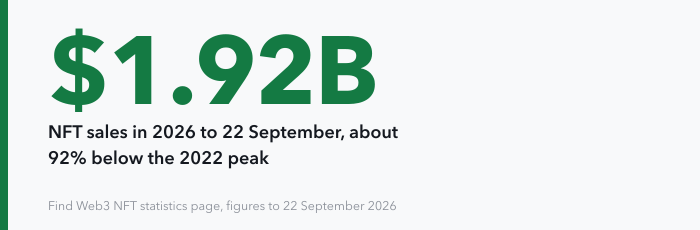
An honest answer belongs in a how-to. NFT sales came to $1.92 billion in 2026 to 22 September, about 92% below the 2022 peak, and the average sale this year is $75, against $96 across 2025. There are more than 1.34 billion NFTs in existence. The full picture, with each figure dated and sourced, is on the NFT statistics page.
That does not make minting pointless. It makes it cheap, permanent and unlikely to sell on its own. The things still working are specific: tokens that represent a physical object held in a vault, memberships that do something, and single artworks sold to people who already follow the artist. None of that starts with the mint.
If the interesting part of this was the machinery rather than the market, the same skills are hiring. Find Web3 lists NFT roles across crypto companies, and the crypto and Web3 glossary covers the 78 terms that turn up most often in those job adverts.
What could not be verified
Checked on 23 September 2026, and unresolved:
- Rarible's service fee and whether its free minting still works. The create flow is live and lists 16 chains, but
help.rarible.comreturned a Cloudflare "Edge IP Restricted" error at 09:59 UTC, and the flow requires a connected wallet before it shows terms. Widely quoted third-party figures were not used here, because none of them cite Rarible. - SuperRare's creator fees. The platform is active, with live auctions and an artist application, but its create-and-sell page states no fee schedule and none was confirmed from its own documentation on this pass.
- Magic Eden's Solana terms. The site returned a bot-protection challenge and was not opened. Its Ethereum, Polygon, Base and Bitcoin marketplaces are confirmed closed.
- Whether Manifold publishes to chains beyond the four above. Its help center lists Ethereum, Optimism, Base and Shape; its developer documentation lists contract addresses more widely, and the two were not reconciled.
- The exact gas cost of a contract deployment. It depends on which contract a platform deploys, so the calculation above is given as a method rather than a figure.