Remote Contract Work in Web3: Pay, DAOs and Risks
What Web3 contracting pays, how DAO clients and token compensation work, where to find gigs, and the tax and legal side to handle.
Web3 companies and DAOs hire a lot of contractors: fixed-scope engagements, no office, payment in crypto, and often no single employer on the other side of the agreement. This guide covers how those arrangements work, what they pay in, what protections you give up, and where the work is listed.
How Web3 Contract Work Differs
Web3 contracting looks like ordinary freelancing until you reach the questions of who is hiring and how they pay. The client may be a Decentralized Autonomous Organization (DAO) rather than a company, part of the agreement may be enforced by code, and the money usually arrives as crypto.
Four things set it apart:
- Decentralized clients. Work often comes from a DAO or an open-source project rather than a company with a manager and a payroll department.
- Token pay. Compensation is commonly in stablecoins or in the project's own token, which hands you a stake in the project alongside, or instead of, a flat fee.
- A public work record. On-chain contributions, governance votes and public repositories leave a history anyone can check.
- Open entry. Projects generally recruit on demonstrated skill, often from their own communities. Tax, sanctions and immigration rules still apply wherever you live.
Smart Contracts, DAOs, and Token Pay
You do not need to write Solidity to contract in Web3, but three mechanics decide how you are hired and how you are paid.
Smart Contracts
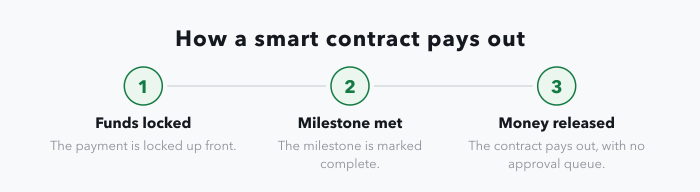
A smart contract is a program stored on a blockchain that runs when its conditions are met. In a work arrangement it usually handles payment: funds are locked up front, a milestone is marked complete, and the contract releases the money without an invoice passing through anyone's approval queue.
That removes the wait for a payment cycle. It also removes the recourse. Code executes as written rather than as intended, so the terms encoded in it matter more than anything agreed on a call. Before funds are locked, confirm what triggers release, who is able to mark a milestone complete, and what happens if the work is disputed.
DAOs
A DAO coordinates through on-chain voting and a shared treasury rather than a management hierarchy. That changes the mechanics of a contract: scope and budget may require a public proposal and a vote, decisions take longer than a manager's yes, and there is often nobody who can unilaterally approve a change of scope mid-project.
It also changes how you get hired. Contributors are usually drawn from the project's own community, so a record of useful participation counts for more than a résumé. Many DAOs post small bounties, which is the normal way in.
Token Pay
Some contracts pay in stablecoins — crypto pegged to a currency, usually the US dollar — which behave much like ordinary payment. Others pay in the project's own token, in whole or in part.
Token pay is closer to equity than to wages. What it is worth depends on the project, it may carry a vesting schedule or a lock-up, and it can be worth considerably less on the day you are able to sell it than on the day the rate was agreed. Before settling a rate, ask which token, whether it trades anywhere with real liquidity, and when it unlocks. A fixed token amount and a fixed dollar amount are very different deals. Published medians for Web3 roles are on the salaries page, though those figures are counted from the cash pay employers state in their listings and take no account of a token grant on top.
The Risks and the Rewards
What Draws People In
- Location freedom. Most of this work is remote by default and much of it is asynchronous, because the teams are already spread across time zones.
- A stake, not just a fee. Token pay gives you an interest in whether the project succeeds. That is part of the appeal and all of the risk.
- Current work. Contract roles are how much of the space staffs new protocols and products, so the work tends to be new build rather than maintenance.
What You Give Up
Price risk. A payment in a volatile token can be worth materially more or less by the time it reaches your wallet, and again before you convert it. Budget on what you can convert, not on the headline number.
Benefits and safety net. No employer health cover, pension contributions, sick pay or paid leave. Those become line items you fund out of the rate.
Counterparty risk. Projects run out of treasury and teams disband. A DAO's treasury is usually public — look at it, and at how long the project has been paying contributors, before you start.
Regulatory uncertainty. How crypto income is taxed and reported differs by country and continues to change.
Distance. Teams spread across many time zones answer slowly, and a decision that would take a conversation takes a thread. Front-load the scoping.
Web3 Contract Work vs Traditional Freelancing
| Aspect | Web3 Remote Contract Work | Traditional Remote Freelancing |
|---|---|---|
| Payment | Cryptocurrencies or stablecoins; token pay can carry vesting and price risk. | Fiat currency; the amount agreed is the amount received. |
| Benefits & Security | No employer benefits, and income that varies with the market as well as the pipeline. | Typically no employer benefits, but predictable income makes planning easier. |
| Legal & Tax | Rules vary by jurisdiction and are still changing; usually needs specialist advice. | Established frameworks and widely available guidance. |
| Ownership | Often includes tokens, giving a direct stake in the project's outcome. | Service for fee; no inherent ownership. |
| Working Culture | Autonomous and asynchronous; approval may run through community governance. | Varies by client, but usually mirrors that client's internal structure. |
| Market Risk | Exposed to crypto prices and to early-stage projects running out of funding. | Insulated from asset prices; risk is client stability and pipeline. |
Which path suits you comes down largely to how much income variability you can absorb.
Managing Money and Legal Obligations
Contracting means running a business of one. The invoicing, the tax and the record-keeping are yours.
How to Structure Your Work
The simplest arrangement is to work as a sole proprietor, trading as yourself. It is easy to start and offers no liability protection: personal assets are exposed if something goes wrong.
Once income is steady, a limited company — an LLC in the US, and its equivalents elsewhere — separates business and personal liability at the cost of filing fees and paperwork. Which structure makes sense depends on where you live and what you earn, so it is a question for an accountant in your own country rather than a rule of thumb.
What the Written Contract Should Cover
Automated payment does not replace a written agreement. Even where a smart contract releases the funds, you want a document that says what the work is.
- Scope. The specific tasks, milestones and deliverables, and what is explicitly out of scope.
- Payment terms. The total fee, the schedule, the asset you will be paid in, and how that asset is priced.
- Revisions. How many rounds are included, and what happens beyond them.
- IP and confidentiality. Who owns the output, and what you may show publicly. Open-source work is often more permissive here than traditional contracts, but write it down rather than assume it.
Crypto and Tax
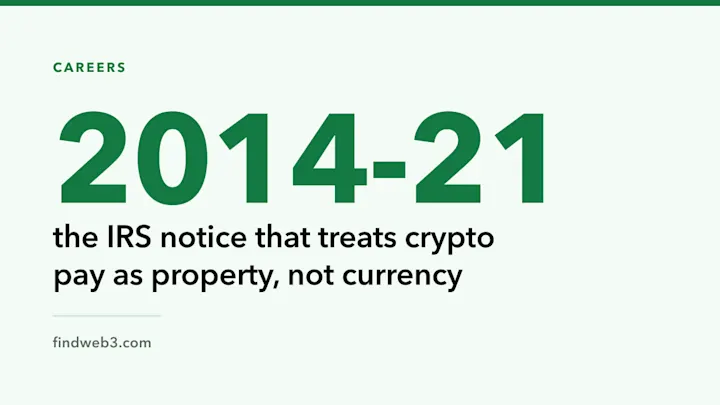
In the US, the IRS has treated virtual currency as property rather than currency since Notice 2014-21. A payment is income at its fair market value on the day it is received, and selling or swapping it later is a separate capital gain or loss. Other countries treat it differently, and some treat token grants differently again from payment for services.
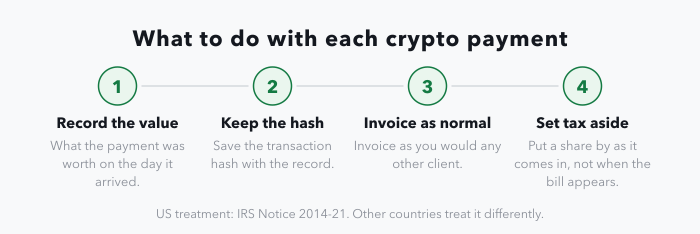
In practice: record the value of every payment on the date it arrives, keep the transaction hashes, invoice as you would any other client, and set aside a share of each payment for tax as it comes in rather than converting when the bill appears.
Finding Your First Contract
Hiring here is less résumé-driven than in traditional employment. Most clients look at what you have shipped and where you have shown up.
Build a Profile That Can Be Checked
- A wallet you use publicly. Governance votes, grants received and bounties completed are attached to an address, and anyone considering you can verify them.
- Public work. For developers, contributions to open-source Web3 repositories are the strongest evidence available. For everyone else, published writing, designs or community work serves the same purpose.
- Somewhere to point people. A portfolio site is fine. Hosting it on IPFS is a small signal that you use the tooling, not a requirement.
Where the Work Is Listed
Web3-specific boards carry contract and part-time protocol roles that generalist freelance sites tend to miss. Find Web3 lists open Web3 and crypto jobs, including NFT roles and crypto roles, and tracks the companies currently hiring and hiring by month and category.
Beyond the boards, DAO governance forums and project Discords carry paid work that is never posted anywhere else.
Networking and Proposals
In a community-driven space, many contracts start in a Discord thread rather than an application form.
- Participate before you pitch. Answer questions, report problems and join calls in projects you actually follow. Being recognized is most of the qualification.
- Take a bounty first. A small paid task lets a project see your work at low risk to both sides, and it is the usual route to a larger contract.
- Write proposals about their problem. Name the specific thing you would fix, what you would deliver and by when. A clear plan carries more weight than a job history.
Building a Longer Career
The first contract is the hard one. After that, most of the work comes from reputation and referral, which makes how you finish engagements more important than how you find them.
Reputation
- Reliability. Hit dates, and flag slippage early rather than at the deadline.
- Written communication. These teams are asynchronous, so regular written updates are part of the job, not an extra.
- Scope discipline. Extra work is only valuable if it was wanted. Raise the idea before you build it.
Rates and Selectivity
Track hours and outcomes from the first contract onward, so that rate conversations rest on what you delivered. As referrals accumulate, you can be more selective about both the projects and the pay mix — for example, weighting toward stablecoins with projects you are less certain of. Published medians by role are on the salaries page.
Common Questions
How do you handle payment in a volatile token?
Decide the split before the payment arrives, rather than after watching the price for a week. A common approach is to convert a fixed share of every payment into a stablecoin or fiat to cover living costs and tax, and to leave the remainder in the token. What matters is that the rule is set in advance and applied consistently. What that share should be is a personal financial question, and a good one for an accountant or a licensed adviser.
Do you need to be a developer?
No. Projects contract for community management, content and marketing, design, and operations and project management as well as engineering. The salaries page covers 15 roles, and the hiring report breaks open roles down by category.
Find Web3 lists remote and contract roles from companies and protocols across the space. Browse the current openings.