What Is Tokenomics? Supply, Utility and Distribution
How token supply, distribution, utility and vesting shape value, plus a framework for judging whether a project's economics hold up.
Tokenomics is a portmanteau of "token" and "economics": the rules that decide how many of a token will ever exist, who received them first, how new ones are created, and what holders can do with them.
Those rules are usually written into the token contract and set out in a public document before launch, and where the contract's source is verified anyone can check the supply and allocations against the chain itself — though not every project publishes them, and an upgradable contract can change the rules later. That is the difference between tokenomics and a company's financial plan — the policy is visible, and so is whether the project is following it.
What Is Tokenomics and Why It Matters
A central bank manages a national currency: it decides how much to issue, influences interest rates, and targets an inflation rate. Tokenomics does a similar job for a crypto project, except the policy is fixed in advance and enforced by code rather than decided meeting by meeting.
The design carries real weight. A project can have sound technology and still fail on its economics — if the token has no job to do, or if the people who received it first can sell all of it at once.
The Foundation of Digital Value
Reading tokenomics means looking at four levers: how many tokens exist, how they are released over time, who got them first, and what the token can actually be used for.
A well-designed model aligns developers, investors and users, so that what is good for one holder is also good for the network.
This is also working knowledge, not just analysis for buyers. Token design sits inside the job at protocol and DeFi teams; those roles are listed under DeFi jobs.
More Than Just Fundraising
Early crypto tokens were often little more than a way to raise money in an ICO. A token's design is now also used to direct behavior: to secure a network, to reward liquidity, to hand out votes. Selling tokens also lets a project raise money without giving up equity.
Three questions cover most of what matters about any token:
- Why does it exist? Its purpose and utility.
- Why should it be worth anything? Its supply and demand.
- Why should anyone trust it? Its distribution and incentives.
Deconstructing a Token's Economic Blueprint
Four components make up the blueprint: supply, distribution, utility and incentives.
The Critical Role of Token Supply
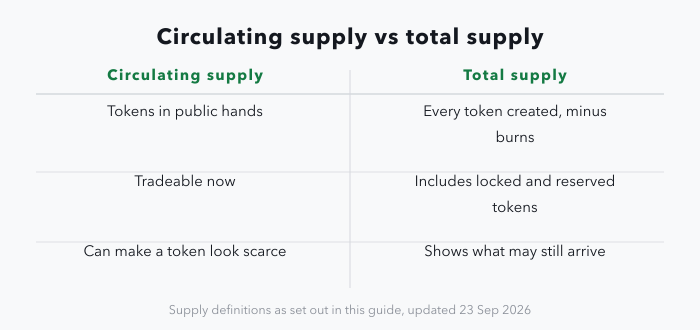
Supply is usually quoted as three numbers, and they are not interchangeable.
- Circulating supply: the tokens in public hands and tradeable now.
- Total supply: every token created, minus any verifiably burned. This includes locked and reserved tokens that are not on the market yet.
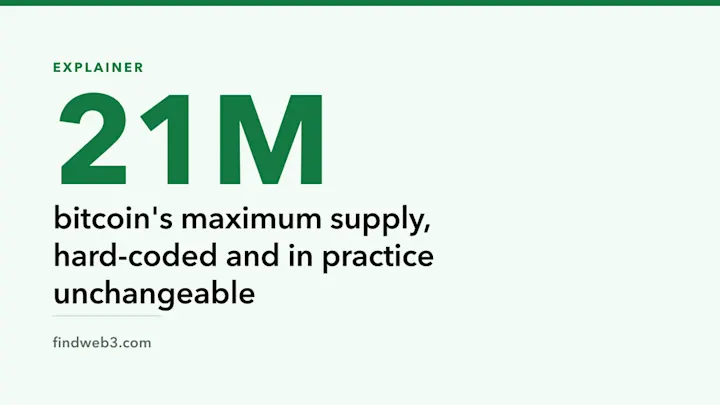
- Maximum supply: the hard-coded ceiling, where one exists. Bitcoin's is 21 million.
The gap between circulating and total supply is the part worth attention. A small circulating supply can make a token look scarce while a large locked allocation waits to be released into the same market.
How Tokens Get Into People's Hands
Distribution is how the tokens were handed out at the start. It is the most revealing single section of most token documents.
- Initial coin offerings (ICOs): the project sells tokens directly to the public to raise money.
- Airdrops: tokens sent free to particular wallets, usually to seed a community or reward early users.
- Fair launches: tokens released on the open market with no pre-sale and no team allocation.
A founding team holding a large unlocked allocation is a risk to the price, whatever the rest of the document says. A wide distribution with published vesting is the thing to look for.
What's the Point? The Token's Utility
Utility is what the token does inside its own system. The usual jobs:
- Governance: holders vote on proposals that set the project's direction.
- Platform access: the token is required to use a feature or a service.
- Native currency: the token pays for transactions or services within the ecosystem.
A token with no job inside its own system is priced on speculation alone.
Giving People a Reason to Participate
Incentives are the rewards that get people to do what the network needs done. The most common is staking: holders lock tokens to help secure the network and earn newly issued tokens in return. Staked tokens are also out of circulation while they are locked, which pulls in the opposite direction to the new issuance paying for them.
Understanding Token Supply and Demand
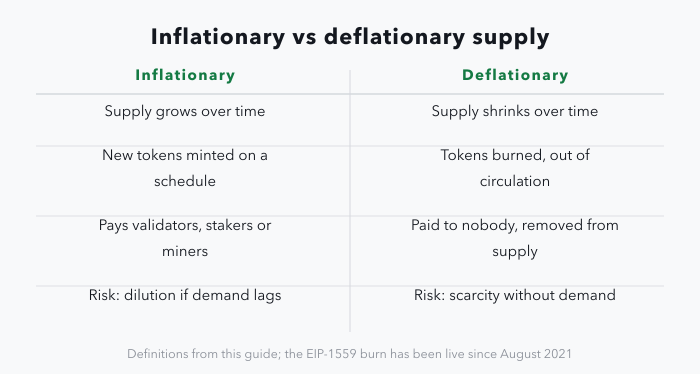
Two questions decide the shape of a token economy: will there be more or fewer tokens over time, and why would anyone want to hold them. The first answer puts a project in one of two camps.
Inflationary Models: Fueling Growth
An inflationary token's supply grows. New tokens are minted on a schedule, usually as rewards to the validators, stakers or miners who keep the network running. The new supply is what pays for security.
Issued faster than demand grows, that same supply dilutes existing holders. The questions are the rate of issuance and what the network gets for it.
Deflationary Models: Creating Scarcity
A deflationary token's supply shrinks, usually through a burn: tokens sent to an address nobody controls, permanently out of circulation.
Ethereum is the best-documented example. Under EIP-1559, live since August 2021, the base fee on every transaction is destroyed rather than paid to a validator — as Ethereum's own gas documentation puts it, the base fee is burned when the block is created, removing it from circulation.
A burn is a programmatic commitment to shrinking supply. It says nothing on its own about demand, and scarcity without demand does not support a price.
Preventing Price Dumps with Vesting and Lock-Ups
A sound supply model can still be undone by the people who were there first. If the team, advisors and early investors hold a large share and can sell it on day one, they can take the price down with them. Two mechanisms exist to prevent that:
- Vesting schedules: insider allocations unlock gradually across a set period rather than arriving all at once.
- Lock-up periods (often called a cliff): a waiting period before any of an allocation unlocks at all.
Both are published, so read the actual terms rather than assuming a standard: how long the schedule runs, how long the cliff is, and how large each unlock is relative to the circulating supply.
Your Framework for Evaluating Tokenomics
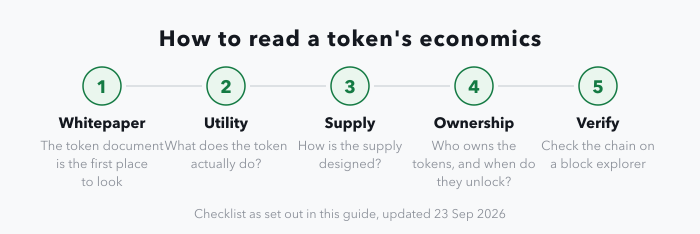
Applying the theory is a matter of asking the same questions every time, in the same order, of every project.
Start With the Project's Blueprint
Every serious project publishes a whitepaper or token document setting out its goals, its technology and its token model. It is the first place to look.
If there is no whitepaper, or the one there is consists of vague promises, that is itself the finding. Unfamiliar terms are covered in the Web3 dictionary.
Key Questions for Your Checklist
- What does the token actually do?
- What problem does it solve inside its own ecosystem?
- Is there a reason to hold or use it other than expecting the price to rise?
- Does its purpose follow from the product, or was a token added to a product that did not need one?
- How is the supply designed?
- What are the circulating, total and maximum supply figures?
- Is the supply inflationary or deflationary?
- If it is inflationary, what does the new issuance buy — security, liquidity, or nothing in particular?
- Who owns the tokens?
- Was this a fair launch, or a sale that placed large allocations with private investors?
- What share of the supply is held by the team, advisors and early investors?
- Are those allocations under vesting schedules and lock-ups, and when do the unlocks land?
Where to Find the Real Answers
The whitepaper states intentions. The chain records what happened.
- Block explorers: Etherscan for Ethereum, Solscan for Solana. Use them to verify total supply, see the largest holders, and watch how tokens move.
- Project documentation: developer docs and governance forums usually carry more detail on token mechanics than the whitepaper does.
- Community channels: official Discord and Telegram groups are noisy, but they are where the team can be asked directly. Whether a question gets a straight answer is information too.
Tokenomics in Action: Real-World Case Studies
Bitcoin and Ethereum took opposite approaches, which makes them a useful pair to compare.
Bitcoin: The Original Deflationary Model
Bitcoin's token model is rigid and predictable by design, and built on one principle: verifiable scarcity.
The maximum supply is 21 million coins, hard-coded and, in practice, unchangeable. That makes bitcoin a finite digital resource with a schedule anyone can check.
Scarcity is reinforced by the halving:
- Every 210,000 blocks — roughly every four years — the reward paid to miners for producing a block is cut in half.
- This slows the rate at which new bitcoin enters circulation.
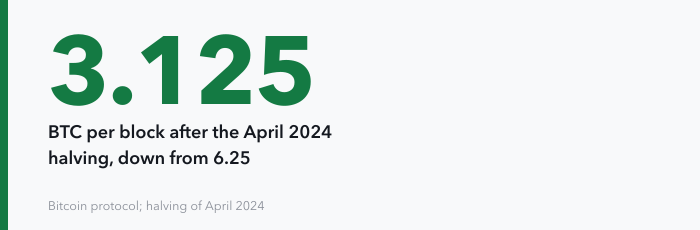
- The halving in April 2024 cut the block reward from 6.25 BTC to 3.125 BTC.
The result is a supply schedule known years in advance. Bitcoin's tokenomics are built for one job: a predictable store of value. The simplicity is the point.
Ethereum: The Dynamic Economic Engine
Ethereum has no fixed maximum supply. Its supply is set by two forces pulling against each other:
- Issuance: new ETH is created as a reward for validators who stake ETH to secure the network. Ethereum has run on proof of stake since September 2022, so this issuance goes to stakers, not miners. It adds to supply.
- Burning: the base fee on every transaction is destroyed under EIP-1559. It removes supply.
Which force wins depends on how busy the network is. When activity is high, more ETH can be burned than is issued, and the total supply falls over that period; when activity is low, issuance dominates and supply grows. Scarcity is tied directly to use of the platform.
Roles that involve this kind of design work are listed under crypto jobs.
Bitcoin vs. Ethereum Tokenomics Comparison
| Feature | Bitcoin (BTC) | Ethereum (ETH) |
|---|---|---|
| Max Supply | Fixed at 21 million | No fixed maximum supply |
| New Issuance | Mining rewards, halving every 210,000 blocks | Staking rewards (variable) |
| Scarcity Driver | The hard cap and predictable halvings | Transaction fee burning (EIP-1559) |
| Primary Goal | A secure, decentralized store of value | Powering a decentralized computational platform |
| Flexibility | Extremely rigid and difficult to change | Changed by community upgrades |
Neither model is the correct one. Bitcoin's rigid scarcity and Ethereum's use-driven supply are answers to different problems, and both are worth understanding before judging any third project.
Common Questions About Tokenomics
Can a Project Just Change Its Tokenomics?
Technically yes, but whether it can happen in practice comes down to governance.
Changing Bitcoin's core rules — the 21 million cap, say — would require agreement from a large majority of independent miners and node operators worldwide. That difficulty is a feature, and it is where Bitcoin's store-of-value argument comes from.
Newer projects, particularly in DeFi, are usually more flexible:
- On-chain governance: token holders propose and vote on changes directly. A proposal that passes can update the smart contracts automatically.
- Team control: the founding team retains the ability to make changes through admin keys or a multisignature wallet. Common early on, and a growing risk as the amount of value at stake grows.
A change in tokenomics is not automatically bad. The questions are who can make it and whether the process is visible in advance. A surprise change made from the top is a different signal from one voted through by holders.
Is Good Tokenomics a Guarantee of Success?
No. It is one component among several:
- Product-market fit: is the project solving a problem people have?
- Technology and security: is the code sound? A history of hacks costs trust regardless of the token model.
- Team and community: is the team experienced and open about what it is doing?
- Market conditions: broad market moves affect well-designed projects too.
A strong deflationary model will not save a platform nobody wants to use. Tokenomics creates the conditions for value; the product has to supply it.
What Is the Difference Between Tokenomics and Token Metrics?
Tokenomics is the design. Token metrics are the readings.
Tokenomics is the model: the rules and incentives, and the reasoning behind them. Why does this token have a burn? How are stakers paid? What is the supply meant to do over ten years?
Token metrics are the specific numbers that model produces at a given moment. For an imaginary token, the two would look like this:
| Aspect | Tokenomics (the design) | Token metrics (the reading) |
|---|---|---|
| Supply | The token is designed to be deflationary over the long run. | Circulating supply today: 150 million. |
| Distribution | Tokens are distributed widely to build a decentralized holder base. | The team holds 12% of supply, vesting over three years. |
| Value | Platform fees are shared with long-term holders. | 24-hour trading volume: $4.2 million. |
Tokenomics is the rulebook. Token metrics are the current score. The rules are what make the score mean anything.
Web3 roles that involve token design are listed under DeFi and crypto, and hiring by month and category is in the Web3 jobs report.