Web3 vs Blockchain: 7 Differences in How They Work
Blockchain is the ledger; Web3 is what gets built on it. Seven differences across architecture, tokens, governance, identity and interoperability.
Web3 and blockchain get used as if they mean the same thing. They do not. Blockchain is a technology: a ledger that many machines keep a copy of and agree on. Web3 is what people are trying to build with it, plus a set of other decentralized technologies, and it is an intention rather than a component.
The distinction matters in seven concrete places: how each decentralizes, how each is put together, what smart contracts and dApps each are, what tokens are for, how decisions get made, how identity works, and how systems talk to each other.
1. Decentralization Paradigms
Blockchain decentralizes one thing well: agreeing on a record. A network of machines keeps the same ledger, and no single operator can quietly change an entry. Web3 takes that property and tries to apply it to the rest of the stack, including storage, computation, and identity.
Blockchain is the engine; Web3 is the car being built around it. Bitcoin and Ethereum are blockchains. Filecoin (decentralized storage) and Polkadot (connecting separate chains) are Web3 infrastructure that assume a blockchain underneath.
What the shift buys you: fewer central points of failure, more resistance to censorship, and user control over data and assets without trusting an intermediary. What it costs: decentralized systems are slower and more expensive than centralized ones, governance gets hard, and throughput limits are a real constraint on what you can build.
Names attached to this: Satoshi Nakamoto (Bitcoin), Vitalik Buterin (Ethereum), Gavin Wood, who coined the term "Web3" in 2014, and Juan Benet (IPFS and Filecoin).
2. Technical Architecture
A blockchain is a specific kind of distributed ledger. Records are grouped into blocks, each block carries a cryptographic link to the one before it, and a consensus mechanism decides which blocks are valid. Bitcoin uses proof of work, where miners spend electricity to propose blocks. Ethereum has used proof of stake since September 2022, where validators lock up ether instead. Anything you read that describes mining ether is out of date.
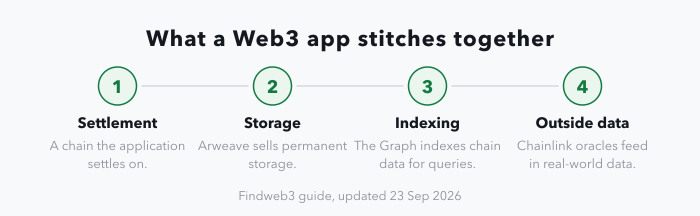
Web3 is layered rather than singular. A working application usually stitches together several protocols: a chain for settlement, a storage layer, an indexing layer, and a way to get outside data in. Chainlink runs oracles that feed real-world data to smart contracts. Arweave sells permanent storage. The Graph indexes chain data so applications can query it without reading every block themselves.
The trade-offs run in opposite directions. A single blockchain is simpler to reason about and limited in throughput. A composed Web3 stack is more capable and has more places to break: every protocol you add is another integration, another dependency, and another thing that can fail.
If you are building: decide early where you actually need decentralization and where you are paying for it out of habit, keep components modular so you can replace one without rewriting the stack, and assume you will eventually need to work across more than one chain.
3. Smart Contracts vs. dApps
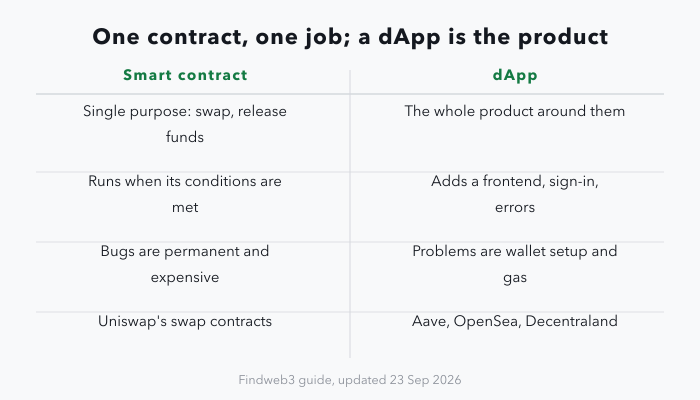
A smart contract is a program that lives on a blockchain and runs when its conditions are met. It is usually single-purpose: swap this token for that one, release these funds when that condition holds.
A decentralized application is the whole product. It typically calls several smart contracts, adds a frontend, and handles the things users expect from software, including sign-in, readable state, and error handling. Uniswap's swap contracts are smart contracts. Aave, OpenSea, and Decentraland are dApps built on top of contract logic.
The failure modes differ too. A contract bug is permanent and usually expensive, because deployed code is hard to change and holds real money. A dApp's problems are more often product problems: wallet setup, gas, and confirmations that no web user has been trained to expect.
Practical notes for builders: get contracts audited before they hold funds; expect to launch with more centralized control than you want and hand it over in stages; and spend disproportionate effort on the first five minutes of the user experience.
Nick Szabo described smart contracts as a concept in the 1990s, long before a blockchain existed to run them. If the vocabulary in this section is unfamiliar, the Web3 glossary defines the terms and shows how often each one appears in job adverts on this board.
4. Tokenization Models
On a blockchain, a token is mostly a unit of value: something you hold, send, and account for. Bitcoin works this way.
In Web3, tokens are asked to do more jobs. Fungible tokens (the ERC-20 standard on Ethereum) behave like currency or credits. Non-fungible tokens (ERC-721 and ERC-1155) represent one specific item rather than an interchangeable amount. Governance tokens carry voting rights in a protocol. Utility tokens buy access to a service.
The examples show the range. Bitcoin is held and transferred. Ether is both an asset and the fuel that pays for computation on Ethereum. UNI gives holders a vote over Uniswap. Axie Infinity paid players in tokens for playing, which made the game's economy and its token price the same problem.
The case for token models is that they let strangers coordinate: fractional ownership, aligned incentives between a protocol and its users, and a way to pay for network participation before there is revenue. The case against is that regulation is unsettled in most jurisdictions, price volatility undermines any token meant to be used rather than traded, distribution is hard to get right, and speculation tends to drown out whatever the token was for.
If you are designing one: model it over years rather than months, take legal advice early rather than after launch, and check that no single group of holders benefits at everyone else's expense.
Most of the paid work in this area sits in DeFi. Current openings are on the DeFi jobs page.
5. Governance Systems
Blockchain governance is mostly about the protocol itself: which upgrade ships, what the parameters are. Core developers propose, and miners or validators effectively decide by running the software or not.
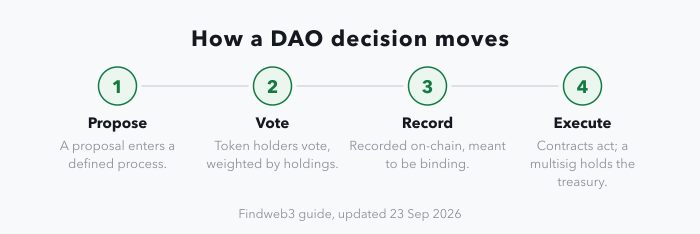
Web3 extends that to governing products, treasuries, and whole ecosystems, usually through a DAO. Decisions are made by token holders voting, and the outcome is executed by smart contracts rather than by a manager. The machinery is fairly consistent: proposals with a defined process, token-weighted voting, votes recorded on-chain where the result is meant to be binding, and multi-signature wallets so no one person can move the treasury.
Working examples: Tezos lets token holders vote on protocol upgrades on-chain. Compound's Governor contracts run the lending protocol's votes. The ENS DAO governs the Ethereum Name Service.
The failure modes are well documented by now. Turnout is often low, which makes a small number of voters decisive. Token-weighted voting hands the largest holders the most power, which is plutocracy with better branding. Governance itself can be attacked, usually by acquiring votes long enough to pass one proposal. And consensus is slow, which is a problem when something is on fire.
Things that help: let holders delegate votes to people who will actually use them, start with a simple structure and add mechanisms only when a real problem demands them, and document how the process works so participants are not reverse-engineering it from past proposals.
If this is the work you want, DAO roles are listed on the DAO jobs page.
6. Identity and Authentication
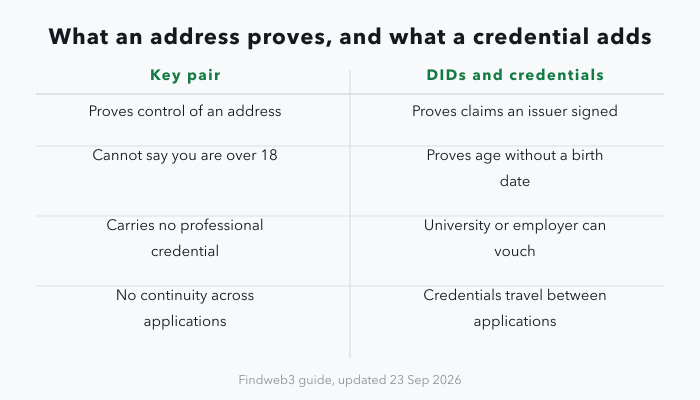
On a blockchain, identity is a key pair. Your address is derived from a public key, and you prove control by signing with the private key. That is enough to own assets and nothing more: an address cannot say you are over 18, or a licensed engineer, or the same person who used a different application last week.
Web3 identity tries to close that gap with self-sovereign identity. Two pieces do most of the work. Decentralized identifiers (DIDs) are identifiers you control rather than ones issued by a platform. Verifiable credentials are signed statements from an issuer, such as a university or an employer, that you hold and present yourself. Together they allow selective disclosure: proving you are over a threshold age without handing over a date of birth.
In practice: the Ethereum Name Service maps readable names to addresses, Ceramic provides a data network for the mutable parts of an identity, and Spruce ID builds sign-in and credential tooling for applications.
The upside is real: control over your own data, no single identity provider to be locked out by, and credentials that travel between applications. The obstacles are equally real. Key management is unsolved for ordinary users, and losing a key can mean losing an identity rather than resetting a password. Standards are still competing. Regulators have not settled how any of this interacts with know-your-customer rules. And almost nobody has been asked to do this before.
Sensible practice: offer social recovery so a lost key is survivable, stick to published standards rather than a bespoke scheme, and add identity features gradually instead of requiring them at sign-up.
7. Interoperability Frameworks
Blockchains are isolated by design. A chain agrees on its own state and knows nothing about any other. Blockchain-level interoperability has mostly meant moving an asset from one chain to another. Web3 wants something wider: applications composed from protocols on different chains, with data and value moving between them.
Four mechanisms do most of this. Cross-chain bridges move tokens and messages between chains. Layer-0 protocols sit underneath several chains and connect them natively. Middleware provides shared interfaces between applications. Standardized APIs let developers write against a protocol without learning its internals.
Polkadot connects parachains through a central relay chain. Cosmos defines IBC, a standard for chains to pass messages to one another. Chainlink connects chains to data that lives off them. LayerZero passes messages between chains without moving through a central chain.
| Pros | Cons |
|---|---|
| Reduced siloed blockchain ecosystems | Increased attack surface |
| Enables greater application functionality | Security vulnerabilities in bridges |
| Improves capital efficiency | Complexity increases development costs |
| Facilitates specialization of protocols | Potential for cascading failures |
Bridges deserve particular caution. They hold assets on one side while issuing representations on the other, which makes them among the most attacked components in the industry. If you build or depend on one, audit it, monitor it, and start with the smallest set of cross-chain interactions that does the job.
Where the Two Sit
Blockchain is a component with a narrow, well-understood job. Web3 is an ambition that uses that component along with several others, and it inherits both the guarantees and the limits. Almost every argument about whether "Web3 works" is really an argument about one of the seven areas above, and it is easier to settle once you know which.
For what this looks like as work rather than theory, this site publishes its own numbers: median pay by role from listings that state a salary, hiring by month and category, and the companies currently hiring.